
How to Align Your Parenting Styles Before Having Kids (And Prevent a Future Clash)
Navigating Baumrind’s four styles, childhood blueprints, and how to build a unified marital front before baby arrives.
By Dr. Sangeeta Pattanaik | Read Time: 15 Minutes

The decision to bring a child into the world is one of the most profound, heart-expanding commitments a couple can make. In our Indian culture, we spend months celebrating the pregnancy, arranging Godh Bharai (baby shower) ceremonies, designing nurseries, and consulting elders for names. Yet, as a clinical relationship therapist, I consistently see couples commit a critical oversight during this preparatory stage: They spend hundreds of hours preparing the physical home for the baby, but zero hours preparing their psychological alignment for raising one.
Most engaged or newly married couples naturally assume that because they love each other and share similar life goals, they will automatically agree on how to raise a child. But when the baby arrives—bringing sleepless nights, temper tantrums, and developmental milestones—these unspoken assumptions shatter.
Suddenly, a severe parenting styles clash erupts. One partner accuses the other of being too harsh and controlling, while the other accuses their spouse of being too soft and spoiling the child. What began as a dream of building a family quickly deteriorates into daily domestic warfare, silent resentment, and marital estrangement.
The Ultimate Psychological Gift
To protect your marriage and give your future child the greatest psychological gift possible—a unified, stable home—you must align your parenting visions before conception or childbirth. Let us dive deep into the clinical psychology of why couples clash over children, understand the four major parenting styles, and learn how to blueprint a unified parenting strategy today.
1. The Psychology Behind the Clash: Why We Disagree on Children
To understand why a husband and wife can deeply love each other yet bitterly disagree on childcare, we must examine a clinical concept known as Intergenerational Transmission of Parenting. You did not learn how to parent from a textbook; your primary neurobiological blueprint for parenting was wired into your brain during your own childhood. The way your parents disciplined you, comforted you during distress, and celebrated your achievements became your internal "default setting."
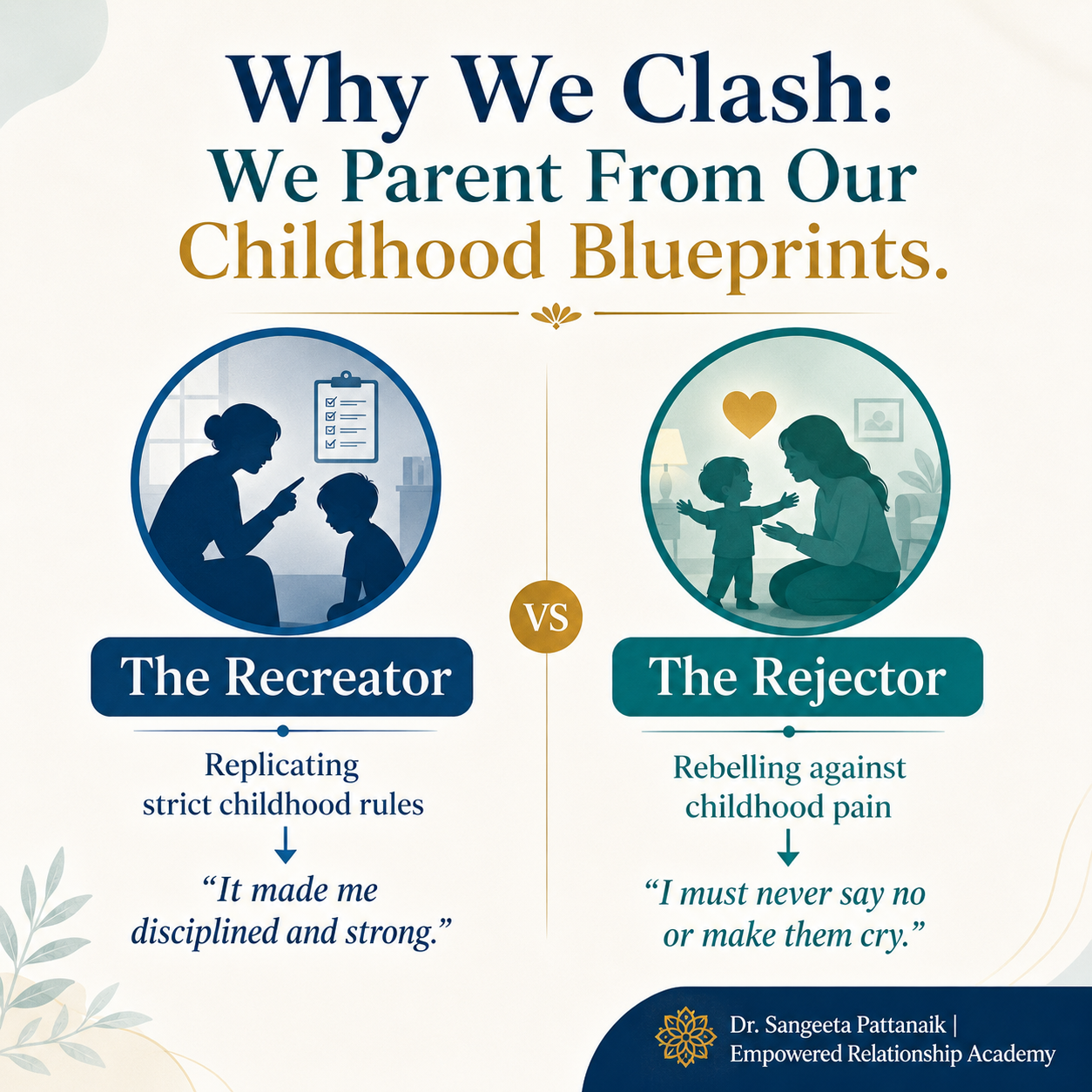
When couples face a parenting decision, they usually fall into one of two psychological camps without realizing it:
The Recreator ("It Made Me Strong")
This partner subconsciously seeks to replicate their own childhood. If they grew up in a strict, traditional Indian home where unquestioned obedience was demanded, they believe strict discipline is the only way to build a resilient, successful child.
The Rejector ("I Will Never Do That")
This partner carries unhealed childhood wounds. If they felt ignored, overly criticized, or crushed by academic pressure, they vow to do the exact opposite—aiming to be overly gentle and permissive to protect their child from pain.
The Phenomenon of "Ghosts in the Nursery"
Renowned child psychoanalyst Dr. Selma Fraiberg coined the clinical term "Ghosts in the Nursery" to describe how our unresolved childhood traumas and unexpressed grief step into the room when we raise our children. When a parenting styles clash occurs between spouses, you are rarely arguing about the actual child in front of you. You are arguing between your two conflicting childhood blueprints. You are watching your partner's parenting approach trigger your own childhood wounds, causing your nervous system to fight back in defense of how you believe a child should be loved.
2. Baumrind’s Four Parenting Styles: Where Do You Fall?
In developmental psychology, the gold standard for classifying how parents interact with children is Baumrind’s Parenting Typology, developed by researcher Dr. Diana Baumrind. She identified that all parenting behaviors fall onto two axes: Parental Responsiveness (warmth, empathy, and emotional validation) and Parental Demandingness (boundaries, rules, and behavioral expectations).
Before having children, both partners must assess where their instinctive reactions fall among these four psychological archetypes:
1. The Authoritarian Style
High Demand, Low Warmth | "Do as I say because I am the parent."
The Behavior: Strict rules, unquestioned obedience, academic perfection, and punishment above emotional expression.
Child's Outcome: Compliant and high-achieving, but prone to low self-esteem, severe anxiety, and fear of failure.
2. The Permissive Style
Low Demand, High Warmth | "I want to be my child's best friend."
The Behavior: Intensely loving and nurturing, but fails to set boundaries, rarely says "no," and rescues from consequences.
Child's Outcome: Feels loved, but struggles with poor impulse control, low frustration tolerance, and entitlement.
3. The Authoritative Style ⭐
High Demand, High Warmth | The Clinical Gold Standard
The Behavior: Enforces clear, consistent boundaries and high ethical standards while validating emotions and offering deep affection.
Child's Outcome: Develops high emotional intelligence, academic success, self-reliance, mental resilience, and secure attachment.
4. The Uninvolved Style
Low Demand, Low Warmth | "Raising themselves is their job."
The Behavior: Emotionally detached and physically absent due to burnout, depression, or severe workaholism.
Child's Outcome: Develops attachment traumas, behavioral issues, and profound emotional neglect.
The Danger of the "Good Cop vs. Bad Cop" Polar Trap
A severe parenting styles clash occurs most frequently when an Authoritarian marries a Permissive partner. When the strict parent sets a harsh rule, the permissive parent secretly overrides it to "comfort" the child. Seeing the rules undermined, the strict parent becomes even harsher to compensate for the partner's leniency. Seeing the harshness increase, the permissive parent becomes even softer and more rescuing to protect the child. This dynamic polarizes the marriage, destroys spousal intimacy, and teaches the child how to manipulate both parents by playing them against each other (a clinical pattern known as Triangulation).
3. Navigating the Indian Ecosystem: Modern vs. Traditional Values
In the Indian cultural landscape, couples do not parent in an isolated silo. Raising a child is a communal affair that intensely involves grandparents, extended family, and societal expectations. One of the greatest benefits of early alignment is preparing a strategic defense against external friction.
The Conflict Between Traditional Obedience and Modern Bodily Autonomy
Many modern Indian couples find themselves trapped between two contrasting cultural ideologies: traditional Indian expectations (emphasizing hierarchical respect for elders, academic competition, unquestioned obedience, and family reputation) versus modern child psychology (emphasizing emotional validation, bodily autonomy, open communication, and creative independence).
If you and your spouse have not aligned on where you stand on this spectrum before childbirth, the first time a grandparent demands that your toddler force-feed a meal or stay silent during an adult gathering, your marriage will erupt into conflict.
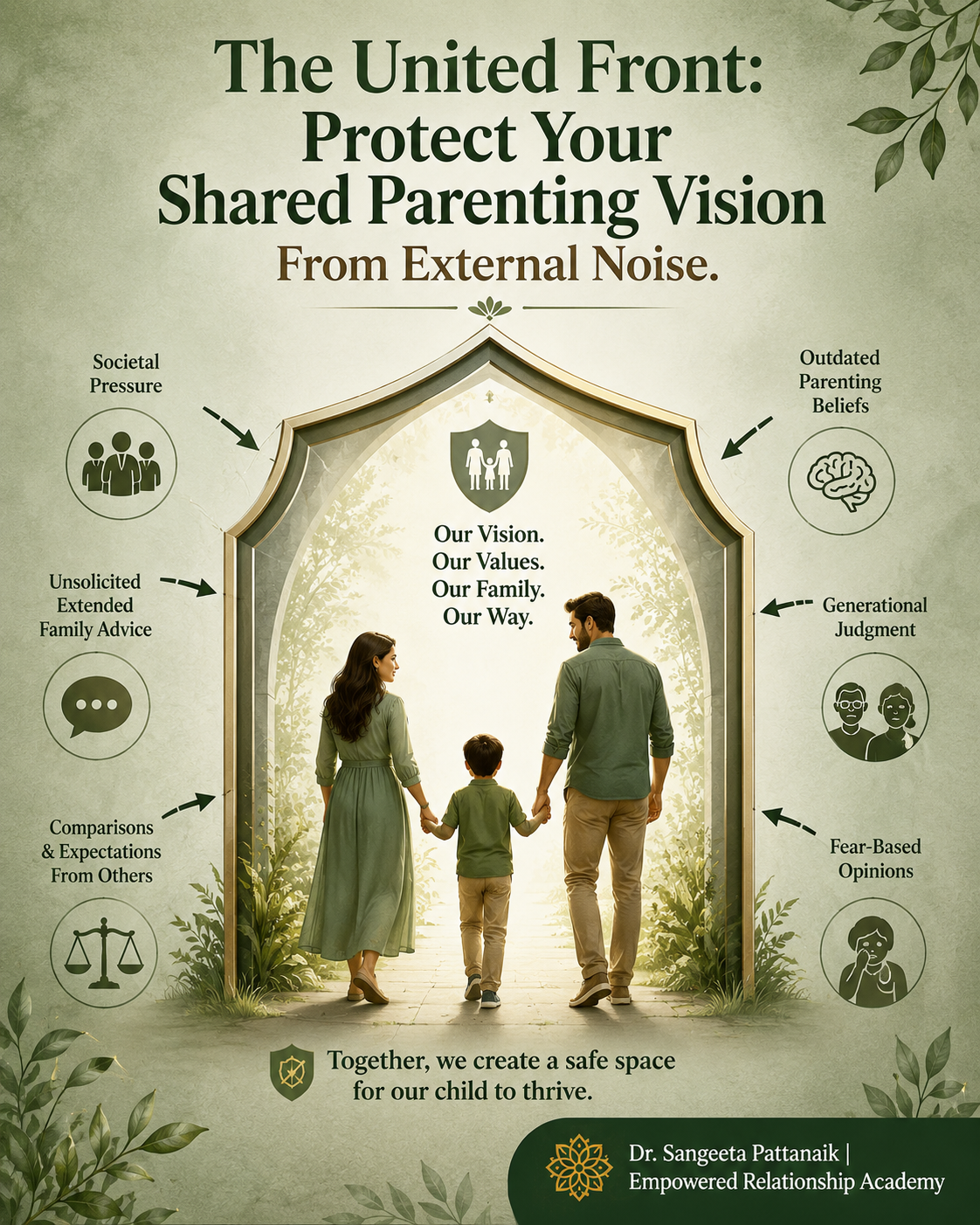
Building a Marital "United Front"
In relationship therapy, we teach couples that their marriage must act as an unbreakable United Front. When extended family members attempt to override your parenting boundaries—such as feeding sweets to an infant against medical advice, using shame to discipline, or criticizing your modern childcare methods—you and your spouse must operate as a single, impenetrable shield.
The Absolute Rule: You never publicly contradict or undermine your partner's parenting decision in front of extended family or in front of the child. If you disagree with your spouse's decision, you support them in the moment to maintain parental authority, and you discuss your disagreement privately behind closed doors later.
4. The 4 Core Conversations You Must Have Right Now
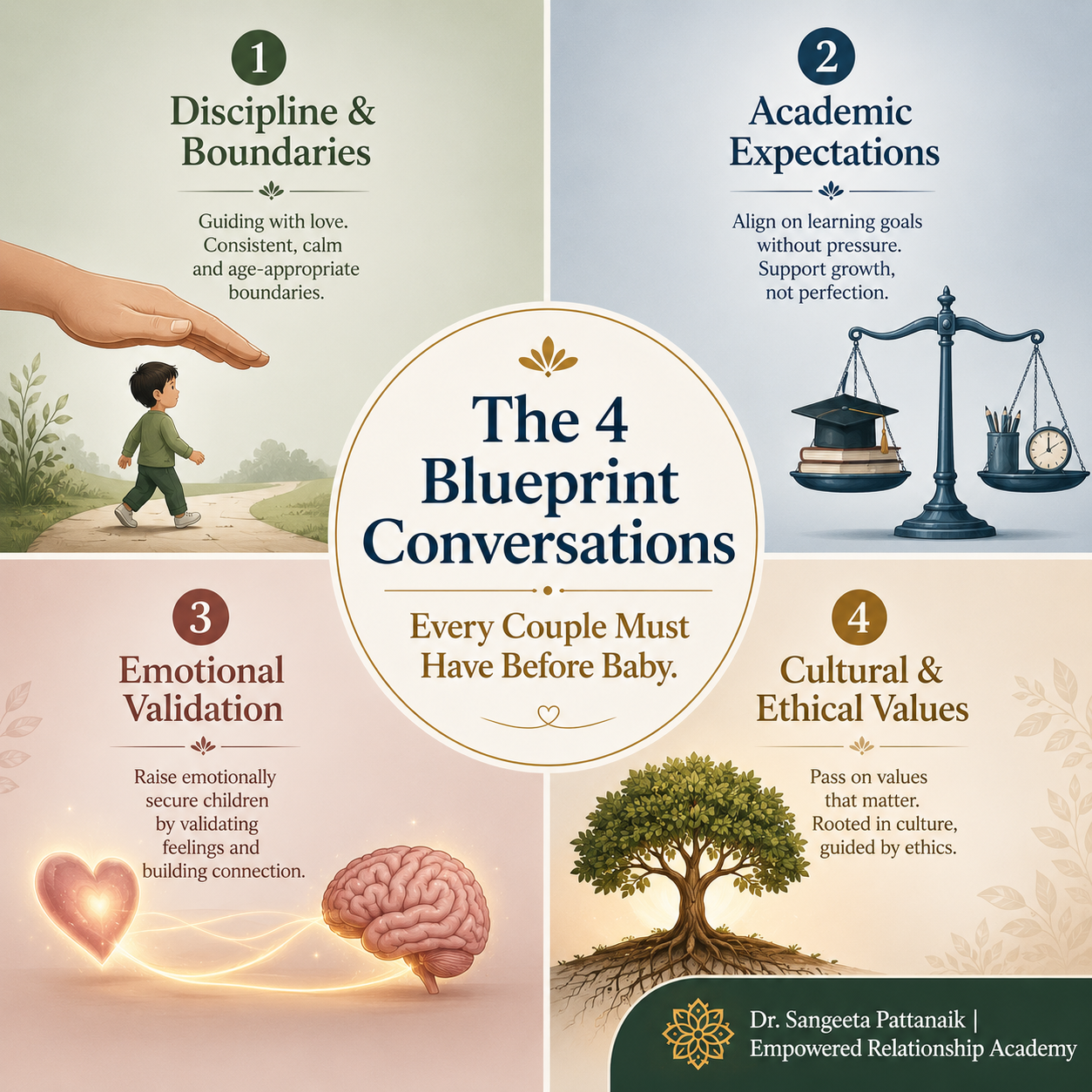
To prevent an agonizing parenting styles clash years down the road, you must conduct a deep, structured inventory of your parenting values while you are still expecting or planning your family. Schedule four dedicated, device-free date nights—one for each of these core psychological scripts—and discuss these questions with absolute vulnerability and zero judgment:
Conversation 1: The Discipline and Boundary Script
- How will we correct negative behavior without inflicting psychological trauma or using shame?
- What specific disciplinary behaviors from our own childhoods are strictly banned in our home (e.g., physical slapping, screaming, silent treatments, comparing our child to Sharma ji’s son)?
- How do we define the difference between punishment (causing pain to teach a lesson) and discipline (guiding behavior through natural consequences)?
- When a toddler throws a public temper tantrum, how will we support each other instead of feeling embarrassed or turning on each other?
Conversation 2: The Academic and Achievement Script
- How will we balance excellence with mental health in a hyper-competitive Indian education system?
- Are we willing to prioritize our child's emotional well-being and natural talents over top-tier academic ranks or engineering/medical career expectations?
- How will we react if our child brings home a failing grade or exhibits learning difficulties? Will our default response be anger and pressure, or curiosity and academic support?
Conversation 3: The Emotional Co-Regulation Script
- How will we respond to our child's difficult emotions, tears, and fears?
- Do we believe that crying is a manipulative behavior that needs to be shut down immediately, or a normal biological release of stress that needs comfort?
- How will we teach our child Emotional Co-Regulation (helping them calm their nervous system through our physical presence) rather than isolating them alone in a room when they are overwhelmed?
Conversation 4: The Cultural and Value Script
- What fundamental ethical, religious, and social values are non-negotiable in our home?
- How will we navigate religious traditions, festivals, and spiritual education?
- How will we teach gender equality in our home regarding chores, career dreams, and emotional expression for both boys and girls?
- What are our specific boundaries regarding screen time, smartphones, and social media access during early childhood?
5. A Therapist’s Roadmap to Reaching Alignment
What happens if you complete these conversations and realize that your parenting styles are fundamentally different? What if one of you leans naturally toward strict authoritarianism and the other toward gentle permissiveness? Do not panic. Differences in parenting philosophy are entirely normal. The secret to a thriving marriage is not identical thinking; it is the mastery of collaborative compromise. Here is your clinical roadmap to harmonizing your differences:
Step 1: Identify "Amygdala Triggers"
Recognize that when your partner parents differently, it can trigger an Amygdala Hijack in your brain. When panic or rage rises over a minor disagreement (like a skipped vegetable), take a 20-minute physiological timeout. Remind yourself: "My partner is not my enemy; they are simply parenting from their own unique blueprint."
Step 2: "Two-Yes, One-No" Rule
To prevent one parent from dominating, implement this rule for all major developmental, educational, and medical decisions. If both say Yes, it moves forward. If even one says No, the action is paused immediately, forcing both of you to sit down, explore underlying fears, and negotiate a collaborative middle ground.
Step 3: Practice the "24-Hour Rule" for Disagreements
If your spouse handles a disciplinary situation with your child in a way that you strongly disagree with, you are strictly forbidden from correcting, criticizing, or overriding them in front of the child. Wait until the child is asleep or out of earshot. Then, use Dr. Gottman’s Soft Start-Up to address the issue within 24 hours:
By leading with vulnerability rather than accusation, you invite your partner into a collaborative conversation rather than a defensive argument.
The Greatest Legacy You Will Ever Leave
Let us conclude with a foundational clinical truth: The greatest predictor of a child's lifelong emotional security, self-esteem, and mental health is not the brand of strollers you buy, the elite schools they attend, or the organic food they eat. It is the observation of a loving, respectful, and united marriage between their parents.
When you and your spouse invest the time to align your parenting philosophies before having children, you are actively breaking generational cycles of trauma. You are ensuring that your home is not a battlefield of egos, but an unshakable sanctuary of consistency, warmth, and structured guidance.
Do not wait for the sleep-deprived chaos of the postpartum period to discover who you are as parents. Step into this sacred journey with your eyes wide open, your childhood ghosts acknowledged, and your hands held tightly together as an unbreakable team.
Take the First Step Before Your Session
Emotional Invisibility Score™
Discover How Seen, Valued & Emotionally Connected You Feel In Your Relationship.
Aligning your parenting visions requires a deep, honest understanding of how you and your partner currently communicate under stress. Before you can successfully blueprint your future family, you must clearly understand the present emotional foundation of your marriage. Before making assumptions about your relational readiness for parenthood, I invite both of you to take this quick, scientifically structured self-assessment. It will immediately map your communication patterns and reveal exactly where your connection needs the most support before your baby arrives.
Discover Your Score NowTakes 2 Minutes • 100% Confidential • Instant Results
Frequently Asked Questions About Aligning Parenting Styles
Why do couples argue so much about parenting after having a baby?
Couples often clash because of "intergenerational transmission of parenting"—our subconscious tendency to either replicate our strict childhoods (The Recreator) or rebel against childhood wounds by being overly permissive (The Rejector). Without pre-planning, these differing internal blueprints collide under the stress of sleep deprivation and infant care.
What is the most effective parenting style according to psychologists?
The clinical gold standard is the "Authoritative Style" from Baumrind’s Typology. It combines high demandingness (clear boundaries, structured rules, and high ethical standards) with high responsiveness (unconditional love, empathy, and emotional validation). Studies prove this style builds resilience, emotional intelligence, and secure attachment in children.
What is the "Good Cop vs. Bad Cop" parenting trap?
This occurs when one parent is strict (Authoritarian) and the other is lenient (Permissive). The permissive parent undermines rules to comfort the child, making the strict parent even harsher to compensate. This dynamic polarizes the marriage and teaches the child how to manipulate both parents through a behavior called "triangulation."
How can couples compromise if they have completely different parenting styles?
Couples can harmonize differences by implementing three rules: taking a 20-minute timeout when triggered, using the "Two-Yes, One-No" rule for all major decisions (if one says no, the action pauses for discussion), and practicing the "24-Hour Rule"—never contradicting a spouse in front of the child and discussing disagreements privately later.
I had a great realisation on how parenting should be. It hit straight into my head how am i reacting and why am i reacting whenever i came cross the tantrum thrown by my little daughter. Everything comes from my generational parenting method which i have being carrying along these many years. This blog really helping me to know how parenting should be and how me and my partner should behave to grow our child together with values.