
The Danger of the "Roommate Phase" in Long-Term Relationships: Rebuilding Intimacy in Your Marriage
Navigating the neurobiology of passion loss, Indian cultural duty traps, and how to transition from polite co-managers back to passionate lovers.
By Dr. Sangeeta Pattanaik | Read Time: 15 Minutes
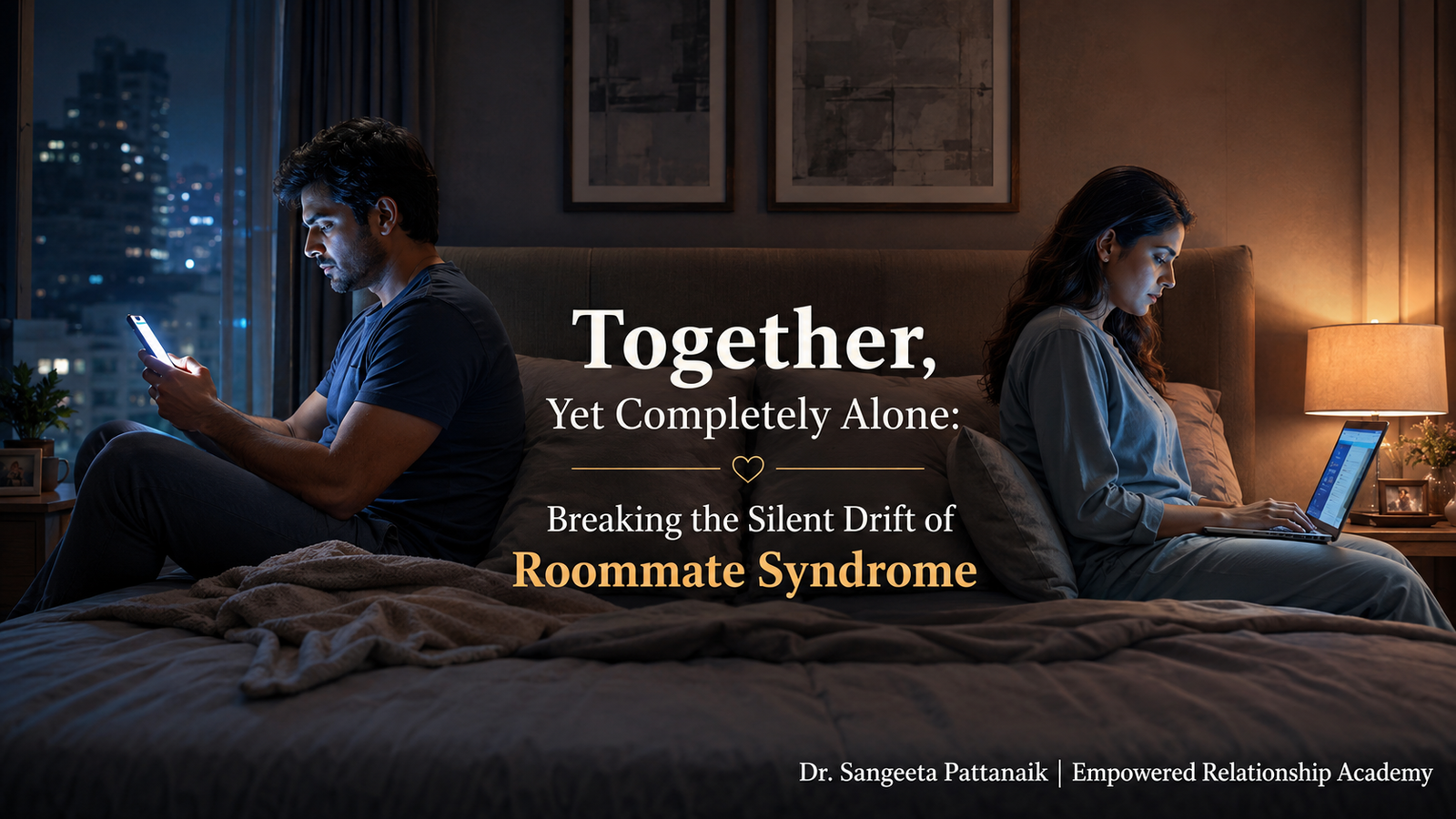
In my clinical practice as a relationship therapist, I often sit across from couples who look deeply bewildered by the state of their own marriage. Nobody is screaming, there has been no dramatic infidelity, and there are no shattered plates on the kitchen floor. On paper, their lives look like a resounding success: they share a beautiful home, raise well-mannered children, manage finances effectively, and operate like a well-oiled corporate machine.
Yet, when I ask them to describe their emotional bond, a profound sadness fills the room. One partner will look at me with tears welling up and say, "Dr. Sangeeta, we don't fight anymore, but we don't really love anymore either. We have turned into efficient co-managers of a household. I feel like I am living with a polite roommate, not a romantic partner."
The Silent Relationship Killer
Let me state a profound, clinical truth that often surprises couples: The silent, gradual drift into emotional apathy is far more dangerous to the survival of a marriage than explosive, passionate arguments. When two lovers devolve into mere logistical roommates, the emotional safety net of the marriage dissolves, leaving the relationship vulnerable to chronic depression, profound loneliness, and eventual infidelity or divorce.
When couples enter the roommate phase in marriage, they often rationalize it as a normal consequence of aging, busy corporate careers, or parenthood. We tell ourselves, "We are mature adults now; we don't need that youthful romance anymore." But in relationship psychology, we know that this slow emotional starvation is a silent killer.
Let us take a deep clinical dive into the psychology of the roommate phase, understand the neurobiology behind why passion fades, examine how Indian cultural dynamics accelerate this drift, and build a concrete roadmap to reignite emotional and physical intimacy before the gap becomes unbridgeable.
1. The Anatomy of the Roommate Phase: How We Drift Apart
To heal a relationship, we must first accurately diagnose the dynamic. The roommate phase in marriage does not happen overnight. It is a creeping, insidiously slow process of emotional detachment that psychologists call Relational Habituation.
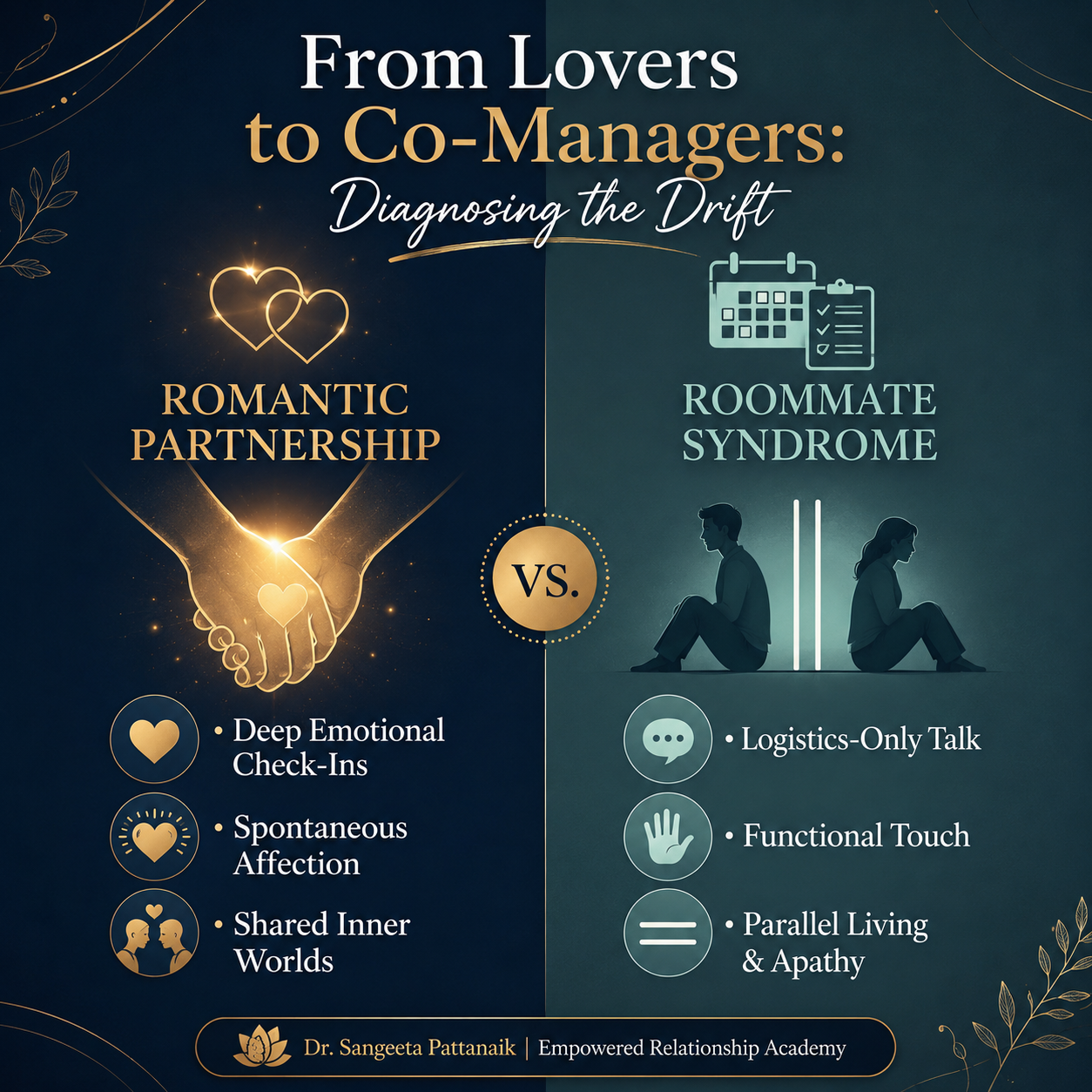
In the early years of marriage, your relationship is built on intentional discovery, shared dreams, and physical responsiveness. However, as the demands of daily life—mortgages, career climbs, parenting schedules, and household maintenance—pile up, couples subtly change the contract of their relationship. Without realizing it, you transition from Romantic Partners to Logistical Co-Managers.
The Three Clinical Stages of the Roommate Drift
Stage 1: The Logistical Takeover
Your daily communication slowly narrows until it consists entirely of administrative updates. You stop asking, "How are you feeling inside today?" and replace it with, "Did you pay the electricity bill? Who is picking up the kids from school?" Your spouse transforms from an emotional safe harbor into a business associate helping you run the household corporation.
Stage 2: Parallel Living
You still share a home, a dinner table, and a bed, but your internal worlds no longer intersect. You engage in what child psychologists call Parallel Play—sitting on the same couch for three hours every evening, but entirely absorbed in separate smartphones, separate laptops, or separate television shows. You share physical space, but zero emotional oxygen.
Stage 3: Erotic & Emotional Apathy
Because physical desire relies on emotional closeness and novelty, touch evaporates. Kissing becomes a functional peck on the cheek; hugs disappear. Sexual intimacy either becomes a scheduled, mechanical chore or vanishes for months. The worst symptom is the Death of Conflict—you stop arguing because you have stopped caring enough to invest emotional energy.
2. The Neurobiology of Detachment: Why Passion Fades
Why does the intense, effortless connection of early romance evaporate so easily in long-term domestic partnerships? The answer lies inside your autonomic nervous system and brain chemistry.
The Dopamine Crash and Hedonic Adaptation
During courtship and early marriage, your brain is flooded with Dopamine—the neurochemical responsible for excitement, anticipation, reward, and intense focus. Dopamine thrives on novelty, mystery, and unpredictability.
Human brains are biologically wired for Hedonic Adaptation—the psychological tendency to quickly adapt to new situations and return to a baseline emotional state. When you live with the exact same person for five, ten, or twenty years, sharing the exact same routine, eating the exact same meals, and following the exact same schedule, novelty disappears. Because the brain no longer perceives mystery or anticipation, dopamine production drops significantly. If couples do not consciously inject novelty into their routine, the relationship feels neurologically flat and boring.
Oxytocin Starvation and "Skin Hunger"
While dopamine drives excitement, Oxytocin is the "bonding hormone" that drives deep, enduring trust, physical warmth, and psychological safety. Oxytocin is released primarily through prolonged, non-demanding physical touch, eye contact, and emotional vulnerability.
When couples enter the roommate phase, they experience severe Oxytocin Starvation (clinically referred to as Skin Hunger). Because they stop touching, holding hands, or cuddling without sexual expectations, their brains stop receiving the biological signal that they are bonded and safe. Over time, the nervous system begins to view the spouse not as an intimate lover, but as a neutral roommate—or worse, an irritating presence invading their personal space.
3. The Indian Cultural Catalyst: When Duties Eclipse Romance
While the roommate phase threatens couples globally, navigating long-term domestic life within our Indian cultural ecosystem introduces unique social pressures that dramatically accelerate marital detachment.
The "We Are Parents Now" Myth
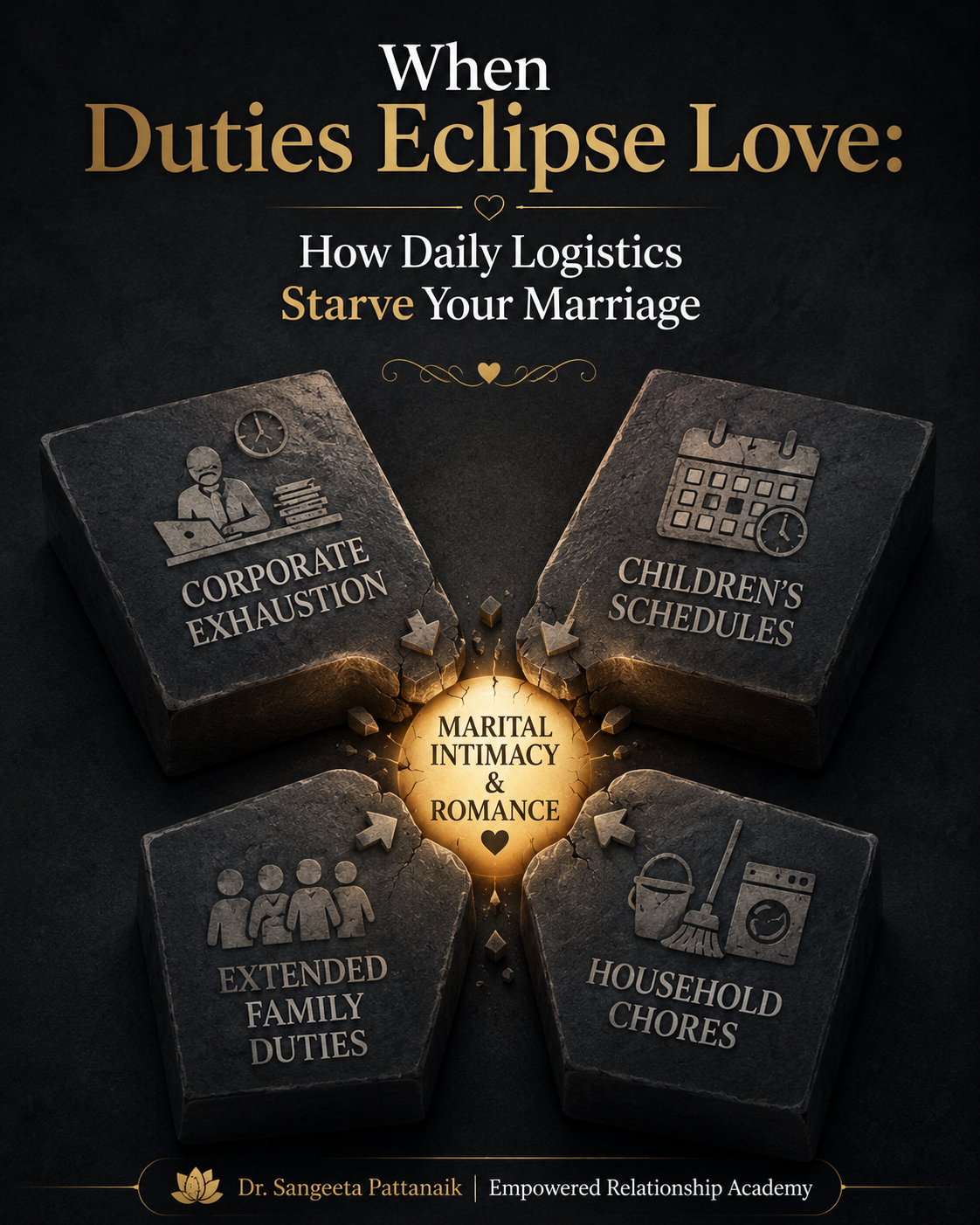
In many traditional and semi-modern Indian households, there is a pervasive cultural script that romantic love and physical affection are reserved exclusively for newlyweds. The moment a couple becomes parents—or reaches their late thirties—society implicitly demands that they shed their identity as "lovers" and transition 100% into "responsible parents and dutiful children." Viewing emotional intimacy as a frivolous luxury rather than the structural bedrock of the family accelerates emotional drift.
Eclipsing the Core with Extended Family
Couples frequently find themselves sandwiched between raising competitive children and caring for aging parents or in-laws.
The Displacement: Rather than turning to each other for emotional intimacy, wives often displace their emotional needs onto their children (becoming hyper-involved mothers), while husbands displace their energy into corporate workaholism or extended family logistics. The marriage is completely eclipsed by family duties.
4. The 4 Red Flags Your Marriage Has Crossed into Roommate Territory
How can you objectively evaluate whether your relationship is simply going through a busy season or if you are trapped in a dangerous roommate phase marriage? In my clinical assessments, I look for four unmistakable diagnostic red flags:
1. Conversations Are 100% Transactional
If you record your conversations over a typical seven-day week and discover you have not discussed a single personal feeling, fear, dream, or emotional observation, you are operating as roommates. Talk sounds like: "We need groceries," "Your mother called," and "What should the cook make for dinner?"
2. Touch is Functional or Nonexistent
In a romantic partnership, touch expresses desire and connection. In roommate syndrome, touch is either completely absent or reduced to functional greetings—a mechanical peck on the cheek while rushing out the door, or brushing past each other in the hallway without eye contact.
3. Separate Schedules to Avoid Intimacy
Roommates often develop an unconscious avoidance choreography. You might suddenly find yourself staying up until 1:00 AM scrolling your phone just so you can go to bed after your spouse is asleep, or waking up at 5:00 AM to leave for work before they wake up to minimize unprotected alone time.
4. Complete Emotional Apathy
When a couple stops arguing because they have reached profound empathy, the atmosphere feels warm and loving. However, when a couple stops arguing because they have surrendered to emotional apathy, the atmosphere feels icy and hollow. You no longer care enough to fight for connection; you simply shrug and retreat.
5. A Therapist’s Roadmap to Break Out of Roommate Syndrome
If you recognize that your marriage has drifted into the roommate phase, do not despair. Relational habituation is completely reversible. You do not need an expensive two-week European vacation or a massive lifestyle overhaul to rebuild your romantic bond. You simply need to reintroduce intentionality, emotional safety, and physical co-regulation into your daily domestic routine.
Here is your clinical roadmap to transition from roommates back to lovers:
Strategy 1: Master the Art of "Turning Toward" (Gottman’s Bids for Connection)
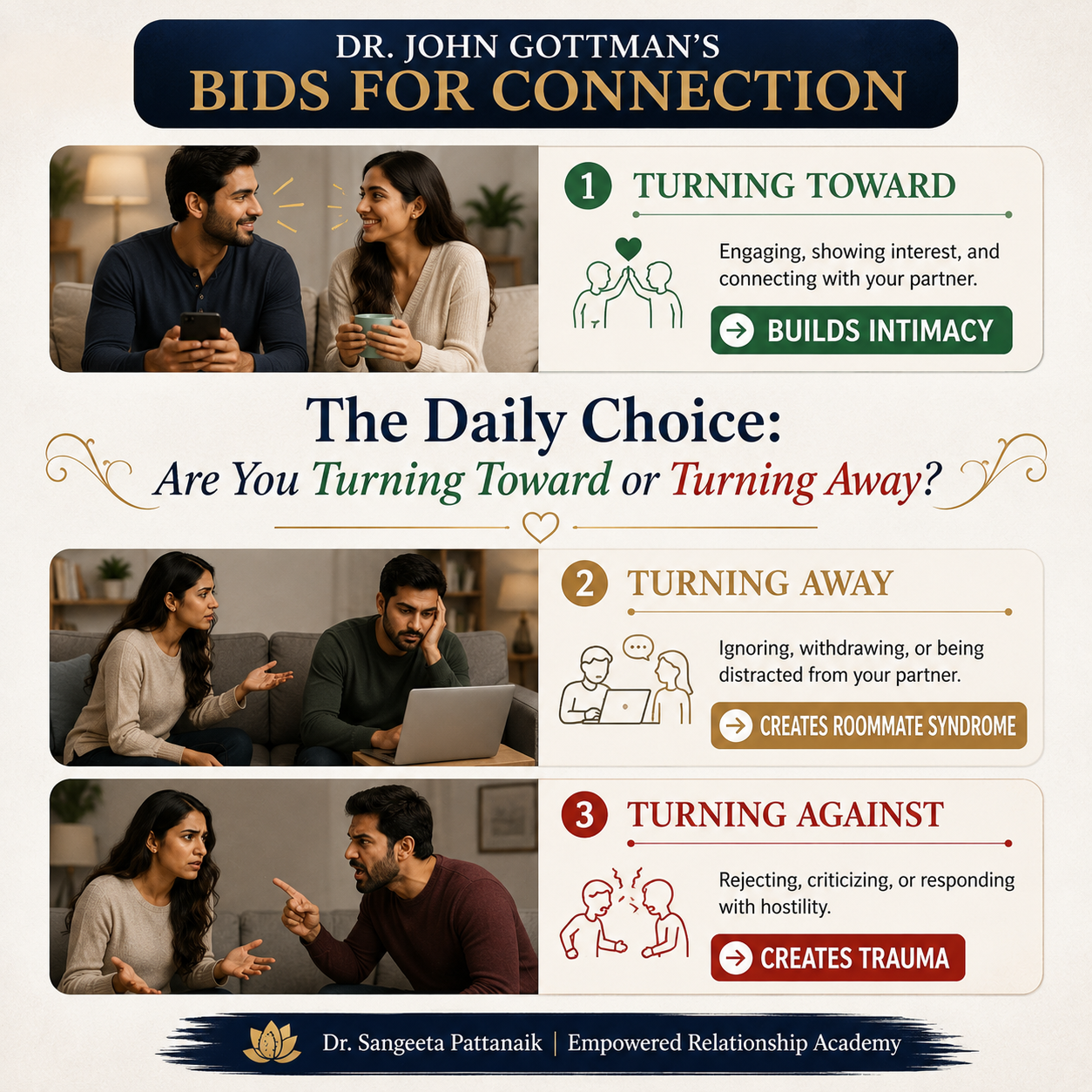
In his Love Lab research, Dr. John Gottman discovered that couples constantly make small attempts to connect, which he calls Bids for Connection (a sigh, a remark about the weather, or reaching out to touch an arm). Turning away means ignoring the bid or grunting while staring at a screen. Turning toward means putting down your phone, making eye contact, and engaging with curiosity.
The Clinical Fact: Studies show that couples who stay passionately married for decades "turn toward" each other's bids 86% of the time, while couples who divorce or drift into apathy turn toward each other only 33% of the time. Commit today to catching and answering your partner’s micro-bids.
Strategy 2: Implement "Non-Demand Touch" Daily
To cure oxytocin starvation without triggering performance anxiety around sex, you must decouple physical affection from sexual intercourse. When touch only happens as a prelude to sex, an exhausted partner will start rejecting hugs and kisses simply because they are too tired for intercourse.
- The 6-Second Kiss: Kissing your partner passionately for six continuous seconds shuts down the brain's survival alarm and stimulates dopamine.
- The 20-Second Hug: Hugging in silence for twenty seconds forces your breathing to synchronize, lowers cortisol, and floods your bloodstream with oxytocin. Rebuild physical friendship first; sexual vitality will naturally follow.
Strategy 3: Establish the 15-Minute "Logistics-Free" Check-In
You cannot rebuild emotional intimacy while discussing school fees, grocery lists, or household repairs. Carve out a protected emotional sanctuary every single evening.
The Iron-Clad Rule: Spend exactly 15 minutes every evening sitting together without devices or children where talking about household logistics, bills, or family drama is strictly forbidden. Ask open-ended vulnerability questions: "What was the most emotionally draining part of your day?" or "How can I make you feel more cherished this week?" Listen to understand and validate, never to problem-solve.
Strategy 4: Inject Novelty to Stimulate Dopamine
To overcome hedonic adaptation and break the monotonous loop of domestic life, you must consciously reintroduce mystery and novelty into your relationship. Engage in unfamiliar experiences together—try an unfamiliar cuisine, take a pottery or dance class, explore a new neighborhood, or read a challenging book together. When your brain experiences a novel stimulus in the physical presence of your spouse, it transfers that rush of dopamine directly onto your partner, reawakening romantic attraction.
Choosing Romance Over Routine
Let us conclude our exploration with a profound, foundational clinical truth: A thriving romantic marriage is not a self-sustaining organism; it is a fire that must be continuously fed.
The passionate, effortless attraction you experienced during your courtship was a gift of biology and novelty. But sustaining intimacy across decades of mortgages, children, aging parents, and corporate burnout is not an accident of fate—it is an intentional, courageous daily decision.
When you refuse to accept emotional apathy as normal, when you put down your smartphones to look into your partner's eyes, when you prioritize physical affection without demands, and when you consciously separate your romantic friendship from your household logistics, you break the destructive cycle of the roommate phase marriage. You transform your home from a cold administrative boardroom back into what it was always meant to be: a vibrant, deeply loving sanctuary of romantic warmth and unshakable partnership.
Take the First Step Before Your Session
The Emotional Invisibility Score™
Discover How Seen, Valued & Emotionally Connected You Feel In Your Relationship.
Rebuilding emotional and physical intimacy requires a clear, objective understanding of how far you and your partner have drifted in your daily communication. Before you can successfully implement new daily rituals of connection, you must understand the present emotional foundation of your marriage. Before making assumptions about your relational dynamics, I invite both of you to take this quick, scientifically structured self-assessment. It will immediately map your communication patterns and reveal exactly where your connection needs the most support as you work to break out of the roommate phase together.
Discover Your Score NowTakes 2 Minutes • 100% Confidential • Instant Results
Frequently Asked Questions About the Roommate Phase
What is the "roommate phase" in a marriage?
The roommate phase (clinically known as Relational Habituation) occurs when couples drift away from emotional and romantic intimacy and transform into polite, logistical co-managers of a household. While they share bills, children, and physical space, their personal communication becomes 100% transactional, physical touch evaporates, and passion fades into emotional apathy.
Why do couples stop feeling passionate after years of marriage?
Passion fades due to neurochemical shifts. Early romance is driven by Dopamine, which thrives on novelty and mystery. Over time, human brains undergo "Hedonic Adaptation"—getting used to daily predictable routines—which causes dopamine production to drop. Additionally, a lack of non-sexual physical touch leads to Oxytocin starvation (skin hunger), making partners feel emotionally detached.
How can we break out of the roommate phase and rebuild intimacy?
Couples can reverse emotional drift by practicing four daily rituals: answering each other's "bids for connection" (turning toward instead of staring at screens), practicing non-demand touch (a 6-second kiss and 20-second hug daily), holding a 15-minute logistics-free emotional check-in every evening, and engaging in novel, unfamiliar activities together to stimulate dopamine.
Is stopping fighting a sign of a healthy marriage or emotional apathy?
It depends on the underlying root. If a couple stops fighting because they have mastered empathy, active listening, and healthy repair protocols, the atmosphere feels warm and connected. However, if fighting stops due to the "Death of Conflict"—where couples surrender to emotional apathy and no longer care enough to invest energy into resolving differences—it is a dangerous red flag of roommate syndrome.