
How to Convince Your Partner to Go to Marriage Counseling (Without Starting a War)
Dismantling the psychology of refusal, avoiding toxic communication traps, and using clinical strategies to invite your spouse to therapy.
By Dr. Sangeeta Pattanaik | Read Time: 12 Minutes
In my clinical practice, one of the most heartbreaking scenarios I witness is not a couple screaming at each other in my office, but a single spouse sitting alone on my sofa, crying silently because their partner refused to walk through the door with them.
When your marriage is suffocating under the weight of chronic conflict, emotional distance, or shattered trust, recognizing that you need professional help is a profound act of courage. But what happens when you take that brave step, look at your spouse, and ask them to attend therapy—only to be met with a flat "No"?
When a partner refuses counseling, the initiating spouse often feels a devastating mix of panic, rejection, and hopelessness. You might think, "If they won't even try therapy, it means they don't love me enough to save our marriage."
The Hidden Meaning of "No"
Before you let this rejection convince you that your marriage is permanently doomed, we need to take a deep clinical look at the psychology of refusal. In Indian society, the resistance to therapy is rarely a declaration of a lack of love; it is almost always a profound biological and cultural defense mechanism rooted in fear.
Let us dismantle the psychological walls of resistance, understand exactly why your spouse is saying no, and learn the precise, clinical communication strategies to invite them into the therapy room without triggering a defensive war.
1. The Psychology of Refusal: Why Do They Say No?
To change your partner's mind, you must first understand the invisible fears driving their resistance. When you say, "We need marriage counseling," your brain thinks you are offering a life raft. But because of deep societal conditioning, your partner's brain often interprets those words as an emotional attack.
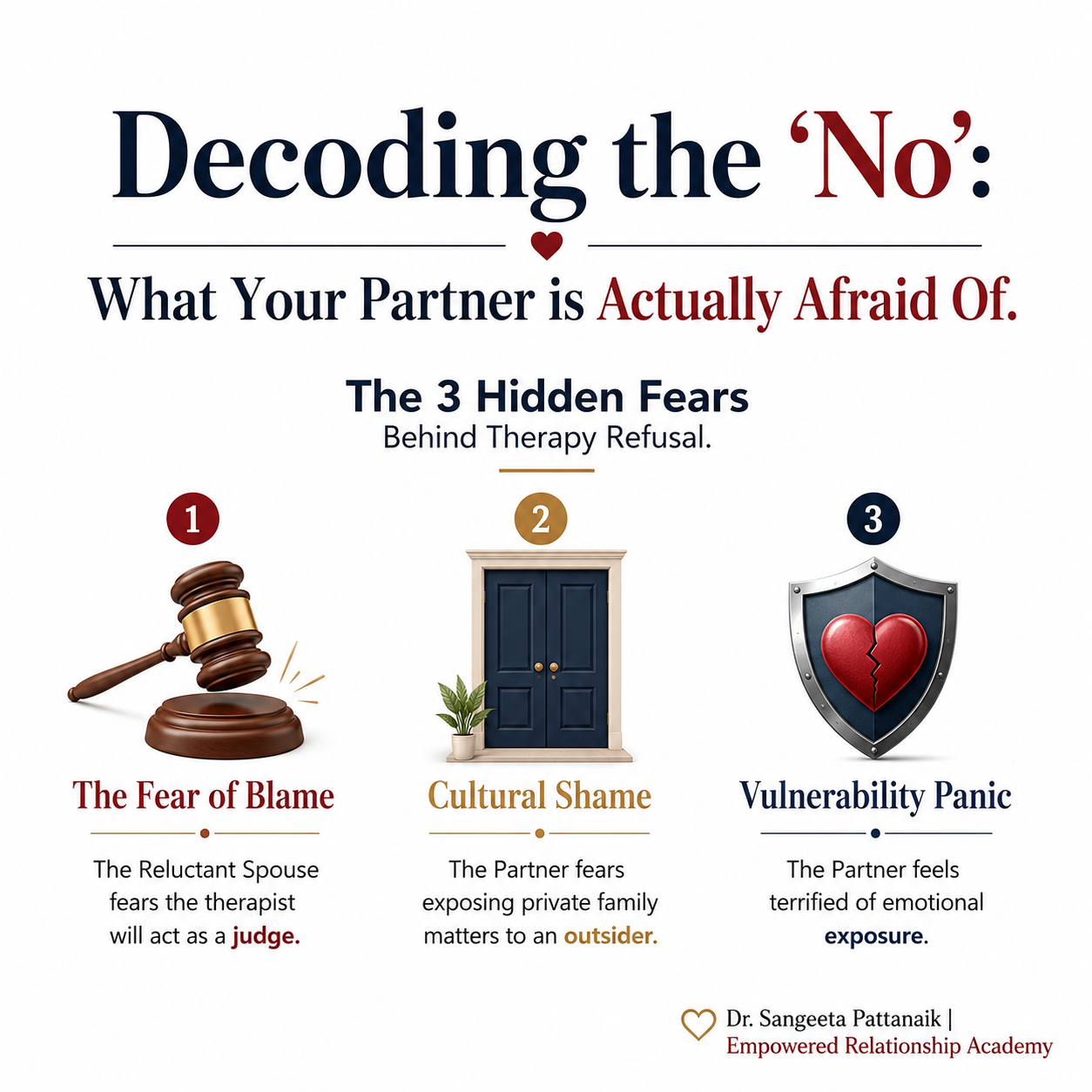
In our Indian cultural ecosystem, seeking psychological help is still heavily stigmatized. A reluctance to attend therapy is usually driven by one of these three subconscious fears:
1. The Fear of the "Courtroom"
The Blame Game
Many mistakenly believe a marriage counselor acts like a judge. The reluctant partner assumes they are being dragged into the clinic simply to have their flaws and failures listed in front of a professional. They fear being ambushed, ganged up on, and officially diagnosed as the "bad guy" in the marriage.
2. The Cultural Shame of "Failing"
Log Kya Kahenge
In traditional Indian households, domestic issues are fiercely guarded secrets. Exposing private struggles to a "stranger" brings deep shame. For many men conditioned to be self-reliant pillars, admitting the marriage needs outside help feels like a public declaration of personal failure.
3. The Terror of Vulnerability
Emotional Exposure
Therapy requires emotional transparency. If your partner grew up where expressing sadness, fear, or insecurity was mocked or punished, the mere thought of talking about their feelings triggers an acute survival panic. Their refusal is not arrogance; it's a desperate attempt to protect their nervous system.
2. The Threat Trap: What NOT to Do
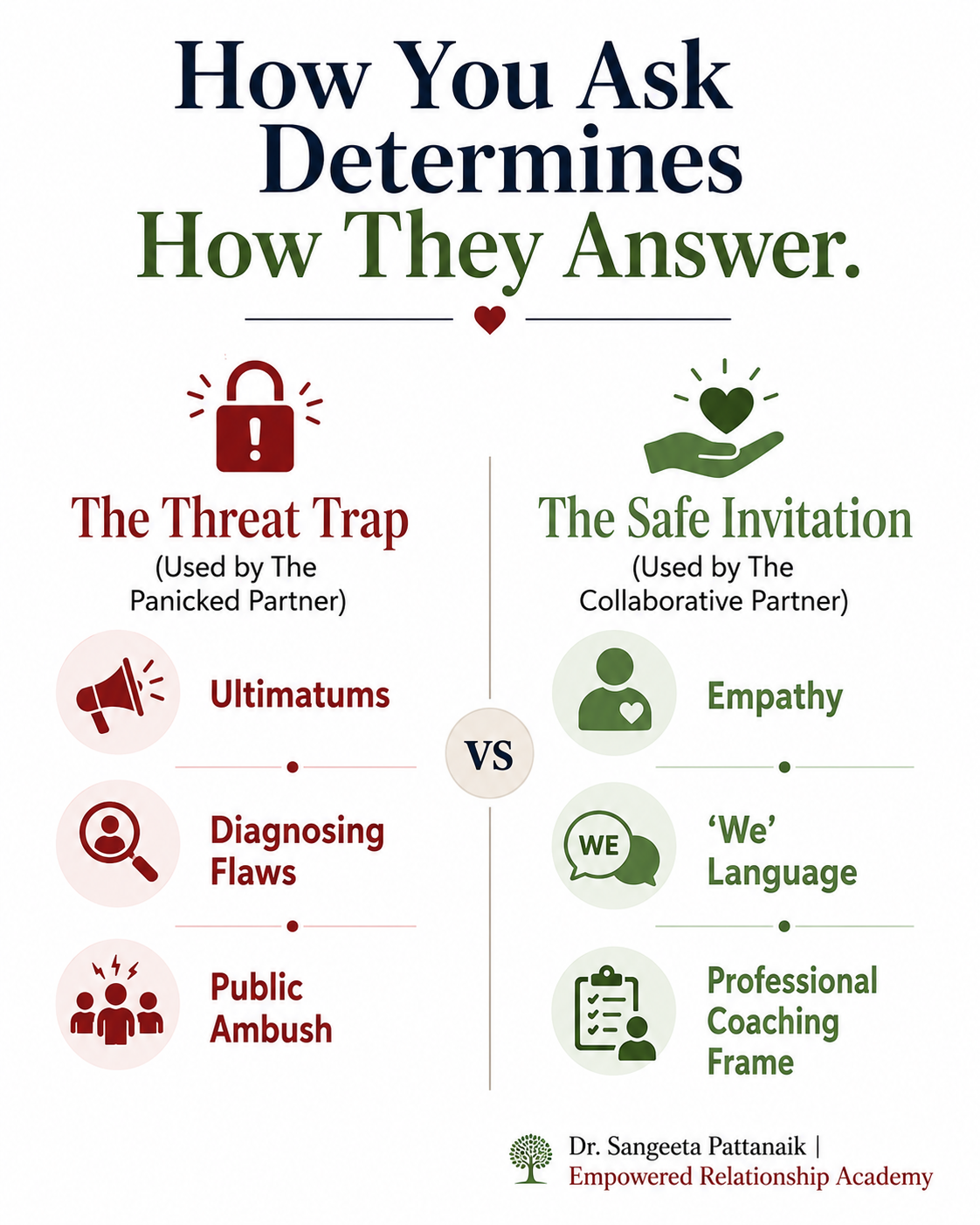
When your partner refuses counseling, your own anxiety will naturally spike. In a desperate attempt to force them to go, you might inadvertently use communication tactics that push them further away. If you want a successful outcome, you must absolutely avoid these three toxic approaches:
1. Avoid the "Ultimatum" Trap
The Mistake: "If you don't come to therapy with me this week, I am calling a divorce lawyer."
The Clinical Reality: Ultimatums trigger an immediate Amygdala Hijack (fight-or-flight response). Even if they agree out of sheer terror, they will sit in the office with arms crossed, completely closed off, and highly resentful. Forced therapy is clinically useless.
2. Avoid the "Diagnosis" Trap
The Mistake: "You have anger issues and you are a narcissist. You need professional help to fix your toxic behavior."
The Clinical Reality: Using therapy as a weapon guarantees a rejection. The reluctant partner will instantly stonewall to protect their ego. Therapy must be presented as a tool for the relationship, not a rehabilitation center for a defective spouse.
3. Avoid the "Ambush" Trap
The Mistake: Booking a session in secret, driving your spouse to the clinic under false pretenses, or inviting a therapist home without prior consent.
The Clinical Reality: This destroys foundational marital trust. Your partner will feel profoundly betrayed, and the therapeutic alliance with the counselor will be dead on arrival.
3. The "Soft Start-Up": How to Propose Therapy Successfully
To successfully guide your spouse into the therapy room, you must bypass their defensive alarm system. In clinical relationship therapy, we teach a communication technique called the Soft Start-Up. You must present counseling not as a desperate final measure, but as a proactive, collaborative project.
Here is your exact, step-by-step clinical script for proposing marriage counseling:
Step 1: Use "We" Framing, Never "You" Framing
Remove all blame from the invitation. Frame the marriage—not your partner—as the entity that needs support.
The Script: "I have been feeling really disconnected from us lately. I love our marriage, but I feel like we have gotten stuck in a negative communication loop that is draining both of us. I want us to consult a relationship expert together so we can both learn better tools to understand each other."
Step 2: Compare Therapy to Respected Professional Coaching
To dismantle the cultural stigma in India, reframe relationship therapy by comparing it to highly respected medical or professional fields.
The Script: "If we were running a business together and hit a financial roadblock, we would hire a consultant without hesitation. If I had a chronic knee injury, we would go to a physiotherapist. Our communication is hurting right now, and going to a counselor is simply bringing in a specialist to give us the right tools to heal."
Step 3: Offer Absolute Veto Power
Give the reluctant partner a sense of control over the process to drastically reduce their anxiety and fear of being trapped.
The Script: "I have found a therapist who focuses on practical communication tools, not just assigning blame. Let us just commit to one single introductory session. If we go, and you absolutely hate the therapist or feel disrespected, you have complete veto power and we do not have to go back. I just ask that we try one session together."
4. The Solo Pivot: What if They Still Say No?
What happens if you use the perfect clinical script, approach them with deep empathy, and your partner refuses counseling anyway?
Do not let their refusal paralyze your own growth. If they will not walk through the clinic door with you, you must walk through it alone.
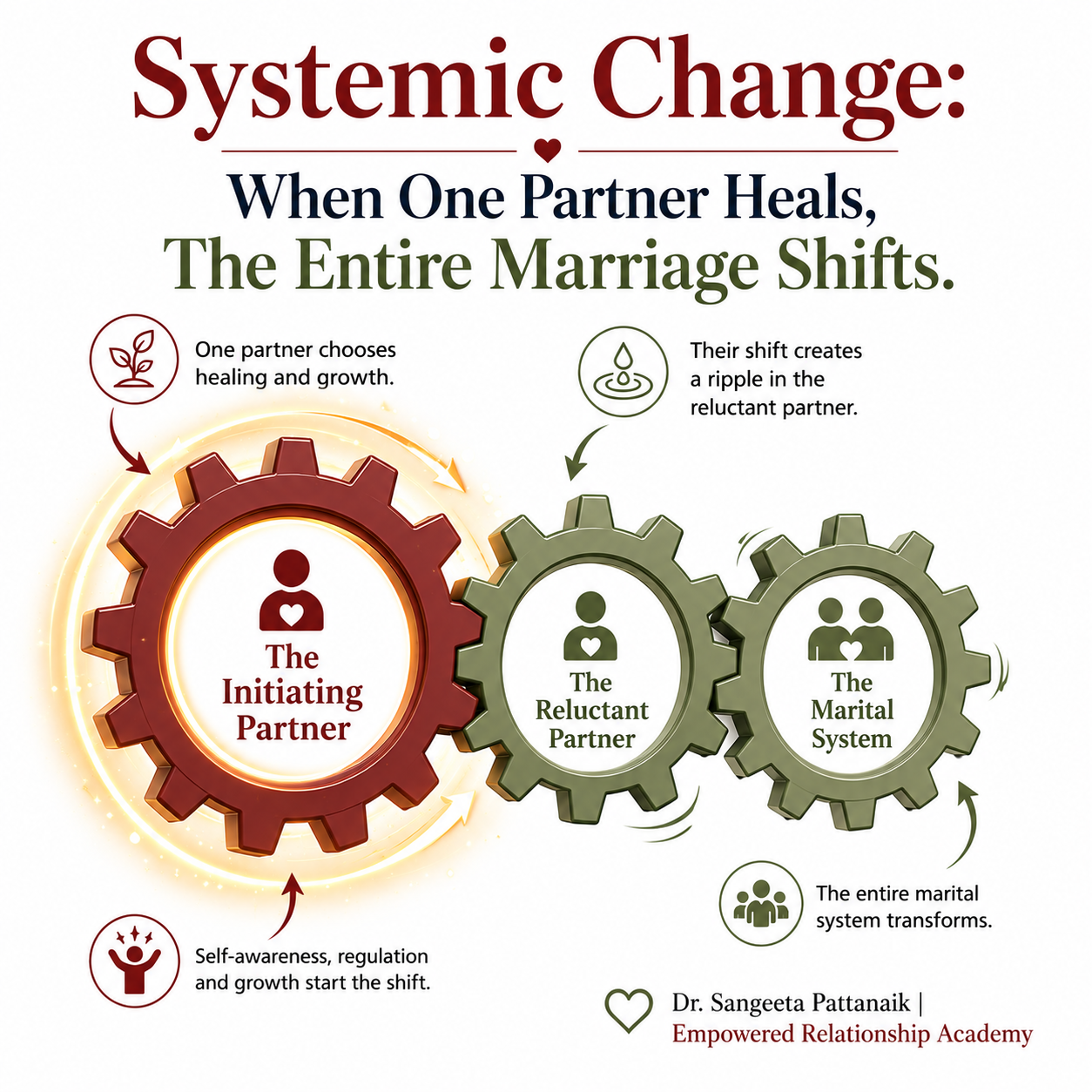
The Power of Systemic Family Theory
In clinical psychology, a marriage is viewed as an interconnected system—much like a hanging mobile over a crib. If you pull on one single piece of the mobile, the entire structure is forced to move, sway, and adjust to the new dynamic.
When you attend individual therapy for your marriage, you learn how to stop reacting to your partner's specific triggers. You learn how to set iron-clad emotional boundaries without screaming. You learn how to manually regulate your own nervous system so you do not absorb their anxiety. When you change your half of the marital dance, your spouse can no longer execute their old, toxic steps. The entire relationship dynamic is forced to change.
The Transformation of the Reluctant Spouse
Very often, the most powerful catalyst for a resistant partner is watching the profound transformation of the spouse who goes to therapy alone. When the reluctant partner sees the initiating partner becoming calmer, less reactive, and more emotionally grounded, their fear of therapy evaporates.
They realize the therapist is not a judge, but a genuine healer. In many cases, the spouse who adamantly refused counseling will voluntarily ask to join the sessions a few months later.
Taking the Lead in Your Relationship's Healing
Let us conclude with an empowering clinical truth: You cannot control your partner's readiness to heal, but you have absolute control over your own.
Waiting for a deeply resistant spouse to magically wake up and suggest therapy is a recipe for decades of silent resentment. True marital leadership sometimes means taking the first terrifying step entirely on your own.

By removing the threats, extending a collaborative and safe invitation, and being willing to undertake the journey of self-healing even if you have to start solo, you become the architect of your family's emotional rescue. You prove that your marriage is valuable enough to fight for, and that profound peace is always worth the effort.
Take the First Step Before Your Session
The Emotional Invisibility Score™
Discover How Seen, Valued & Emotionally Connected You Feel In Your Relationship.
Whether you are preparing to invite your spouse into counseling, or you are preparing to begin your own solo therapeutic journey, clarity is your most powerful tool. Before booking an appointment, I invite you to take this quick, scientifically structured self-assessment. It will immediately map your communication patterns and reveal exactly where your marital connection needs the most clinical support.
Discover Your Score NowTakes 2 Minutes • 100% Confidential • Instant Results
Frequently Asked Questions About Marriage Counseling
What should I do if my partner absolutely refuses to go to marriage counseling?
If your partner refuses, the most effective clinical step is to begin individual therapy for yourself (known as the "Solo Pivot"). According to systemic family theory, when you learn to regulate your own emotions, set boundaries, and stop engaging in toxic communication loops, the entire relationship dynamic is forced to shift. Often, your personal transformation inspires your partner to join you later.
Why are husbands in India often reluctant to attend marriage counseling?
Resistance is rarely a lack of love; it is rooted in fear and cultural conditioning. Many Indian men are conditioned to be self-reliant and view seeking outside help as a personal failure or a threat to family honor (log kya kahenge). Furthermore, they often fear the "Courtroom Trap"—worrying the therapist will act as a judge to list their flaws and assign blame.
How do I ask my spouse to go to therapy without starting a fight?
Use the "Soft Start-Up" technique. Avoid ultimatums and diagnostic labels (e.g., "You have anger issues"). Instead, use "We" framing: "I feel disconnected from us lately, and I want us to consult a relationship expert to learn better tools." Compare therapy to hiring a business consultant or a physiotherapist, and offer them absolute veto power after the first session to reduce anxiety.
Is forced marriage counseling effective?
No. Using threats, ambushes, or ultimatums (like threatening divorce) to force a partner into therapy triggers an immediate biological fight-or-flight response. A forced partner will sit in the therapy room highly defensive, resentful, and completely closed off to vulnerability, rendering the therapeutic process clinically useless.