
Setting Healthy Boundaries with In-Laws Before You Tie the Knot
Dismantling the psychology of enmeshment, mastering the United Front, and proactively scripting boundaries before the wedding day.
By Dr. Sangeeta Pattanaik | Read Time: 12 Minutes

In the Indian cultural landscape, there is a famous, universally accepted proverb: “In India, you do not just marry an individual; you marry their entire family.”
For generations, this philosophy has been celebrated as the beautiful, communal bedrock of Indian society. However, in my clinical practice as a relationship therapist, this exact philosophy is frequently the root cause of profound psychological distress, marital breakdown, and severe anxiety for young couples.
When The Bride and The Groom enter a marriage without explicitly defining the psychological and logistical perimeters of their new household, they unwittingly leave the door wide open for extreme emotional enmeshment. What begins as "loving advice" from The Mother-in-Law or "financial guidance" from The Father-in-Law quickly mutates into intrusive micromanagement. By the time the newlyweds realize their marital privacy has been completely breached, the resentment has already calcified, and attempting to establish boundaries with in-laws post-marriage often triggers catastrophic family warfare.
Protecting Your Marital Fortress
To protect your future marriage, you must lay the psychological bricks of your marital fortress before you take your wedding vows.
Let us explore the deep clinical difference between healthy family integration and toxic enmeshment, understand the non-negotiable rule of the "United Front," and build a step-by-step roadmap to establish boundaries with in-laws respectfully and firmly before you tie the knot.
1. The Psychology of Enmeshment vs. Healthy Integration
Before The Bride and The Groom can establish rules for their extended family, the couple must understand the clinical psychology of family systems. Why do boundaries feel so offensive to traditional Indian parents?
The answer lies in a concept called Enmeshment.
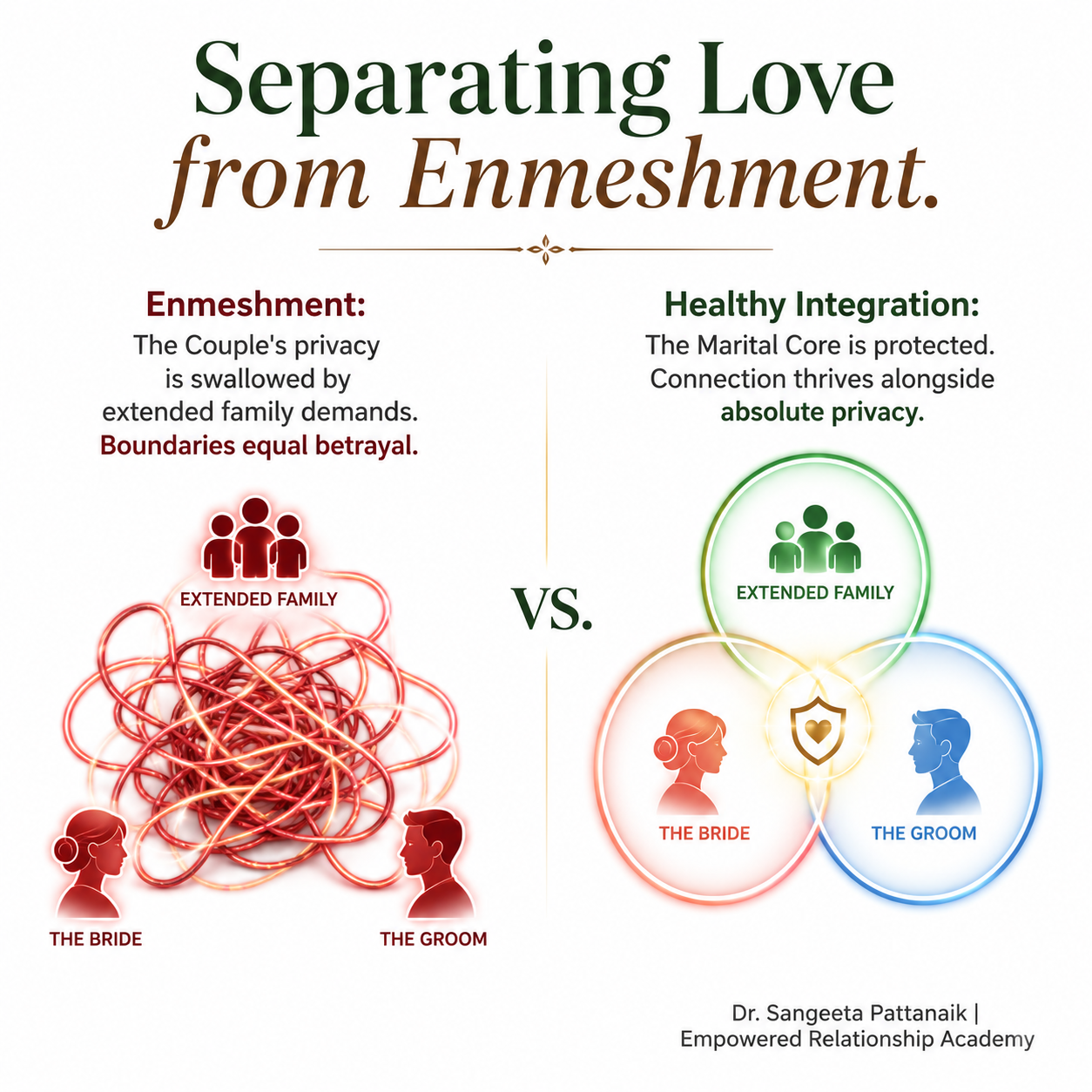
In an enmeshed family system, personal boundaries do not exist. The emotional states, financial decisions, and physical spaces of all family members are completely fused together. If The Mother-in-Law feels anxious, The Groom is expected to instantly absorb that anxiety and fix it, even at the expense of his own peace or his relationship with The Bride. In enmeshed Indian families, privacy is often viewed as a threat, and individual autonomy is actively punished and labeled as "selfishness."
The Marital Paradigm Shift: Leaving to Cleave
To build a psychologically sound marriage, The Bride and The Groom must execute a process that clinical psychologists call Differentiation of Self.
Differentiation means developing the emotional maturity to remain deeply connected to your parents while maintaining a separate, independent psychological identity. When you marry, your primary fiduciary duty—your absolute highest loyalty—must shift from your family of origin to your new spouse. You are moving from a state of enmeshment to a state of Healthy Integration.
Enmeshment (The Toxic State)
The Mother-in-Law demands a key to the couple's apartment and drops by unannounced daily because "we are one family." If The Bride requests privacy, The Groom accuses The Bride of disrespecting his mother.
Healthy Integration (The Secure State)
The Couple deeply loves and respects the extended family, but The Groom clearly communicates to The Mother-in-Law that visits must be scheduled in advance to respect the couple's privacy. The family remains close, but the marital boundary is impenetrable.
2. The Golden Clinical Rule: The Marital United Front
The single most destructive mistake a couple can make when navigating extended family dynamics is allowing a parent to triangulate their marriage.
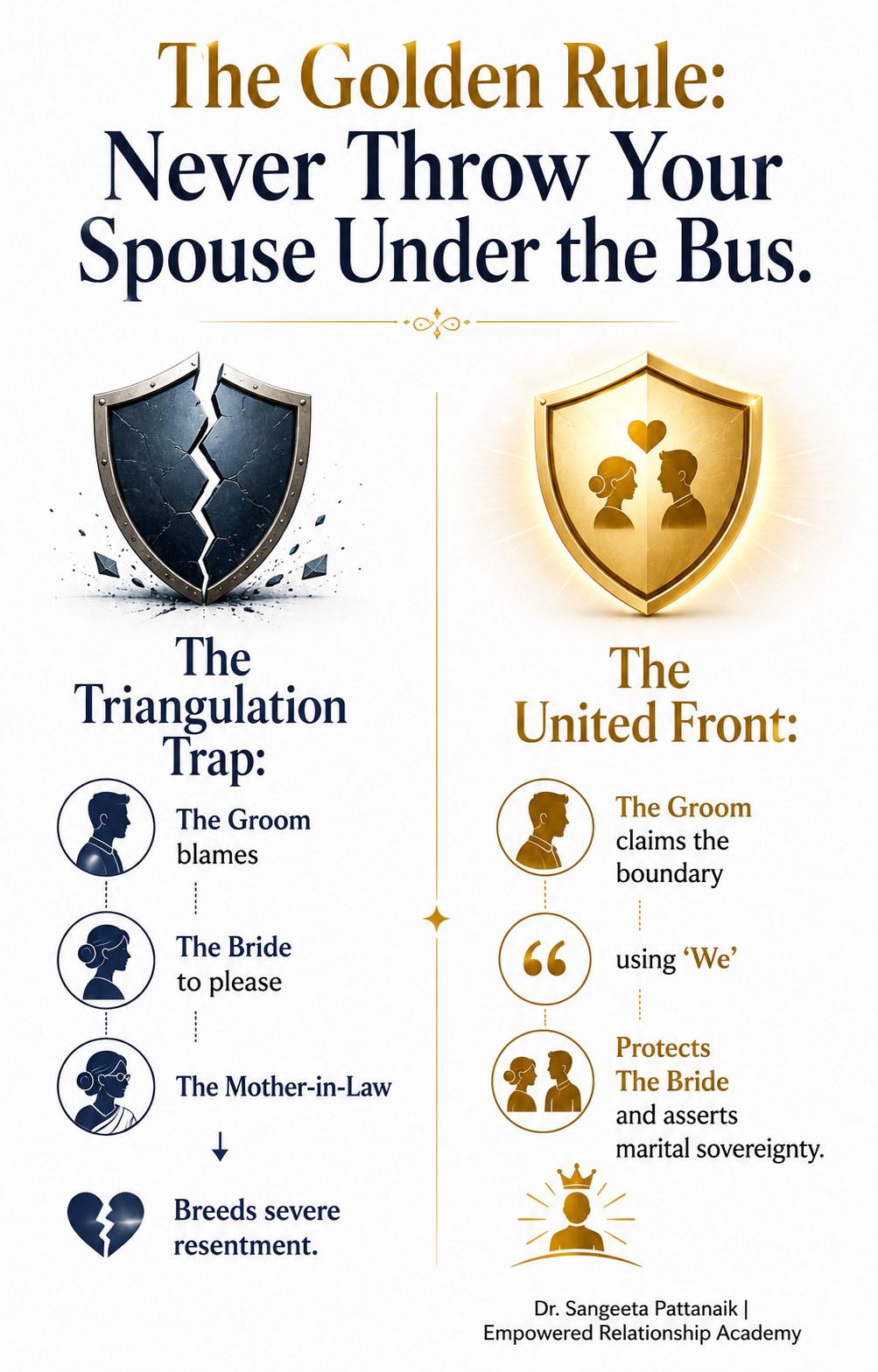
In clinical therapy, we teach couples the concept of the United Front. Before the wedding day, The Bride and The Groom must make an unbreakable pact: We face the world, and our extended families, as a single, unified entity. We will never throw each other under the bus.
How the United Front Operates in Reality
If The Father-in-Law suggests a financial investment that The Bride feels deeply uncomfortable with, The Groom must never say: "Dad, I want to do it, but my wife won't let me."
That statement instantly paints The Bride as the enemy, breeds deep resentment from the in-laws toward the new daughter-in-law, and makes The Groom look like a powerless victim.
Instead, The Groom must internalize the marital decision and present it as his own unified stance: "Dad, we discussed it, and we have decided that this investment does not align with our current financial goals. But thank you so much for looking out for us."
By using "We" and "Our," The Groom acts as a protective shield for The Bride. The clinical mandate is simple: The Husband is responsible for communicating boundaries to The Husband’s family. The Wife is responsible for communicating boundaries to The Wife’s family. You never force your spouse to fight your biological parents.
3. The Four Conversations The Bride and The Groom Must Have Now
To successfully establish boundaries with in-laws, you cannot wait for a crisis to happen. You must proactively script your responses before the wedding.
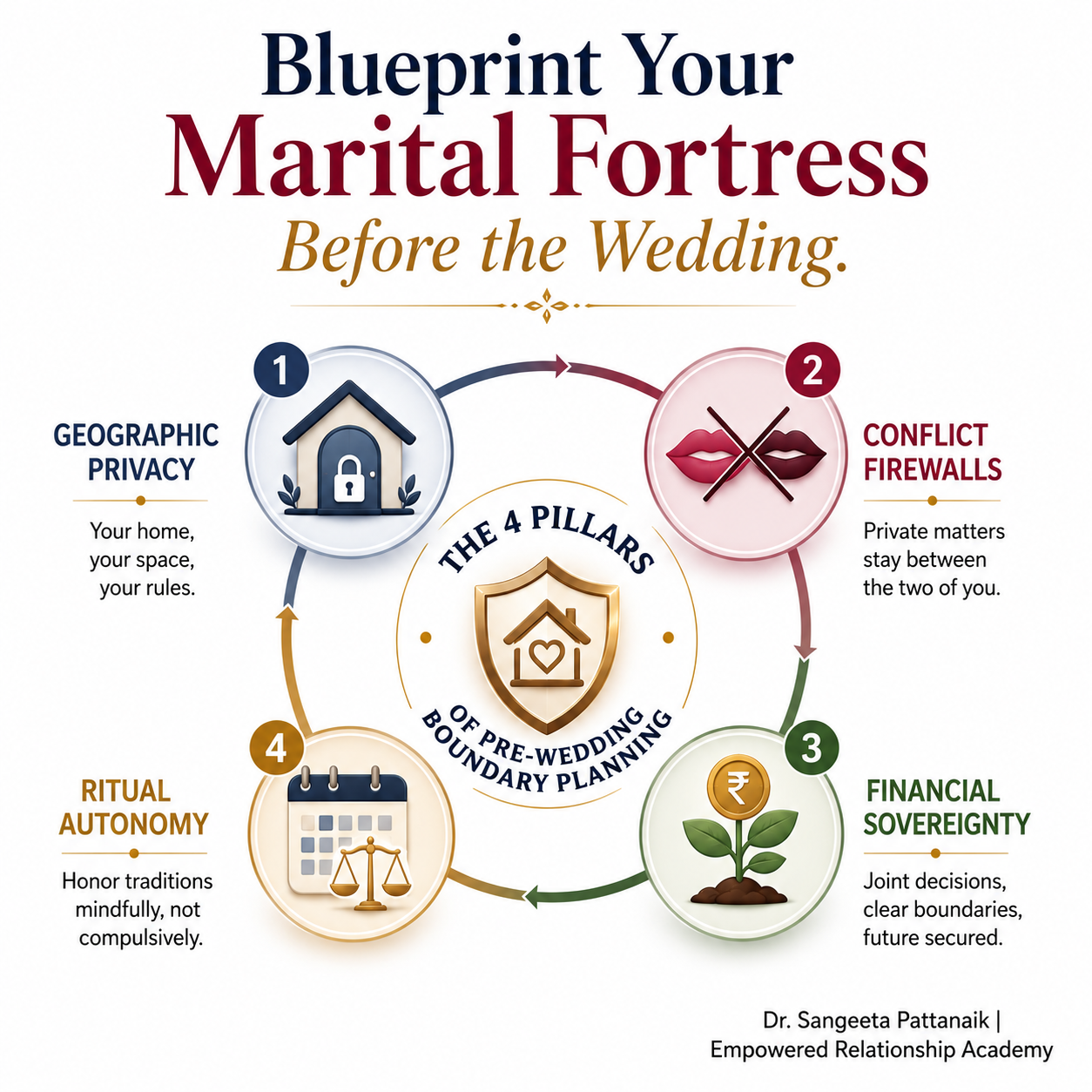
Schedule a quiet, focused date night with your fiancé(e), bring a notebook, and ensure both The Bride and The Groom are in absolute alignment on these four critical pillars:
Conversation 1: The Geography of Privacy (Living Arrangements)
Whether The Couple is living in a joint family setup or moving into an independent apartment, physical boundaries must be explicitly defined. Will extended family members have a spare key to our home? What is our policy on unannounced visits? If we live in a joint household, how do we designate our bedroom as an absolute sanctuary where extended family members are not allowed to enter without knocking and waiting for permission?
Conversation 2: The Firewall of Marital Conflict
In Indian culture, it is highly common for a newlywed to call their own parents the moment an argument erupts with their spouse. This is a catastrophic psychological error. The Bride and The Groom must promise that no matter how angry they become, they will never complain about their spouse to their parents. Marital conflicts stay exclusively between The Husband, The Wife, and a licensed clinical therapist.
Conversation 3: Financial Sovereignty
Money is the ultimate tool of control in enmeshed family systems. Will we accept large financial gifts from our parents if those gifts come with manipulative strings attached? How much financial support are we obligated to provide to our respective extended families, and how will we ensure this support is a joint marital decision rather than a unilateral secret?
Conversation 4: The Autonomy of Tradition and Rituals
The first year of an Indian marriage is flooded with festivals, Pujas, and family rituals. How will we split our time between both families during major holidays? When The Mother-in-Law insists on a specific traditional fasting ritual that The Bride feels uncomfortable with, how will The Groom step in to protect The Bride’s bodily autonomy without causing a war?
4. The Clinical Script: How to Communicate the Boundary
Having the boundary in your head is useless if you do not know how to communicate it out loud without triggering a physiological "fight or flight" response in your parents.
When establishing boundaries with in-laws, you must utilize Dr. John Gottman’s Soft Start-Up technique. You must lead with immense love and gratitude before laying down the firm psychological brick.
Example Scenario: Unannounced Visits
The Mother-in-Law has mentioned that she plans to drop by The Couple's new apartment every evening after work to bring dinner.
The Aggressive (Harmful) Response: "Mom, you cannot just show up at our house every day. We need our own space, and my wife feels suffocated when you do that." (This triggers severe defensiveness, attacks the mother, and throws The Wife under the bus).
The Soft Start-Up (Clinical Best Practice): "Mom, we are both so incredibly grateful for how much you care about us, and we love your cooking so much. Because we are adjusting to our new life and our exhausting work schedules, we really need our evenings to be quiet and private to decompress. Moving forward, we would love to schedule dinner with you every Sunday evening so we can give you our full, undivided attention. We won't be able to accommodate daily drop-ins, but we are so excited for our Sundays together."
In this script, The Groom validates the mother's love, uses "We" to show a United Front, clearly states the boundary (no daily drop-ins), and offers a loving alternative (Sunday dinners). If The Mother-in-Law throws a tantrum or attempts to guilt-trip The Groom ("You don't love your mother anymore"), The Groom must not engage in an argument. He must simply hold the boundary with calm, regulated silence.
Securing Your Marital Peace
Let us conclude with an undeniable clinical truth: Good fences make excellent neighbors, and firm boundaries make loving in-laws.
Setting boundaries is not an act of disrespect toward your parents; it is the ultimate act of respect toward your future spouse. You cannot build a thriving, secure, and passionate marriage if the walls of your home are made of glass, allowing extended family to dictate your internal emotional climate.
By defining your geographic privacy, establishing absolute financial sovereignty, and standing shoulder-to-shoulder as an impenetrable United Front, The Bride and The Groom protect the sacred core of their union. When you do the hard psychological work before you tie the knot, you ensure that your marriage begins not as an extension of your parents' household, but as a magnificent, sovereign sanctuary of your own.

Take the First Step Before Your Wedding Day
The Emotional Invisibility Score™
Discover How Seen, Valued & Emotionally Connected You Feel In Your Relationship.
Establishing boundaries with extended family requires a rock-solid foundation of emotional safety between you and your partner. Before you can successfully build a United Front against external pressure, you must clearly understand the present emotional foundation of your relationship. Before making assumptions about your relational dynamics, I invite both The Bride and The Groom to take this quick, scientifically structured self-assessment. It will immediately map your communication patterns and reveal exactly where your connection needs the most clinical support before you take your vows.
Discover Your Score NowTakes 2 Minutes • 100% Confidential • Instant Results
Frequently Asked Questions About In-Law Boundaries
What is the difference between family closeness and enmeshment?
Healthy family integration means deeply loving and respecting the extended family while maintaining independent marital boundaries and privacy. Enmeshment is a toxic psychological state where personal boundaries dissolve entirely, and individual autonomy or privacy is viewed as a threat or punished as "selfishness."
What is the "United Front" in a marriage?
The United Front is a clinical agreement where partners face the world and their extended families as a single, unified entity. If a partner disagrees with an in-law's suggestion, they use "We" statements (e.g., "We have decided...") rather than throwing their spouse under the bus by saying, "My wife won't let me."
Who should communicate boundaries to the in-laws?
The clinical mandate is clear: The Husband is responsible for communicating boundaries to The Husband’s family, and The Wife is responsible for communicating boundaries to The Wife’s family. You should never force your spouse to fight your biological parents.
How do I set boundaries with my parents without starting a fight?
Utilize the "Soft Start-Up" technique. Lead with immense love, gratitude, and validation for their intentions before clearly stating the firm boundary. Always offer a loving alternative, such as replacing unannounced daily visits with a scheduled, distraction-free Sunday dinner.