
Why Do I Feel Lonely in My Marriage? Understanding the Silent Drift
Discover the hidden psychological realities behind "Intimate Loneliness" and why relationships quietly fade when subtle, daily interactions are lost.
By Dr. Sangeeta Pattanaik | Read Time: 12 Minutes

It is one of the most confusing and painful paradoxes a person can experience: feeling completely alone while sleeping right next to someone.
Society often conditions us to believe that a failing marriage is loud. We are taught to expect melodramatic themes—explosive betrayals, constant screaming matches, or narratives where one partner feels they are sacrificing everything for the other. But as a psychological professional, I can tell you that this is an incredibly one-note perspective. In reality, marriages rarely collapse from a single explosive event. Far more often, the foundation erodes through a quiet, almost imperceptible drift.
The Psychological Reality: Intimate Loneliness
If you are asking yourself, "Why do I feel lonely in my marriage?" you are experiencing what psychologists call Intimate Loneliness. This is the profound sense of isolation that occurs not from a lack of physical presence, but from a lack of emotional resonance. You aren't necessarily fighting; you just aren't connecting. It is a quiet incompatibility built purely on the subtle, daily interactions that have slowly lost their warmth.
Let’s explore the deep psychological realities behind why this silent drift happens, stripping away the confusing jargon so you can finally put a name to what you are feeling and understand how to bridge the gap.
The 5 Psychological Drivers of Marital Loneliness
1. The Trap of Adult "Parallel Play"
In developmental psychology, there is a term called Parallel Play. It describes a stage in childhood where two toddlers will sit in the same room, playing with their own toys, completely ignoring each other. They are sharing a space, but they are not interacting. It is completely normal for a three-year-old, but it is fatal for a marriage.
Many marriages unknowingly regress into a state of adult parallel play. You sit on the same couch, watch the same television show, and eat at the same table—but you are living entirely separate internal lives. One of you is scrolling through a phone; the other is answering work emails. You are physically adjacent, but emotionally miles apart.
The Core Issue: The loneliness you feel here does not stem from a massive, dramatic betrayal. It stems from the slow starvation of shared experience. You have transitioned from being emotional partners to being logistical roommates. When your daily interactions are reduced to discussing grocery lists, paying bills, and coordinating schedules, the emotional core of the relationship quietly starves to death.
2. The Accumulation of "Micro-Rejections"
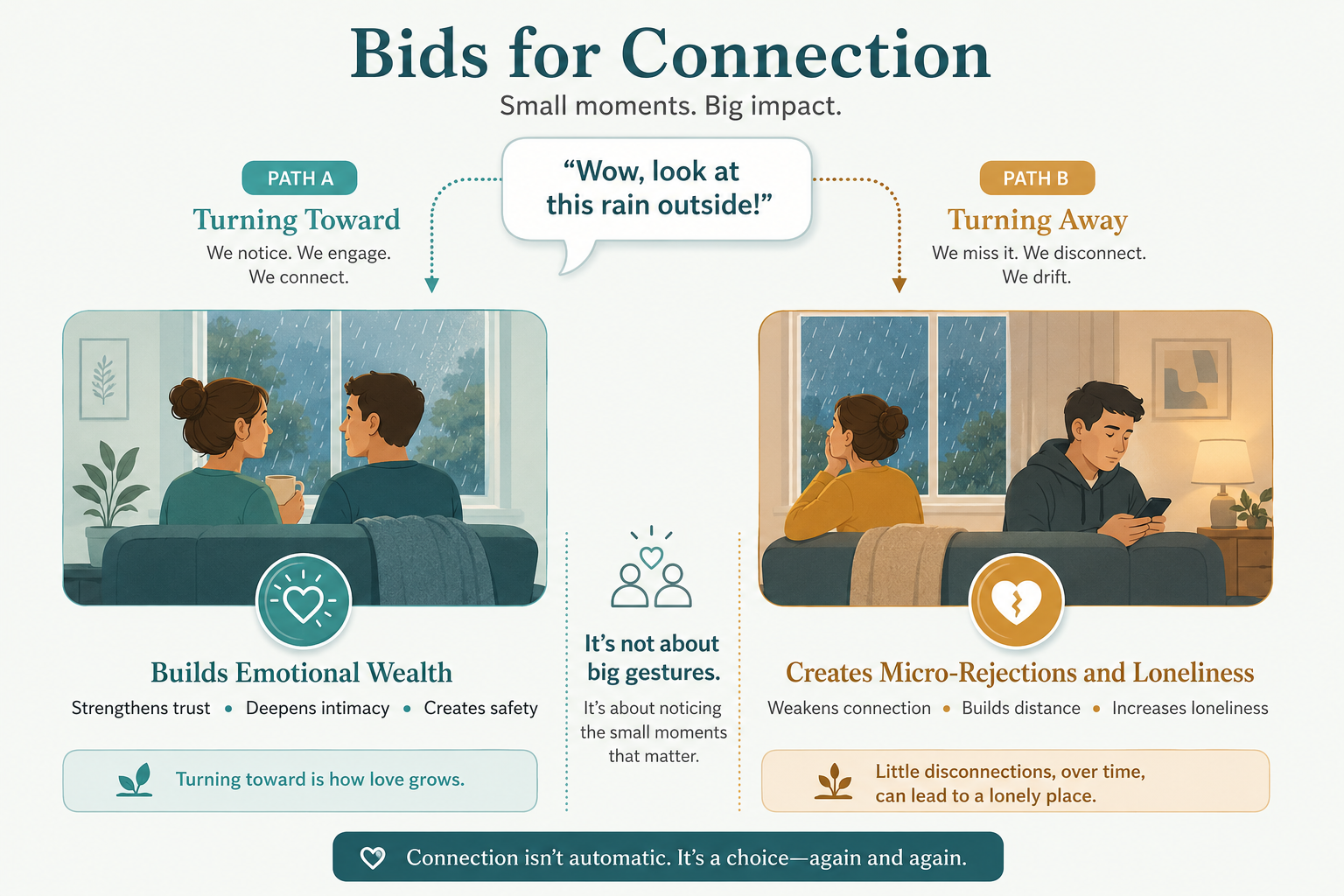
Renowned relationship researcher Dr. John Gottman discovered that successful couples constantly make Bids for Connection. A bid is any attempt—no matter how small or mundane—to get your partner's attention, affection, or support.
When your partner responds positively, they are "turning toward" you. But when your partner ignores you, gives a dismissive grunt without looking up, or keeps staring at their phone, they are "turning away."
The Core Issue: In isolation, a missed bid seems harmless. But when these bids are ignored consistently over months and years, they transform into Micro-Rejections. You feel lonely because your subconscious brain has learned that reaching out is pointless. To protect yourself from the subtle, repetitive sting of being ignored, you simply stop trying to share your inner world altogether. The resulting silence isn't peaceful; it is a profound defense mechanism.
3. The Loss of "Emotional Safekeeping"
Think back to the very beginning of your relationship. If something funny, upsetting, or deeply confusing happened during your day, your partner was the absolute first person you wanted to tell. Psychologists refer to this dynamic as making your partner your Emotional Safekeeper—the designated person who holds your most vulnerable thoughts without judgment.
The Shift to "Unhelpful Logic"
Loneliness sets in when that dynamic quietly shifts. You might start noticing that when you share a deep worry, your partner responds with cold, unhelpful logic ("Well, you just need to fix it by doing X") instead of providing the emotional validation you actually need ("That sounds incredibly stressful, I'm so sorry you're dealing with that").
The Heavy Burden of Filtering
When your partner stops being a safe harbor for your vulnerabilities, you naturally begin to filter what you say. You start carrying your emotional burdens alone because it feels easier than risking a dismissive or critical response from the one person who is supposed to understand.
The Core Issue: You feel lonely because the deepest, most authentic parts of your identity are no longer being witnessed by the person you love.
4. The Weight of "Implicit Contracts"
An Implicit Contract is an unspoken expectation you have about how your partner should behave in the relationship. Because these "rules" are never spoken out loud, your partner doesn't even know they exist—let alone that they are actively breaking them.
Example of an Implicit Contract:
You might have an internal rule that says: "If they see I am exhausted after putting the kids to bed, they should automatically offer to do the dishes without me having to ask." When they don't do the dishes, you feel profoundly abandoned, unloved, and taken for granted.
The Core Issue: We often feel the most lonely when we expect our partners to read our minds, and they inevitably fail. This creates a quiet, toxic resentment. You feel entirely invisible because your silent cries for help are going unanswered, yet your partner is completely unaware that a test is even taking place.

5. The Illusion of the "Low-Maintenance" Phase
Many couples who experience intimate loneliness pride themselves on how little they fight. They wear their lack of conflict as a badge of honor, assuming it means they have a "low-maintenance" or easygoing relationship.
However, the absence of fighting does not equal the presence of connection. A relationship without conflict is often a relationship without passion, boundary-setting, or vulnerability. When you stop fighting because you simply don't have the energy to care anymore, or because you believe speaking up won't change anything, apathy takes over.
The Core Issue: Apathy is the true opposite of love. If you are avoiding all friction just to keep the peace, you are also avoiding the deep, honest conversations required to stay intimately connected. You become polite strangers living under the same roof.
Moving From Isolation to Connection
The most important thing to understand about Intimate Loneliness is that it thrives in silence. It is not necessarily a sign that your marriage is broken beyond repair; rather, it is a glaring indicator that the emotional wi-fi between you and your partner has disconnected.
Rebuilding this connection does not require grand, sweeping romantic gestures. In fact, it requires the exact opposite. It requires a return to the subtle, daily interactions: putting the phone down when they speak, asking a curious question about their day, and offering a moment of genuine eye contact. But before you can fix the loneliness, you need absolute clarity on exactly where the disconnect is happening.
Take the Next Step
The Emotional Invisibility Score™
Discover How Seen, Valued & Emotionally Connected You Feel In Your Relationship.
To help you gain immediate clarity on the state of your emotional connection, I highly recommend taking this professional self-assessment. This 2-minute test calculates your emotional connection health and reveals the hidden emotional gaps in your marriage.
Find Your Score NowTakes 2 Minutes • 100% Confidential • Instant Results
Frequently Asked Questions About Marital Loneliness
Why do I feel lonely even when my spouse is in the same room?
This is known as "Intimate Loneliness." It happens when you share physical space but lack emotional resonance. When daily interactions become purely logistical (like adult parallel play) and vulnerable conversations cease, your brain registers a deep sense of isolation, regardless of physical proximity.
What is a "Bid for Connection" in a marriage?
A bid is any attempt to get your partner's attention, affirmation, or affection. It can be verbal (asking a question, sharing a story) or non-verbal (a sigh, a touch). When partners consistently ignore these bids, it creates "micro-rejections" that slowly erode the emotional bond.
Can a marriage survive if we feel like roommates?
Yes, but it requires active, intentional effort to transition out of the roommate phase. You must start prioritizing subtle daily interactions over simple logistical planning. Reintroducing small moments of eye contact, undivided attention, and curious questioning can begin to repair the emotional bridge.
Is it normal to stop sharing my feelings with my partner?
While common in drifting relationships, it is not healthy. This usually happens when a partner loses their status as your "Emotional Safekeeper." If you feel your vulnerabilities are met with dismissive logic or criticism rather than empathy, you will naturally start filtering your thoughts as a defense mechanism.