
How to Recognize and Break Trauma Bonds in a Relationship
A clinical guide to understanding trauma bonding signs, why your brain won't let you leave, and the steps to finally break free.
By Dr. Sangeeta Pattanaik | Read Time: 12 Minutes

As a clinical relationship therapist, one of the most heartbreaking statements I hear in my practice is, "I know they treat me terribly, but I just can't leave. I love them too much."
In Indian society, we are heavily conditioned to believe that "adjustment" and "compromise" are the hallmarks of a successful relationship. We are taught that true love requires suffering, and that weathering a partner's toxic behavior is a sign of devotion. But as a psychological professional, I must shatter this dangerous myth: There is a profound difference between a difficult marriage and an abusive dynamic.
When you feel addicted to a partner who continuously disrespects, manipulates, or emotionally harms you, you are not experiencing true love. You are experiencing a psychological phenomenon known as a Trauma Bond.
What is a Trauma Bond?
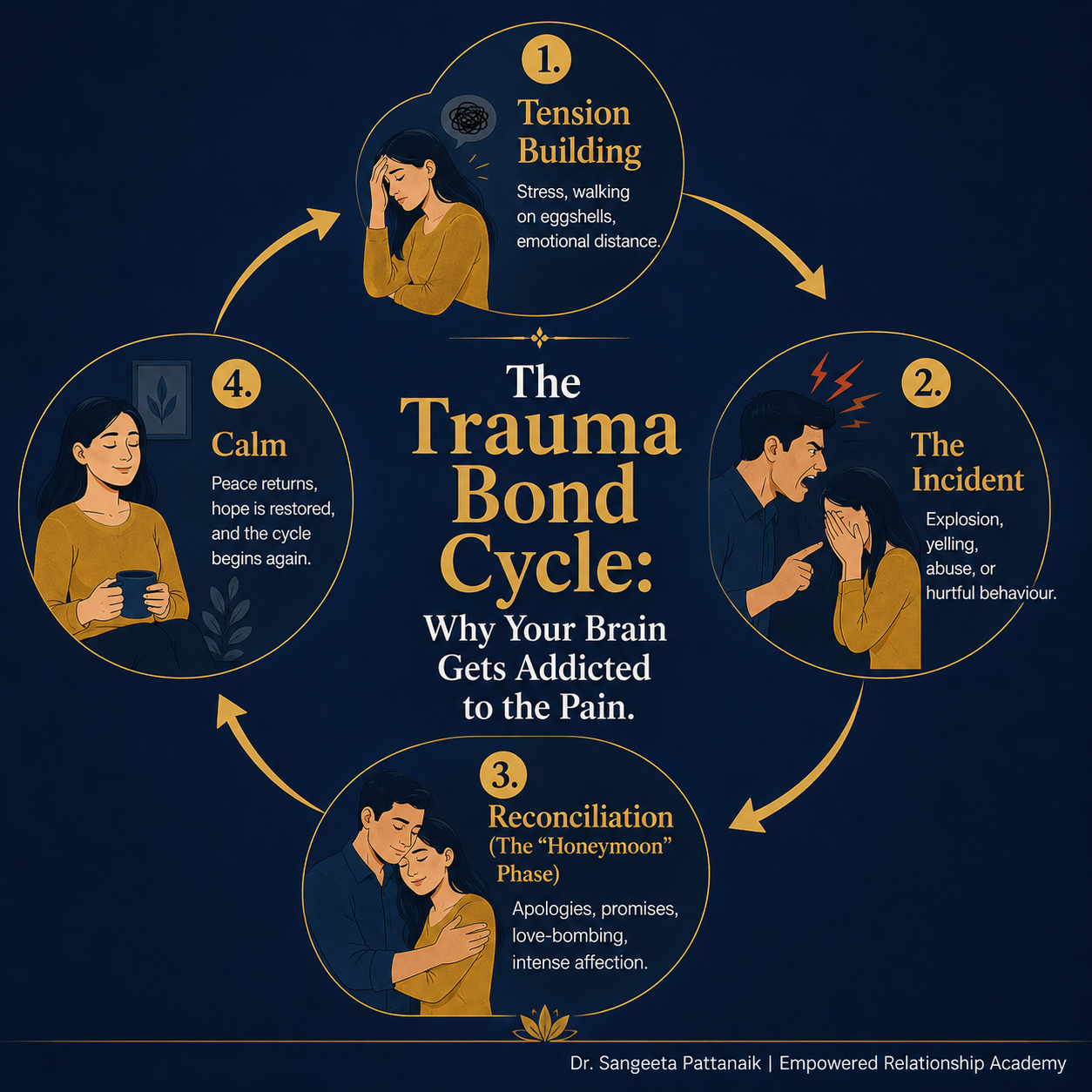
Trauma bonding occurs when a cycle of intense emotional or physical abuse is immediately followed by periods of intense affection, apologies, and promises to change. This creates a biological addiction in your brain that is as powerful as a chemical dependency.
If you feel trapped in a cycle of extreme highs and devastating lows, you need to understand the psychology behind it. Here is a clinical guide to understanding the trauma bonding signs, why your brain won't let you leave, and the steps to finally break free.
1. The Psychology of the Bond: Intermittent Reinforcement
To understand why you cannot simply "walk away," you have to understand a psychological concept called Intermittent Reinforcement.
Imagine a slot machine. If you put a coin in and lost every single time, you would stop playing immediately. But if the machine gives you a massive jackpot just when you are about to walk away, your brain gets flooded with Dopamine (the reward and pleasure chemical). You keep pulling the lever, enduring hundreds of losses, just hoping for that next high.
This is exactly how a trauma bond works. Your partner causes you immense pain, triggering a flood of Cortisol (the stress hormone). You feel terrified, anxious, and ready to leave. But suddenly, they switch. They cry, they apologize, they buy you gifts, and they promise it will never happen again. This sudden shift from terror to extreme affection floods your brain with dopamine and oxytocin.
Over time, your nervous system associates this toxic partner with both the source of the trauma and the only source of comfort. Your brain literally becomes addicted to the cycle of pain and rescue.
2. Key Trauma Bonding Signs You Cannot Ignore
When you are inside a trauma bond, your perception of reality becomes warped. Psychologists call this Cognitive Dissonance—the mental discomfort of holding two conflicting beliefs at the same time (e.g., "My partner is a good person" vs. "My partner is destroying my mental health").
To resolve this discomfort, victims often lie to themselves. Here are the undeniable trauma bonding signs you must watch out for:
A. You Constantly Defend Their Bad Behavior to Others
If your friends or family members express concern about how your partner speaks to you, you immediately make excuses for them. You might say, "He is just under a lot of pressure at work," or "She didn't mean it, she had a difficult childhood." In a trauma bond, you act as your partner's PR manager, hiding the truth of your relationship from the outside world.
B. You Confuse Extreme Intensity with True Intimacy
In healthy relationships, intimacy is built on peace, consistency, and psychological safety. In a trauma bond, there is no peace. The relationship is fueled by jealousy, extreme arguments, and passionate reconciliations. You begin to believe that the lack of drama means a lack of love.
C. You Feel You Owe Them Because of the "Good Times"
The hallmark of a trauma bond is focusing obsessively on the 10% of the time they are wonderful, in order to survive the 90% of the time they are toxic. You hold onto memories of the honeymoon phase, convincing yourself that their "true self" is the loving version, and the abusive version is just a temporary mistake.

3. How to Break the Trauma Bond
Breaking a trauma bond is not a one-time event; it is a profound psychological withdrawal process. When you try to leave, your brain will literally go into panic mode, craving the dopamine hit of your partner's affection. You must treat this with clinical seriousness.
Step 1: Acknowledge the Cognitive Dissonance
You must stop living in the fantasy of who your partner could be, and start looking at who they actually are.
The Clinical Exercise: Keep a secret reality journal. Write down exactly what they said and did during an outburst. When they apologize and your brain tries to trick you into forgiving them, read the journal. You must anchor yourself to the factual reality of the abuse, not the fantasy of the apology.
Step 2: Establish "No Contact" or "Grey Rock"
To break a chemical addiction, you must remove the substance.
- If you are unmarried or do not have children, you must establish Absolute No Contact. Block them on every platform. Every time you view their social media or reply to a text, you reset your healing to day one.
- If you are co-parenting or living together, you must use the Grey Rock Method. Become as uninteresting and emotionally unresponsive as a grey rock. Answer questions with simple "yes" or "no" responses. Do not argue, do not defend yourself, and do not show emotional pain. Toxic partners feed on your emotional reactions; starve them of that supply.

Step 3: Rewire Your Nervous System
When you leave a trauma bond, your body will feel physically ill. You will experience anxiety, insomnia, and obsessive thoughts. This is not a sign that you made a mistake; it is a sign that your nervous system is going through withdrawal. You must replace the toxic dopamine with healthy dopamine. Lean heavily on a support system. Reconnect with the friends and family you were isolated from. Engage in physical exercise to naturally process the lingering cortisol out of your bloodstream.
Step 4: Seek Professional Trauma Therapy
A trauma bond usually latches onto unhealed childhood wounds. Often, we accept toxic love because it feels familiar to the chaotic love we received in our early years. A professional therapist specializing in trauma will help you untangle your self-worth from the abuser and teach you how to tolerate the quiet safety of a healthy relationship.

Choosing Peace Over History
Leaving a trauma bond is one of the hardest things you will ever do. In Indian culture, the pressure to "make it work" can feel suffocating. But I want you to hear this clearly: Enduring psychological abuse is not a badge of honor, and trauma is not a foundation for marriage.
You deserve a relationship that does not require you to constantly sacrifice your mental health for moments of basic affection. Healing begins the moment you decide that your internal peace is more valuable than their unpredictable intensity.
Take the First Step Before Your Session
Emotional Invisibility Score™
Discover How Seen, Valued & Emotionally Connected You Feel In Your Relationship.
If you are reading this and wondering whether your relationship is simply going through a rough patch or if you are trapped in a toxic dynamic, clarity is your most powerful weapon. This quick, scientifically structured self-assessment will immediately reveal the underlying emotional currents in your marriage.
Discover Your Score NowTakes 2 Minutes • 100% Confidential • Instant Results
Frequently Asked Questions About Trauma Bonding
What is a trauma bond in a relationship?
A trauma bond is a strong psychological and biological attachment created by a cycle of intense abuse followed by extreme affection and apologies. This cycle of punishment and rescue creates an addiction in the brain that makes it incredibly difficult for the victim to leave.
Why is it so hard to leave a toxic relationship?
It is difficult because of a psychological mechanism called Intermittent Reinforcement. The unpredictability of the abuser's affection triggers intense dopamine hits in the brain when they are finally kind. This chemically wires your nervous system to rely on them for comfort, creating a literal withdrawal effect when you try to leave.
What are the signs I am trauma bonded to my partner?
Key trauma bonding signs include constantly defending your partner's bad behavior to friends and family, confusing intense drama and jealousy with true intimacy, and obsessing over the "good times" to justify staying through the toxic times (a phenomenon known as cognitive dissonance).
What is the Grey Rock method for toxic relationships?
The Grey Rock method is a psychological strategy used when you cannot completely cut contact with a toxic person (e.g., if you co-parent). It involves becoming completely emotionally unresponsive and boring—like a grey rock. By giving only short "yes" or "no" answers and hiding your emotions, you starve the abuser of the reaction they are looking for.