
How to Break the Cycle: A Psychologist’s Comprehensive Guide to Ending Chronic Relationship Arguments
An in-depth exploration of the hidden neurobiology, attachment triggers, and actionable psychological strategies to permanently rewire your relationship conflict.
By Dr. Sangeeta Pattanaik | Read Time: 15 Minutes

It usually starts the exact same way. It might be a Tuesday evening after a long day of work, a stray comment about household chores, a misunderstood text message, or a sigh that sounds a little too heavy. Within seconds, the atmosphere in the room shifts. The air grows thick. You both know exactly what is happening. The invisible script is written, the roles are strictly assigned, and you are both about to perform the exact same fight you have had dozens—perhaps hundreds—of times before.
Chronic arguing doesn't just destroy emotional intimacy; it takes a severe physical toll. Studies show that couples caught in hostile, repetitive conflict experience chronically elevated blood pressure, weakened immune systems, and severe sleep disruption. You aren't just losing your peace of mind; you are exhausting your physical body.
The Psychologist’s Clinical Perspective:
Partners sit on my couch, exhausted, often leaning away from each other, asking, "Why do we keep fighting about the same stupid things?" My answer always surprises them: You aren't actually fighting about the dishes, the laundry, or the tone of voice. When you find yourself trapped in a chronic argument loop, you are dealing with profound, unarticulated psychological wounds. To break this exhausting cycle, we have to look past the everyday triggers, dive into the neurobiology of your nervous systems, and decode the silent language of your unmet core needs.
This is not just another article telling you to "communicate better." Let’s dive deeply into the fascinating, complex psychology of why this happens and, more importantly, the clinical framework you can use to rewire your dynamic and foster natural teamwork.
Phase 1: The Neuroscience of the "Loop"
To stop a recurring argument, we first have to understand the biological warfare happening inside your brain when the fight begins. When a disagreement repeats itself over months or years, it transitions from a simple conflict into a state that psychologists refer to as Gridlock.
Gridlock is an emotional standstill. It happens when a specific surface issue is so deeply tied to your core values, hidden childhood fears, or unfulfilled life dreams that compromising feels like you are betraying your own identity. But why does a simple conversation about taking out the trash escalate to screaming in 45 seconds?
🧠 The Psychological Fact: The Amygdala Hijack & The Window of Tolerance
The amygdala is your brain's ancient alarm system. It cannot easily tell the difference between a physical threat (like a speeding car) and an emotional threat (like feeling rejected or criticized by your partner). When triggered, it floods your bloodstream with Cortisol and Adrenaline.
This completely bypasses your Prefrontal Cortex—the logical, empathetic front part of your brain. During a heated argument, you are literally pushed outside your "Window of Tolerance" into hyperarousal. You lose the biological capacity to listen, rationalize, or feel empathy. You are no longer arguing; you are fighting for emotional survival.
Phase 2: The Attachment Dance (The Pursuer vs. The Distancer)
Beneath the neurobiology lies another deeply ingrained psychological layer: your Attachment Style. Chronic arguments usually fall into a predictable choreographed dance based on how each partner learned to seek safety in childhood. The most common toxic loop I see in couples therapy is the Pursuer-Distancer dynamic (often heavily influenced by Anxious and Avoidant attachment styles).
| The Pursuer (Often Anxious Attachment) | The Distancer (Often Avoidant Attachment) |
|---|---|
| Reacts to conflict by seeking immediate resolution, pushing for conversation, and demanding emotional reassurance. | Reacts to conflict by feeling overwhelmed, shutting down, needing physical space, and avoiding the conversation. |
| Underlying Fear: Abandonment, rejection, or feeling unloved. "If we don't fix this right now, we are going to break up." | Underlying Fear: Inadequacy, being controlled, or failing their partner. "Nothing I say will be right, so I better stay quiet." |
| The Tragic Irony: The more they pursue to gain closeness, the more they trigger the Distancer's need to flee. | The Tragic Irony: The more they pull away to calm down, the more they trigger the Pursuer's panic of abandonment. |
Understanding this dance is crucial. When Partner A yells, it is a misguided cry for connection. When Partner B walks away, it is a misguided attempt to prevent the relationship from exploding. Neither partner is malicious; both are simply terrified.
Phase 3: The Illusion of the "Silly" Argument
Let's look at one of the most common battlegrounds: shared household responsibilities. Imagine a scenario where Partner A is furious because Partner B left their shoes in the middle of the hallway again.
The Surface Argument:
- Partner A: "You never pick up after yourself! I have to manage everything in this house."
- Partner B: "I just walked through the door! Why are you always attacking me the second I get home?"
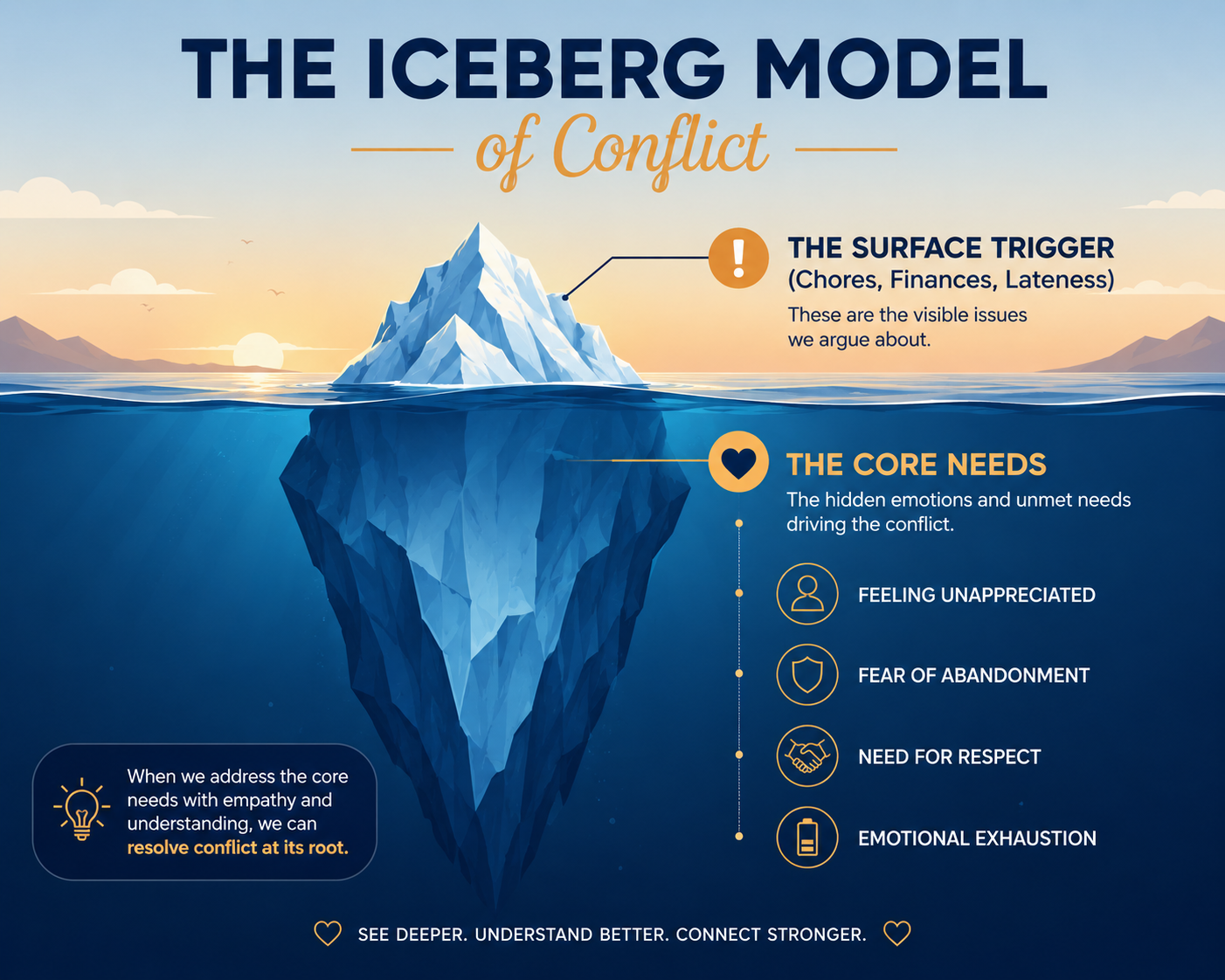
On the surface, this is a fight about footwear. But psychologically, it is a clash of unmet Core Needs. A core need is a fundamental human requirement for safety, validation, and respect.
Partner A's Hidden Need (The Iceberg Base)
The shoes represent an immense lack of respect for their time, mental load, and effort. The unmet core need is screaming: "I feel entirely overwhelmed, alone, and unappreciated. I need to know you have my back and we are an equal team."
Partner B's Hidden Need (The Iceberg Base)
The immediate criticism upon entering the house represents a destruction of emotional safety. The unmet core need is screaming: "I work hard to provide, and I desperately need my home to be a sanctuary of peace, acceptance, and love, not a tribunal where I am constantly judged."
Chronic relationship arguments survive indefinitely because couples spend years debating the tip of the iceberg (the shoes) while completely ignoring the massive emotional wound underneath the water.
Phase 4: The 6-Step Blueprint to Rewire Your Dynamic
To stop the loop, you must change the choreography of the dance. If one partner changes their steps, the old routine mathematically cannot continue. Here is a deeply psychological, yet highly actionable clinical framework to end the cycle.
1. Implement a Hard "Pattern Interrupt"
Because these recurring arguments operate on neurological autopilot, you must short-circuit the routine immediately. In behavioral psychology, a Pattern Interrupt is a technique used to abruptly halt a habitual reaction. When you feel your heart rate hit about 100 BPM (the threshold for flooding), you must call a time-out.
The Science: It takes the human nervous system a minimum of 20 to 30 minutes to metabolize and flush out cortisol. You simply cannot resolve a conflict when your amygdala is hijacked. *Crucial Rule:* The person who calls the time-out is entirely responsible for initiating the conversation again when the time is up. Otherwise, it is just stonewalling.

2. Master the "Soft Start-Up"
Dr. John Gottman's research shows that the first three minutes of a conversation predict how it will end with 96% accuracy. If you start a discussion with harsh criticism, it will inevitably end in a blowout. You must replace this with a Soft Start-Up.
The Formula: I feel [Emotion] about [Specific Situation]. I need [Positive Action].
Instead of: "You always leave the kitchen a mess. You're so inconsiderate," try: "I am feeling really overwhelmed looking at the kitchen right now. I need us to tackle cleaning it up together." By focusing on your own feelings and requesting a positive action, you bypass your partner's defensive alarm system.
3. Shift from "You vs. Me" to "Us vs. The Problem" (Cognitive Reframing)
When stuck in a chronic fight, we naturally view our partner as the enemy. Cognitive Reframing requires you to consciously shift your mental perspective. The problem is not your partner; the problem is the dynamic between you.
Actionable Tip: Next time tension arises, physically change your positioning. Stop standing face-to-face (which is biologically confrontational). Sit next to your partner on the couch, shoulder-to-shoulder. This physical shift sends a profound subconscious cue to the reptilian brain: We are on the same team, looking out at the problem together.

4. Dig for the Core Need (The Iceberg Technique)
Instead of defending your actions with a counter-argument, get intensely curious about your partner's inner world. Ask questions that pierce through the surface-level anger and reach the vulnerable core beneath the water.
- "Can you help me understand what this specific situation means to you deep down?"
- "What is your biggest fear or worry regarding this issue?"
- "What is the one thing you need from me right now to feel completely supported?"
When a partner feels truly seen and psychologically validated—when they realize you care more about their hidden pain than winning a debate—their hostility almost instantly evaporates.
5. Deploy Active "Repair Attempts"
Happy couples still fight, but they are masters of the Repair Attempt. A repair attempt is any statement or action—silly or serious—that prevents negativity from spiraling out of control during an argument.
This could be a gentle touch on the arm, a sudden use of shared humor, or a humbling phrase like, "Okay, hold on, I didn't say that right. Let me try again," or "I can see why that made you mad. That makes sense." Recognizing and accepting your partner's repair attempt is the secret weapon to de-escalating a fight mid-sentence.
6. Maintain the 5:1 Magic Ratio
Chronic arguments drain the emotional bank account of your relationship. Dr. Gottman discovered that for a marriage to thrive, there must be a 5-to-1 ratio of positive to negative interactions during conflict. For every one negative statement, sarcastic remark, or eye roll, you need five positive interactions (validation, a smile, a compliment, an expression of empathy) to balance the emotional scales. If you are stuck in a loop, your ratio is likely upside down. Start actively depositing kindness back into the relationship outside of your arguments.
Final Thoughts for Lasting Peace
Breaking the iron grip of chronic relationship arguments requires immense patience, profound vulnerability, and a willingness to lay down your ego. It requires you to stop obsessing over being "right" and start prioritizing being "connected." The goal of a healthy, mature relationship is not zero conflict—it is successful, loving repair.

Break the Loop Together
Are you tired of having the exact same fight? Book a 1-on-1 Online Couples Counseling Session with Dr. Sangeeta Pattanaik and learn the clinical tools to rebuild your connection.
Book Your Session Now🔒 100% Private • Secure Video Consultation • Pan-India
Frequently Asked Questions
Why do relationship arguments escalate so quickly into yelling?
Arguments escalate rapidly due to a neurobiological phenomenon called an "Amygdala Hijack." When you feel emotionally threatened, criticized, or invalidated, your brain's alarm system floods your body with stress hormones like cortisol. This triggers a visceral fight-or-flight response, temporarily disabling the logical, communicative part of your brain.
Can taking a time-out during a fight make things worse?
A time-out only damages the relationship if it is used maliciously as "stonewalling" or the silent treatment. To use it healthily, you must clearly state that you are feeling physically overwhelmed, ask for a specific amount of time to soothe your nervous system (usually 20-30 minutes), and crucially, you must promise to return to finish the conversation.
What is the difference between an argument and emotional abuse?
A healthy argument focuses on a specific issue or behavior, even if voices are raised. Emotional abuse involves attacking the core character of the person, using contempt, name-calling, manipulation, gaslighting, or threats. If you feel inherently unsafe or demeaned, that transcends a standard communication loop and requires immediate professional intervention.
Is it possible to stop arguing in a relationship completely?
No, and zero conflict should never be the goal. Conflict is entirely natural when two distinct individuals combine their lives. Couples who never fight often suffer from severe emotional detachment and avoidance. The goal is to learn how to disagree respectfully, validate each other's core needs, and repair the emotional bond quickly after a dispute.