
Are You Listening, or Just Waiting to Speak? The Art of Active Listening in a Relationship
Dismantling the defensive brain, recognizing toxic listening traps, and learning the clinical "Mirror & Validate" technique to transform your marriage.
By Dr. Sangeeta Pattanaik | Read Time: 12 Minutes

In my clinical practice, one of the most common complaints I hear from couples sitting on my couch is a desperate, exhausted plea: "Dr. Sangeeta, we talk all the time, but my partner just doesn't hear me."
Communication is often hailed as the golden key to a successful marriage. Yet, there is a massive psychological difference between exchanging words and actually communicating. When an argument breaks out over finances, in-laws, or household chores, most couples are not actually listening to each other. Instead, they are engaging in a competitive verbal tennis match. While one partner is speaking, the other partner is silently rehearsing their rebuttal, fact-checking their spouse’s memory, and waiting for the exact millisecond they can jump in to defend themselves.
The Exhaustion of the Verbal Tennis Match
We call this "listening to respond" rather than "listening to understand." When you are simply waiting for your turn to speak, your spouse instinctively feels dismissed, invisible, and emotionally abandoned.
The antidote to this destructive cycle is a clinical communication skill known as active listening. Cultivating an active listening relationship does not just prevent arguments; it biologically rewires your nervous systems to feel profoundly safe with one another. Let us take a deep clinical dive into the psychology of defensive listening, understand why our brains hijack our empathy, and learn a step-by-step roadmap to become a master of active listening.
1. The Neuroscience of "Waiting to Speak"
Why is it so difficult to simply sit in silence and listen when our partner is upset? The answer lies not in our lack of love, but in our brain’s biological survival mechanisms.
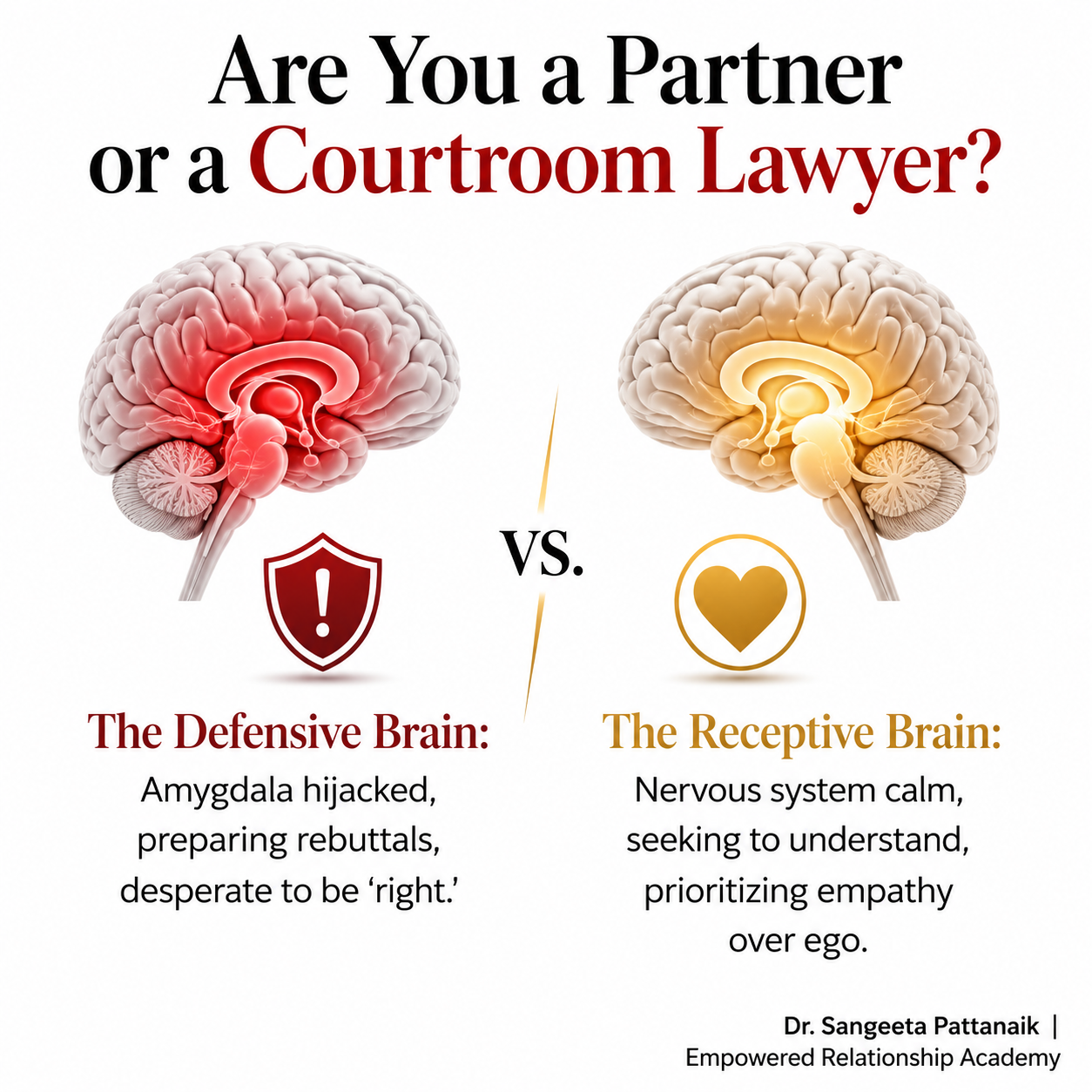
When your spouse approaches you with a complaint—even a mild one like, "You didn't help with the dishes tonight"—your brain's Amygdala (the emotional alarm center) often misinterprets this critique as a direct threat to your character or survival.
The Defensive "Fight" Response
The moment your brain perceives a threat, it floods your bloodstream with cortisol and adrenaline. Your logical, empathetic Prefrontal Cortex temporarily shuts down, and your ego takes the steering wheel. In this state of biological defensiveness, true listening becomes neurologically impossible.
Instead of hearing the underlying exhaustion in your partner's voice, your brain immediately goes into a "fight" response. You begin formulating your defense: "I didn't do the dishes because I worked a fourteen-hour shift to provide for this family!" You are no longer a partner trying to understand your spouse's pain; you have become a lawyer in a courtroom, obsessively building a case to prove your innocence and win the argument.
2. The Four Habits That Destroy Communication
To build a true active listening relationship, you must first eliminate the unconscious communication habits that shut your partner down. In therapy, we identify four specific toxic listening styles that couples must actively unlearn:
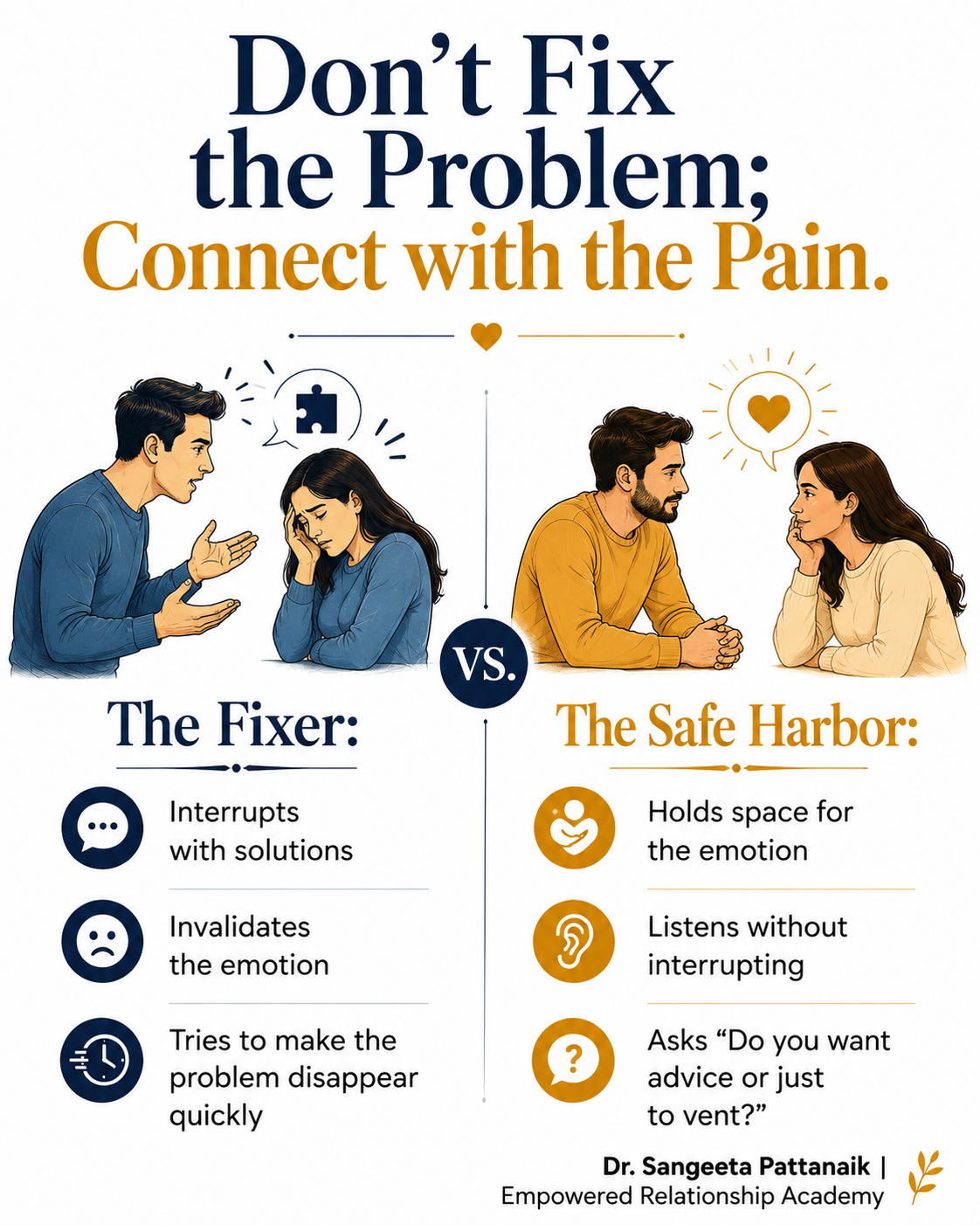
1. The "Fixer" Trap
Premature Problem-Solving
This is incredibly common among husbands conditioned to be providers. When a wife shares an emotional frustration, the Fixer interrupts with a logistical solution ("Just write an email to HR"). While well-intentioned, this invalidates her emotional experience. She didn't want a solution; she wanted a safe space to feel understood.
2. The "Invalidator"
Dismissing the Reality
When your partner expresses hurt, the Invalidator immediately dismisses the emotion because they don't share the same perspective. They use phrases like, "You are overreacting," or "It wasn't that big of a deal." Invalidating your partner’s reality guarantees that they will build a thicker emotional wall against you.
3. The "Hijacker"
Making It About You
The Hijacker listens only long enough to steal the spotlight. If a spouse says, "I feel so exhausted today," the Hijacker responds, "You think you're tired? I had back-to-back meetings all day!" This transforms a bid for connection into a competitive "Exhaustion Olympics."
4. The "Mind-Reader"
Assuming the Intent
The Mind-Reader doesn't listen to the actual words. Instead, they project insecurities onto their partner and react to assumed meaning. If a spouse says, "The house feels a bit messy today," the Mind-Reader instantly snaps, "Oh, so you think I'm a terrible homemaker?"
3. The Cultural Script: Why We Struggle to Listen in India
Developing an active listening relationship in an Indian cultural context requires overcoming deep, generational conditioning regarding how families communicate.
Hierarchical Communication vs. Emotional Equality
In many traditional Indian households, communication is historically hierarchical, not horizontal. We are taught that elders speak and younger family members obey silently. Husbands often hold the dominant voice, while wives are conditioned to "adjust" and keep their frustrations buried to maintain the illusion of a perfect family.
Because we did not witness our parents sitting down to deeply, equally, and vulnerably validate each other’s emotional worlds, we simply do not have a neurological blueprint for how to do it in our own marriages.
The Pressure of "Keeping the Peace"
Indian culture places a massive premium on harmony and avoiding conflict at all costs (Log kya kahenge). Consequently, when a spouse brings up a difficult emotion, the instinctive cultural response is to sweep it under the rug. We say things like, "Let it go," "Don't make a scene," or "It's just how families are."
Active listening requires you to do the exact opposite. It requires you to bravely sit in the discomfort of your partner's negative emotions without trying to rush them to a state of artificial "peace."
4. The 3-Step "Mirror & Validate" Technique
True active listening is not merely staying silent while your partner talks. It is a highly active, engaged psychological process.
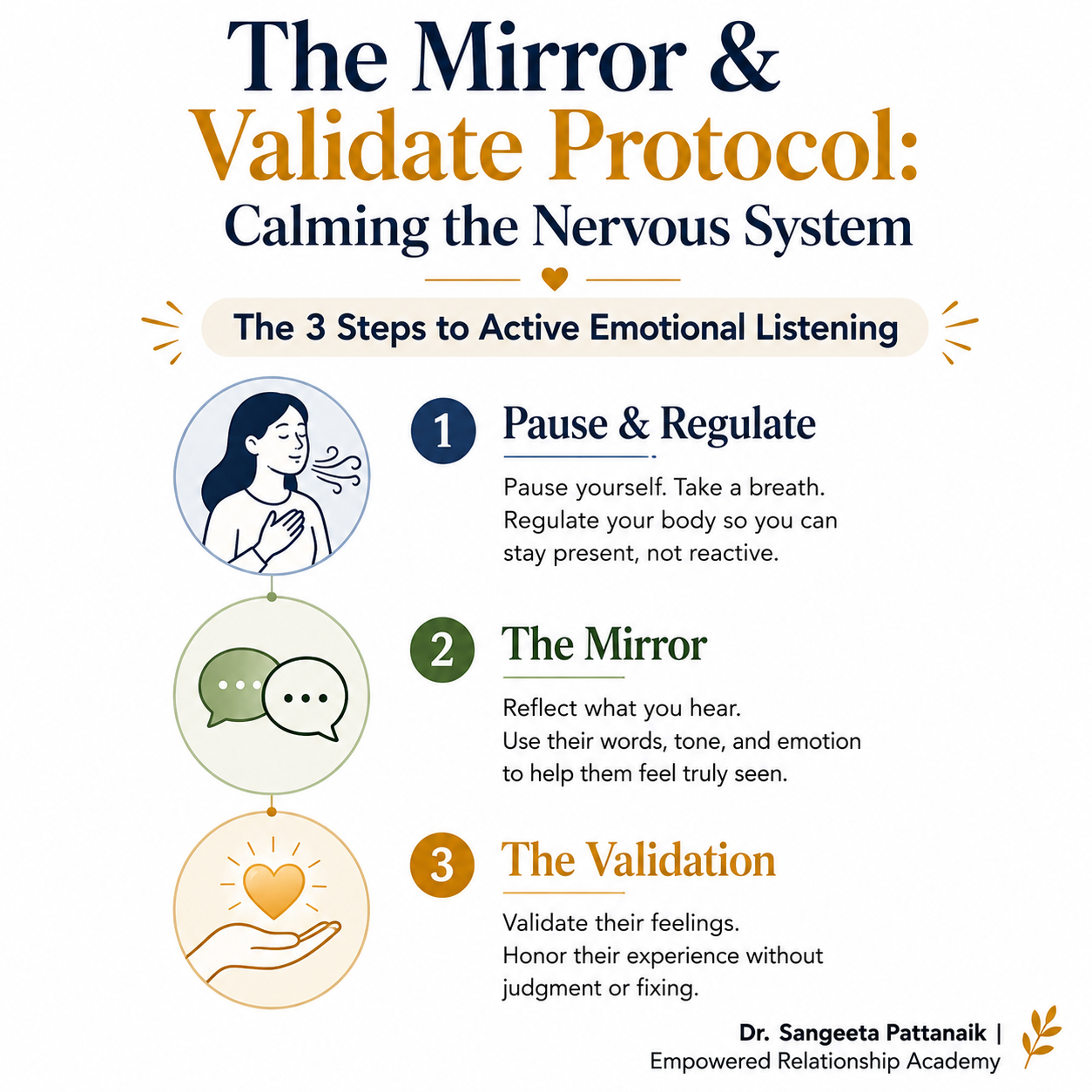
In my clinic, I teach couples a structured, transformative communication protocol called the "Mirror and Validate" Technique. When arguments escalate, use these three exact steps to bring your partner's nervous system back to a state of profound safety:
Step 1: The Pause and Regulate
When your partner brings up a complaint, you will feel your ego flair up. You must consciously stop yourself from speaking. Take a deep physical breath. Remind your nervous system: "My partner is not my enemy. They are in pain, and they are simply asking for my love." Do not formulate your defense; focus 100% of your cognitive energy on hearing the emotions beneath their words.
Step 2: The Mirror (Reflective Listening)
When your partner finishes speaking, you are not allowed to argue, disagree, or state your side of the story. You must first act as a psychological mirror. Repeat back a summary of what they just said to prove you were listening.
The Script: "If I am hearing you correctly, you are saying that you felt really abandoned yesterday when I didn't defend you in front of my mother. Is that correct?"
The Magic: If you got it wrong, let them correct you. When you accurately mirror their words, their defensive walls immediately begin to lower because they finally feel seen.
Step 3: The Validation (Empathy Without Agreement)
This is the most critical step. You do not have to agree with your partner’s facts to validate their emotions. Validation simply means acknowledging that, from their perspective, their emotional pain is real and makes sense.
The Script: "I can completely understand why you would feel so hurt and abandoned in that moment. It makes sense that you felt like I wasn't acting like your teammate."
The Magic: Empathy neutralizes anger. The moment your partner hears that their feelings make sense to you, their amygdala calms down. Only after they feel completely validated can you gently introduce your own perspective or offer a solution.
5. The Power of "Holding Space"
In clinical psychology, we use a beautiful term called "Holding Space."
Holding space for your spouse means being physically, mentally, and emotionally present with them while they process their pain, without judging them, without making it about yourself, and without rushing to fix the unfixable.
It looks like putting your smartphone in another room, turning your body to face them, looking into their eyes, and simply saying, "I am right here with you. Tell me more about how much that hurt."
Building an active listening relationship transforms your marriage from a logistical partnership into an impenetrable emotional sanctuary. When your spouse knows that they can bring their ugliest fears, their deepest exhaustion, and their heaviest complaints to you—and that you will simply sit with them and listen—you create a bond of trust that no external stressor can ever break.

Take the First Step Before Your Session
Mastering the art of active listening requires a clear, objective understanding of how deeply you and your partner currently communicate under stress. Before you can successfully implement the Mirror and Validate technique, you must clearly understand the present emotional foundation of your marriage.
Before making assumptions about your relational communication patterns, I invite both of you to take this quick, scientifically structured self-assessment. It will immediately map your listening styles and reveal exactly where your connection needs the most clinical support.
Take the Next Step
The Emotional Invisibility Score™
Discover How Seen, Valued & Emotionally Connected You Feel In Your Relationship.
This 2-minute assessment calculates your emotional connection health and reveals the hidden emotional gaps in your marriage. Understand how well you are truly listening to one another today.
Discover Your Score NowTakes 2 Minutes • 100% Confidential • Instant Results
Frequently Asked Questions About Active Listening
What is the difference between "listening to respond" and active listening?
Listening to respond happens when your brain is in a defensive state. Instead of hearing your partner, you are silently rehearsing your rebuttal and waiting for a pause so you can defend yourself. Active listening means silencing your ego, turning off your defensive mechanisms, and focusing 100% of your cognitive energy on understanding the emotional pain beneath your partner's words.
What is the "Mirror and Validate" technique in relationship therapy?
It is a 3-step clinical communication protocol. First, you pause your defensive ego. Second, you Mirror (repeat back a summary of what your partner said without arguing). Third, you Validate (acknowledge that their emotional pain makes sense from their perspective, even if you disagree with the facts). This instantly calms their nervous system.
Why shouldn't I try to solve my partner's problem right away?
This is known as the "Fixer" trap. When your partner is emotionally overwhelmed, their logical brain is offline. Providing an immediate logistical solution invalidates their feelings because it signals that you want to rush them out of their negative emotion. They usually want a safe space to vent and feel understood, not a strategy session.
What does it mean to "hold space" for your spouse?
Holding space in psychology means being fully physically and emotionally present with your partner while they process difficult emotions. It means putting away distractions, maintaining eye contact, and allowing them to be vulnerable without judging them, making the conversation about yourself, or trying to rush them to an artificial state of "peace."
My biggest takeaway is that sometimes we don’t really listen, we just prepare our defence or try to fix things.I learnt that simply listening, understanding and validating someone’s feelings can make them feel safe, heard and connected.
In this modern era most of them are paying more attention and listen to things that show up in their phone. We have never understood how human being requires active listening and how it plays vital role in each relationship we come across.In this reading I have learnt how to listen to our partners than confronting with them.How to respond rather than defending eachother and give our fullest attention to people around around stating that we are their for them