
How to Talk About Money Without Ruining Your Relationship: Solving Financial Stress in Marriage
Navigating childhood money scripts, Indian family financial duties, and how to build a peaceful, hybrid banking architecture together.
By Dr. Sangeeta Pattanaik | Read Time: 15 Minutes

In my clinical practice as a relationship therapist, I often sit across from couples who are willing to bare their souls about their deepest childhood memories, their parenting struggles, and even their physical intimacy with surprising openness. Yet, the exact moment I gently shift the conversation toward their household bank accounts, credit card statements, or monthly budgets, the atmosphere in the consulting room turns to ice. Shoulders tense up, breathing becomes shallow, eye contact drops, and defensive brick walls slam down.
There is a profound, universal psychological truth that every couple must understand: When husbands and wives argue about money, they are almost never arguing about simple mathematics.
Global relationship studies and psychological research consistently demonstrate that chronic financial stress in marriage is one of the leading predictors of severe emotional estrangement and divorce. When couples clash over an expensive credit card bill, an electricity invoice, or a dinner outing, they are not debating the arithmetic of rupees and paise. They are fighting over what that money represents to their individual survival instincts, personal freedom, and emotional security.
The Psychological Reality of Money
When you look at your spouse and say, "You are spending too much money," your brain thinks you are stating a practical mathematical fact. But your partner’s brain does not hear math; their emotional nervous system hears an alarming threat: "You are endangering our safety," or "You are trying to control my life and strip away my independence."
If financial conversations in your home routinely collapse into shouting matches, icy silent treatments, or lingering resentment, you cannot solve the problem simply by downloading a budget tracking app or creating a stricter spreadsheet. To cure financial stress in marriage, you must first heal the underlying psychological currents driving your financial behaviors.
Let us explore the fascinating neuroscience of money, examine how Indian family dynamics complicate our wallets, and build a clear, step-by-step clinical roadmap to talk about finances with profound empathy and unbreakable teamwork.
1. The Psychology of Wealth: Why Money Triggers Our Survival Brain
To understand why two intelligent, deeply loving adults can turn into bitter adversaries over a bank balance, we must examine what happens inside the human brain when money is discussed.
In clinical psychology, we know that financial resources are directly linked to our Amygdala—a tiny, almond-shaped cluster of neurons deep inside the brain that acts as your personal survival alarm system. Its primary job is to scan your environment for life-threatening danger. Thousands of years ago, the amygdala panicked over predators and physical scarcity. In the modern world, the amygdala equates money with physical survival: food, shelter, healthcare, and safety for our children.
When you feel financially threatened or judged, your amygdala triggers an acute Fight-or-Flight Response. Your bloodstream is flooded with stress hormones like Cortisol and Adrenaline. In this biological state of alarm, your Prefrontal Cortex—the logical, empathetic, problem-solving front part of your brain—temporarily shuts down. You literally lose the neurological capacity to listen to reason or empathize with your partner. You are simply fighting for survival.
Dr. Brad Klontz’s Four "Money Scripts"
To decode why certain spending habits trigger this alarm system in you but not in your partner, we rely on the groundbreaking work of financial psychologist Dr. Brad Klontz. He discovered that every human being operates on a Money Script—a core, unconscious belief system about what money means, which is programmed into our subconscious minds during early childhood.
Your money script was written long before you met your spouse. It was shaped by watching how your parents argued or stayed silent about money, experiencing childhood scarcity or financial abundance, and absorbing cultural messages about wealth. Most marital financial battles are simply a clash between two incompatible childhood money scripts:
Money as Security (The Fortress Builder)
For this partner, money represents an absolute biological shield against a dangerous, unpredictable world. A high savings balance is the only thing that soothes their nervous system. When their spouse spends money on non-essential luxuries, the Security partner experiences genuine physical panic—their heart rate spikes, their chest tightens, and they react with anger because their alarm system is screaming that their safety is being destroyed.
Money as Freedom (The Experiential Explorer)
To this partner, money is merely a practical tool designed to unlock autonomy, joy, travel, and memorable life experiences. They believe life is fragile and meant to be enjoyed today. When a vigilant saver demands strict budgeting and financial restrictions, the Freedom partner feels suffocated, controlled, and trapped in an emotional cage.
Money as Status (The Prestige Seeker)
This partner subconsciously ties their net worth directly to their personal self-worth. Purchasing branded goods, driving luxury vehicles, or hosting lavish celebrations is a psychological defense mechanism used to gain social validation, command respect, and soothe deep-seated internal feelings of inadequacy or invisibility.
Money as Love (The Generous Caregiver)
Exceptionally prevalent in our Indian cultural fabric, this partner uses financial generosity to express affection, secure emotional attachment, and fulfill familial duty. They will readily pay for large family dinners, fund a sibling’s education, or lend money to relatives—often at the expense of their own marital savings—because saying "no" to family feels like a heartbreaking moral betrayal of the people they love.

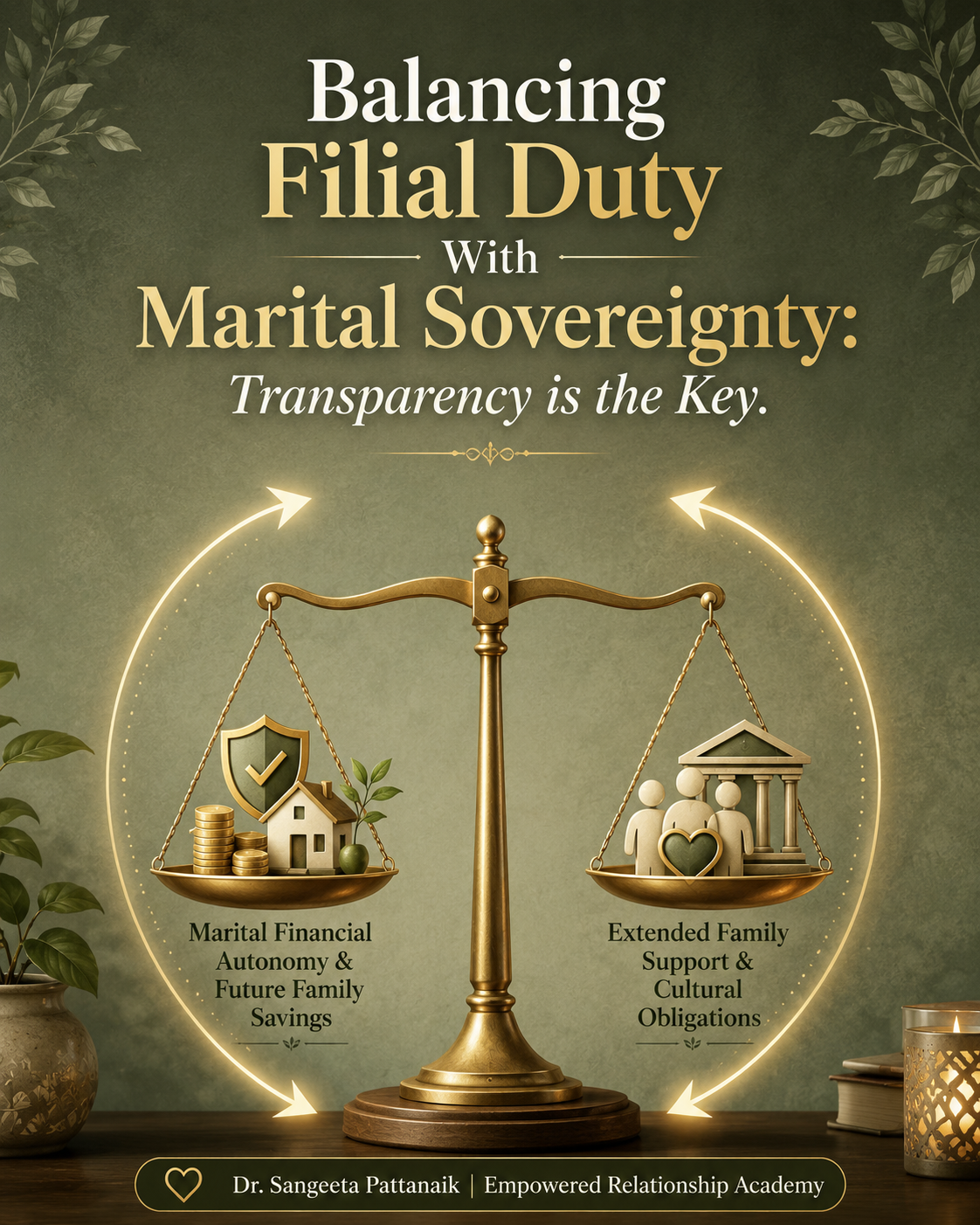
2. Navigating the Indian Ecosystem: Filial Duty vs. Marital Sovereignty
While financial stress challenges couples across the globe, managing money within the Indian cultural landscape introduces complex relational layers that traditional Western psychology books completely ignore. In India, a marriage is rarely just an isolated economic partnership between two individuals; our wallets are deeply entangled with extended family obligations, generational expectations, and sacred cultural duties.
The Friction of Extended Family Support and Filial Duty
In traditional Indian family structures, we operate heavily on Filial Duty—the deep moral and cultural obligation to respect, care for, and financially support our parents and elders. Contributing to medical treatments for aging parents, funding a younger sibling’s higher education, or assisting with extended family weddings is viewed as a fundamental badge of honor and family loyalty.
However, when two individuals marry, a severe psychological friction frequently erupts around these family financial outflows:
The Unspoken Filial Script
A husband or wife may routinely send significant portions of their monthly salary to their parents or siblings without consulting their spouse, operating under the internalized belief that "my family's needs always come first."
The Marital Eclipse
The receiving spouse sitting across the table feels ignored, devalued, and financially unprotected. They silently wonder: "When do our children’s college funds or our own retirement savings become the priority? Why are my hard-earned rupees being given away without my consent?"
In my therapy room, I remind couples of a fundamental structural truth: Honoring your parents and building unbreakable financial security for your marriage are not mutually exclusive. You do not have to choose between being a loving child and a loyal spouse. However, once you take marriage vows, your primary financial fiduciary duty—your legal and moral obligation to protect—shifts to your spouse and your children.
The Clinical Solution: To eliminate resentment, any substantial financial support extended to extended family must be transformed from a secret, unilateral decision into a collaborative, transparent line item in your shared family budget. When you discuss family contributions together as a team, giving to your parents transforms from a source of marital betrayal into a shared act of family generosity.
The Modern Dual-Income Reality vs. Traditional Patriarchy
Modern urban India has experienced a magnificent, empowering rise in dual-income marriages where both husbands and wives are ambitious, high-earning professionals. Yet, many urban couples unknowingly attempt to force modern dual incomes into outdated, single-income patriarchal structures.
If a husband expects to maintain unilateral veto power over how his working wife spends her earnings, or if a wife expects her husband to pay 100% of all household bills while her salary remains entirely her private "pocket money," massive, toxic resentment will inevitably accumulate. Financial peace in a modern marriage requires abandoning archaic power dynamics and establishing absolute economic equality, mutual respect, and 100% financial transparency.
3. The Devastation of "Financial Infidelity"
When we hear the word "infidelity," our minds instinctively picture secret romantic affairs, late-night text messages, or physical betrayals. However, as a clinical psychologist, I can assure you that Financial Infidelity can destroy the emotional foundation of a marriage just as swiftly and permanently as a romantic affair.
What Constitutes Financial Infidelity?
Financial infidelity occurs whenever a partner intentionally conceals financial information, lies about money, or engages in secret financial transactions that impact the marital ecosystem. Common manifestations include:
- Maintaining hidden bank accounts, secret credit cards, or undisclosed cryptocurrency portfolios away from your spouse's knowledge.
- Accumulating substantial credit card debt, personal loans, or gambling losses in secret.
- Lending significant sums of money to siblings, friends, or extended family members without telling your partner.
- Systematically lying about the true cost of purchases—hiding shopping bags in the car trunk, altering price tags, or lying about how much a gadget or saree actually cost to avoid a partner's reaction.
Why Secrecy Triggers Clinical Trauma
Why does discovering a secret bank account or hidden debt hurt so viscerally? Because financial infidelity is what clinical therapists classify as an Attachment Injury—a profound emotional wound that occurs when the person who is supposed to be your ultimate safe harbor shatters your trust in a moment of vulnerability.
To the human brain, marriage is a sanctuary of mutual reliance and shared survival. When you discover that your partner has systematically lied looking you in the eye about fifty thousand rupees, your nervous system experiences acute trauma. You are forced to question reality itself: "If they could lie to me so effortlessly about money, what else are they hiding? Am I truly safe sleeping next to this person?"
Healing from financial infidelity requires the exact same clinical protocol as healing from physical infidelity: the offending partner must abandon all defensiveness, practice 100% radical transparency, provide open access to all financial accounts and passwords, and patiently allow the betrayed partner the time and emotional space required to rebuild their shattered trust.
4. A Therapist’s 4 Golden Rules to Have the "Money Talk" Calmly
You cannot avoid financial conversations forever, nor should you want to. To permanently eliminate financial stress in marriage, you must transform how, when, and where you talk about money. Here is your clinical, step-by-step roadmap to conducting peaceful, highly productive financial discussions:
Rule 1: The Timing (Never Talk Money During Stress)
Never attempt to discuss budgets or spending habits when exhausted after a workday or actively staring at an unexpected hospital bill. That guarantees instant amygdala hijacking and severe defensiveness.
The Clinical Solution: Schedule a dedicated "Financial Date Night" once a month in a relaxing, neutral environment—like a balcony over Sunday morning tea or a cozy café. Treat it as a collaborative team meeting, never an audit or courtroom trial.
Rule 2: Master Dr. Gottman’s "Soft Start-Up"
The first 3 minutes determine how a conversation ends 96% of the time. Ban harsh accusations and words like "always" or "never."
Harsh Attack: "You are completely irresponsible! Look at how much you wasted on shopping!"
Soft Start-Up: "I am feeling anxious looking at our credit card bill because our buffer is lower than what feels secure to me. Can we look at our monthly budget together as a team?"
Rule 3: Implement the "Safety Threshold" Rule
Much daily friction stems from adults feeling micromanaged or treated like children needing permission to spend their own earnings.
The Clinical Strategy: Agree upon a specific financial number called your Safety Threshold (e.g., ₹5,000, ₹10,000, or ₹25,000). Either partner is free to spend up to that threshold on personal discretionary items without permission or judgment. For any single purchase exceeding that threshold, both partners must be consulted for a "Two-Yes" agreement.
Rule 4: The "Two-Yes, One-No" Rule for Major Commitments
To prevent one partner from unilaterally endangering the family’s financial security, use this rule for all major investments, property purchases, or loans to extended family.
If both say Yes, it moves forward enthusiastically. If even one says No (or "I feel uncomfortable right now"), the transaction is paused immediately. Neither partner can bully or guilt-trip the other; instead, you explore the underlying psychological fears driving the "No" together.

5. The "Yours, Mine, and Ours" Hybrid Banking Architecture
One of the most practical, everyday questions couples ask me in therapy is: "Dr. Sangeeta, should we merge all our income into one joint bank account, or should we keep our salaries entirely separate?"
From a clinical relationship standpoint, extreme polarization in either direction can generate friction. Total separation can breed a cold, disconnected "roommate mentality" where couples operate as business partners constantly keeping score of who paid for dinner or who bought the groceries. Conversely, forcing 100% joint income pooling can leave independent adults feeling suffocated, stripped of financial privacy, and unable to purchase a simple surprise birthday gift for their spouse without the exact cost appearing on a shared bank notification.
The Clinical Gold Standard: The 3-Account Hybrid Model
For modern couples seeking both intimacy and autonomy, I strongly recommend implementing a 3-Account Hybrid Banking Architecture ("Yours, Mine, and Ours"). Here is exactly how to structure it:
Account 1: The Joint Family Treasury ("Ours")
This is your primary, shared central bank account. Both partners contribute a designated percentage of their monthly income into this treasury (either split 50/50 or proportionally based on salary, e.g., a 60/40 ratio).
What it covers: This account pays for 100% of your collective household necessities: rent/EMIs, utilities, groceries, children’s school fees, medical insurance, family vacations, and shared retirement investments. It represents your systemic unity and collective survival.
Accounts 2 & 3: Personal Discretionary Accounts ("Yours" & "Mine")
What remains of each partner's income after funding the Joint Treasury stays in their individual, separate, private bank accounts. This represents absolute personal freedom and financial independence.
The Iron-Clad Rule: This discretionary money is spent with zero guilt, zero criticism, and zero accounting required to the spouse. If a husband wants a smartwatch or weekend golf trip, or a wife wants designer clothing or brunch with friends, they fund it from their personal account without being monitored or judged.
This hybrid architecture brilliantly satisfies both fundamental human biological needs: it creates unbreakable, rock-solid systemic unity for your family's survival and future wealth, while simultaneously preserving your personal independence, individual identity, and psychological freedom.
6. Reframing Wealth: From Adversaries to Co-Architects of Peace
Let us conclude our journey with a profound, foundational clinical shift: You must immediately stop viewing budgeting as an exercise in restriction and deprivation, and start viewing it as an exercise in collective architectural design.
When you sit down with your spouse to discuss money, you are not acting as cold corporate accountants balancing sterile ledgers. You are two loving co-architects intentionally laying down the foundation for your family’s future freedom, security, and peace of mind.
Every single rupee you collaboratively allocate toward your savings accounts is a protective brick in your family's wall of safety; every rupee you intentionally budget for vacations, date nights, and personal hobbies is a direct investment in your marital friendship and joy.
When you abandon financial secrecy, respect each other’s underlying childhood money scripts, establish transparent hybrid boundaries that honor both family duty and marital sovereignty, and approach your conversations with profound empathy, money completely loses its destructive power to divide you. It transforms from a source of chronic financial stress in marriage into a magnificent, unifying tool that empowers you to build the secure, joyful, and deeply connected life you both deserve.

Take the First Step Before Your Session
Harmonizing your financial lives requires a deep, honest understanding of how you and your partner communicate during moments of stress, disagreement, and vulnerability. Before you can successfully build financial transparency and eliminate stress, you must clearly understand the present emotional foundation of your marriage.
Before making assumptions about your relational dynamics around money, I invite both of you to take this quick, scientifically structured self-assessment. It will immediately map your communication patterns and reveal exactly where your connection needs the most support as you navigate financial discussions together.
Take the Next Step
The Emotional Invisibility Score™
Discover How Seen, Valued & Emotionally Connected You Feel In Your Relationship.
This 2-minute assessment calculates your emotional connection health and reveals the hidden emotional gaps in your marriage. Gain immediate clarity on your relational baseline today.
Discover Your Score NowTakes 2 Minutes • 100% Confidential • Instant Results
Frequently Asked Questions About Financial Stress in Marriage
Why do couples fight so bitterly over money?
Financial fights are rarely about simple math. Money triggers the brain's amygdala (the survival alarm system). When couples argue over spending or saving, they are fighting over underlying "Money Scripts"—subconscious childhood beliefs about whether money represents security, freedom, status, or love. When these scripts clash, partners feel their biological safety or independence is being threatened.
What is a "Money Script" in psychological terms?
Coined by Dr. Brad Klontz, a Money Script is an unconscious core belief about money formed in early childhood. The four main scripts are: Money as Security (vigilant saving to feel safe), Money as Freedom (spending to unlock experiences and autonomy), Money as Status (spending to gain social validation), and Money as Love (using generosity to secure attachment or fulfill family duty).
How should couples manage bank accounts in marriage?
The clinical gold standard is the "3-Account Hybrid Model" (Yours, Mine, and Ours). Both partners fund a central Joint Family Treasury ("Ours") proportionally to cover 100% of household bills, EMIs, and savings. The remaining income stays in separate personal accounts ("Yours" and "Mine") for discretionary spending, which is used with zero guilt, monitoring, or judgment from the spouse.
How do we handle financial support for extended Indian family without arguing?
Honoring filial duty to parents and protecting marital security can coexist if secrecy is eliminated. Any financial support extended to parents or siblings must never be a unilateral, secret decision. It should be discussed openly and built into your shared monthly household budget as a transparent line item, transforming family obligations into a collaborative team act of generosity.
Very informative