
Navigating the Brink of Divorce: When Is It Time to Let Go?
Understanding the neurology of relationship burnout, diagnosing if your marriage is truly dead, and finding absolute clarity amidst cultural pressure.
By Dr. Sangeeta Pattanaik | Read Time: 14 Minutes

As a clinical relationship therapist, couples often sit on my couch not with the high-octane fire of rage, but with the quiet, hollow exhaustion of complete apathy. The Husband and The Wife usually come to my clinic after months, sometimes years, of silent suffering. Eventually, one partner looks at me with a profound, terrified vulnerability and asks the question they have been afraid to voice out loud: "Dr. Sangeeta, how do I know if I should get a divorce?"
This is not a simple logistical question. It is an agonizing, life-altering intersection of cognitive logic, primal fear, social conditioning, and unhealed attachment wounds.
For urban Indian couples, this ambivalence is amplified tenfold. The Husband and The Wife are navigating the relentless pressure of hyper-competitive careers, the complexities of children’s education, and the looming, suffocating shadow of societal judgment—Log Kya Kahenge (what will people say?). You feel trapped between two unbearable options: remaining in a connection that erodes your self-worth daily, or facing the terrifying, highly stigmatized unknown of life after separation.
The Ultimate Goal is Clarity
Let me share a master therapist’s secret with you: the ultimate goal of counseling at this agonizing stage is not to force the couple to stay together, nor is it to encourage the couple to leave. The ultimate goal is clarity. If you find yourself obsessively asking, “should I get a divorce?” it is a psychological signal that your internal nervous system is trapped in a constant state of biological alarm.
To move past this paralyzing ambivalence, we must look beneath the surface arguments and analyze the deep psychological reality of your marital bond. Here is a clinical guide to understanding the neurology of relationship burnout, diagnosing whether your marriage is truly "dead," and navigating the Indian cultural layers to find your empowered decision.
1. The Neurology of Ambivalence: Why You Feel Paralyzed
When a marriage reaches the brink of dissolution, the brains of The Husband and The Wife are operating in a state of "Amygdala Hijack" almost constantly. Your logical Prefrontal Cortex, which is responsible for sound decision-making, long-term planning, and rational thought, is essentially held hostage by your brain's fear center.
The State of Biological Alarm
You are flooded with stress hormones like Cortisol and Adrenaline. In this biological state of "fight, flight, or freeze," your brain is not designed for nuanced, complex thought. It is designed solely for immediate survival.
This is exactly why you cannot simply "think" your way through this decision logically. You alternate wildly between moments of fierce independence ("The Wife deserves better than this neglect") and paralyzing terror ("The Husband cannot survive the financial or social ruin of a divorce").
To access true clarity, The Husband and The Wife must first stabilize their nervous systems. You cannot negotiate a peace treaty or a separation agreement while your own brain is preparing for nuclear war. Clarity begins when the nervous system calms down enough for you to stop reacting and start observing.
2. Gottman’s Diagnostics: Is It Comatose or Is It Dead?
I often use the clinical analogy that when a relationship is on life support, we must first determine if the marriage is in a treatable coma, or if it is neurologically dead.
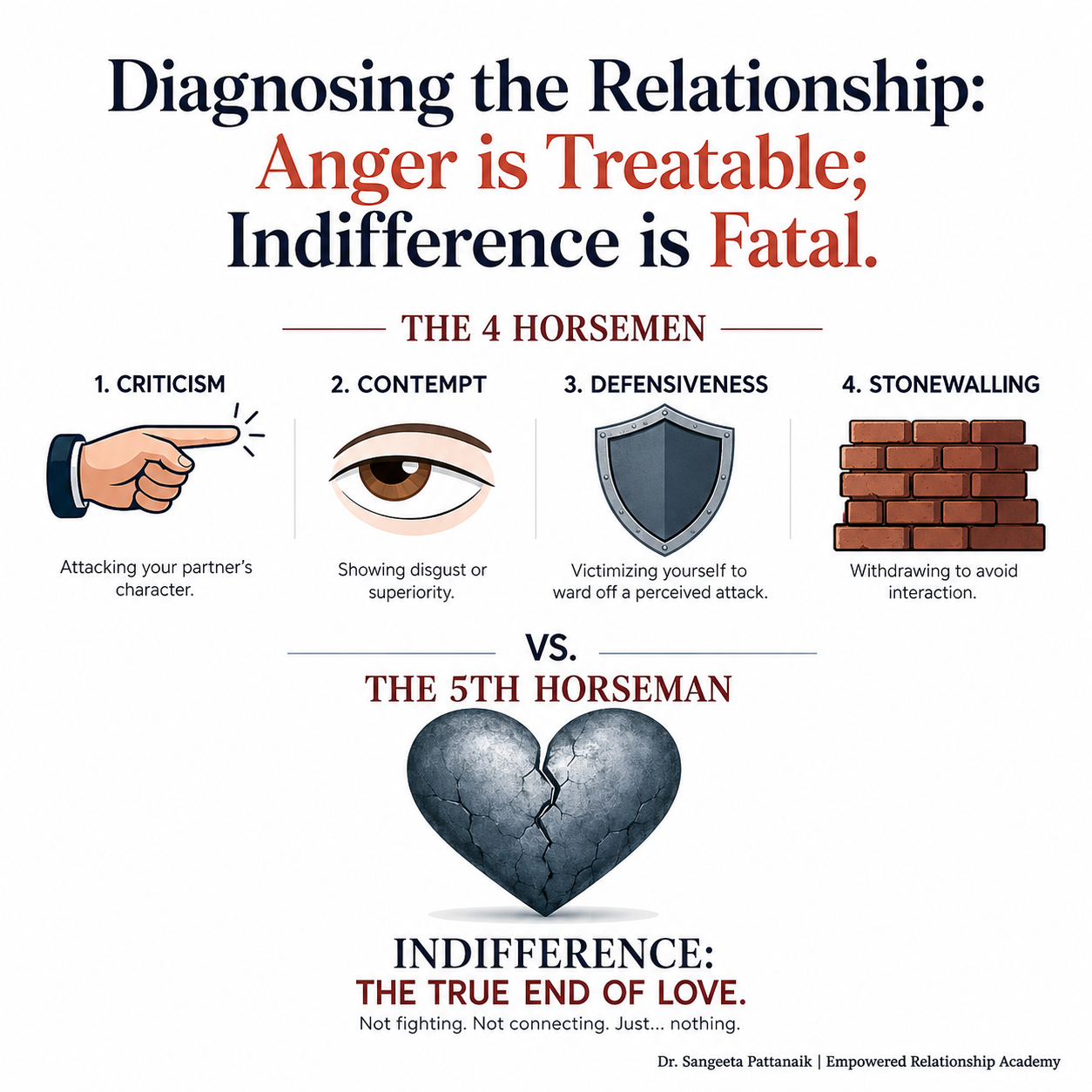
In clinical therapy, we utilize renowned researcher Dr. John Gottman’s concept of the "Four Horsemen of the Apocalypse" as diagnostic tools. If these four communication patterns are present, we predict relationship breakdown with over 90% accuracy:
1. Criticism
Attacking your partner's core character rather than complaining about a specific behavior or event.
2. Contempt
Acting with moral superiority, using sarcasm, mockery, and eye-rolling. (This is the single greatest predictor of divorce).
3. Defensiveness
Playing the innocent victim and refusing to take accountability for your part in the conflict.
4. Stonewalling
Completely withdrawing from the interaction, shutting down, and offering the silent treatment.
However, even if these toxic horsemen are present in the home, if The Husband and The Wife still care enough to be angry, there is often life left to save.
The Threshold of Indifference
The most dangerous psychological state is the threshold that Dr. Gottman did not formally name: The Threshold of Indifference. Hate is not the opposite of love; indifference is. If The Initiating Partner has reached a state where they no longer care to argue, where they feel complete apathy toward their spouse’s whereabouts, and where the idea of the spouse being with someone else elicits profound relief rather than jealousy, the partner has already emotionally detached. Indifference is relationship flatlining.
3. The Cultural Script: Navigating the Indian Ecosystem
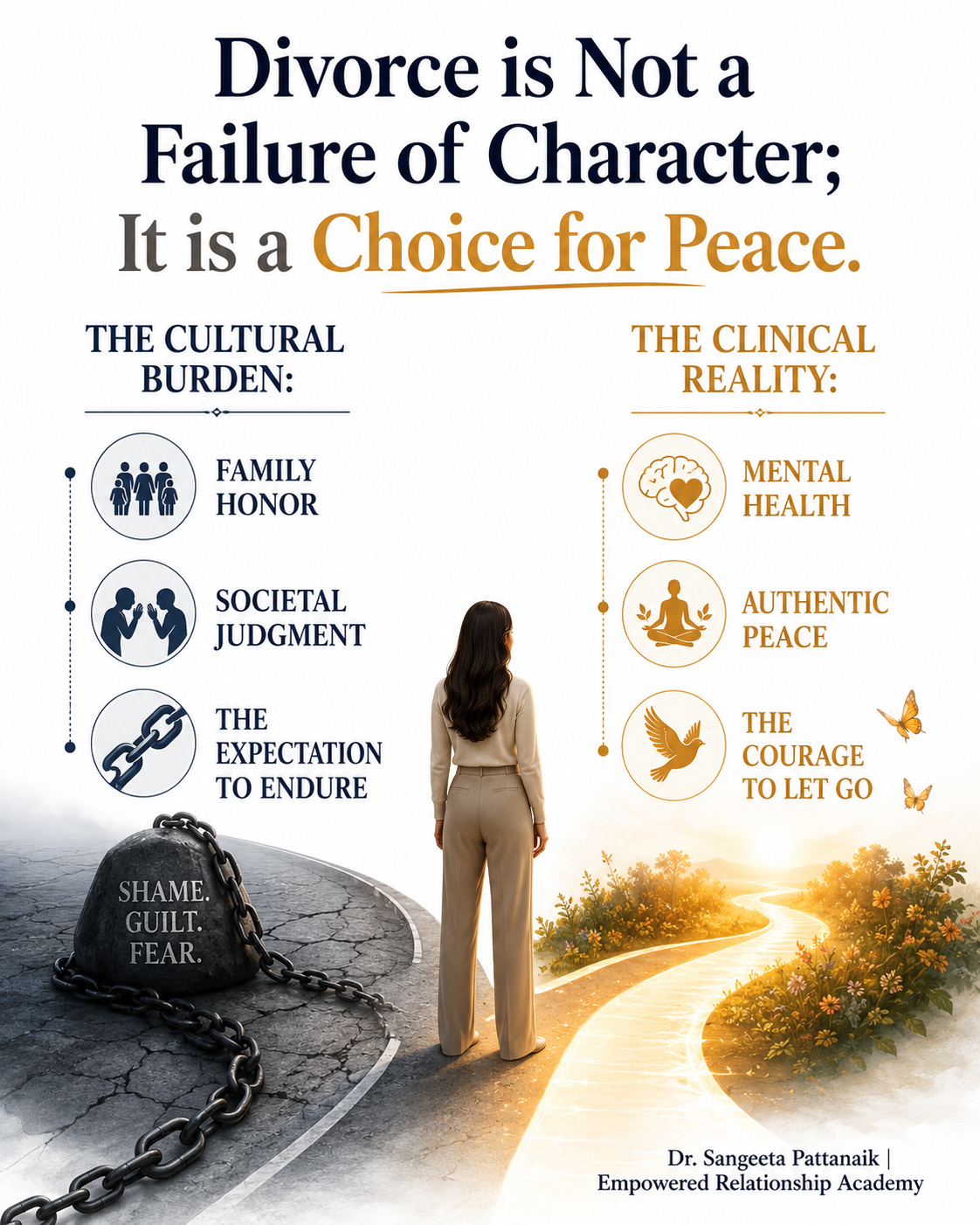
We must courageously acknowledge the deep cultural scripting that amplifies the misery of Indian couples standing on this precipice. You were not just socialized to love; you were socially conditioned to endure.
In traditional Indian conditioning, divorce is framed not as a deeply personal choice for mental health, but as a massive social failure. It is viewed as a failure of family honor, a failure of dharma (duty), and especially for women, a failure of personal character.
Breaking the Silence of Suffering
Urban, educated Indian couples today are the transitional generation. The Husband and The Wife were raised with a childhood blueprint for a traditional, hierarchical marriage (where conflict is buried and family image is paramount), but the couple is actively attempting to live in a modern, egalitarian partnership of mutual respect and career equity.
This culture-clash often detonates inside the therapy room. The Reluctant Partner might say, "My parents told me to just tolerate the emotional distance because at least the marriage looks perfect from the outside." The threshold for silent suffering in our culture is dangerously high.
Reframing this paradigm is essential. Asking the question “should I get a divorce?” is not an admission of moral failure. It is a profound, courageous act of claiming agency over your individual well-being. It is acknowledging that a shared family legacy cannot be built on individual misery. Sometimes, honoring the connection means having the courage to release it before it mutates into toxic contempt.
4. The Path to Clarity: Steps Before the Final Decision
Ambivalence is excruciating. It feels like a persistent, low-grade fever of the soul. If The Husband and The Wife are stuck in this painful gray area, you must not force a definitive choice while your nervous systems are neurologically flooded. Clarity is rarely found through impulsivity.
Discernment Counseling vs. Traditional Marriage Therapy
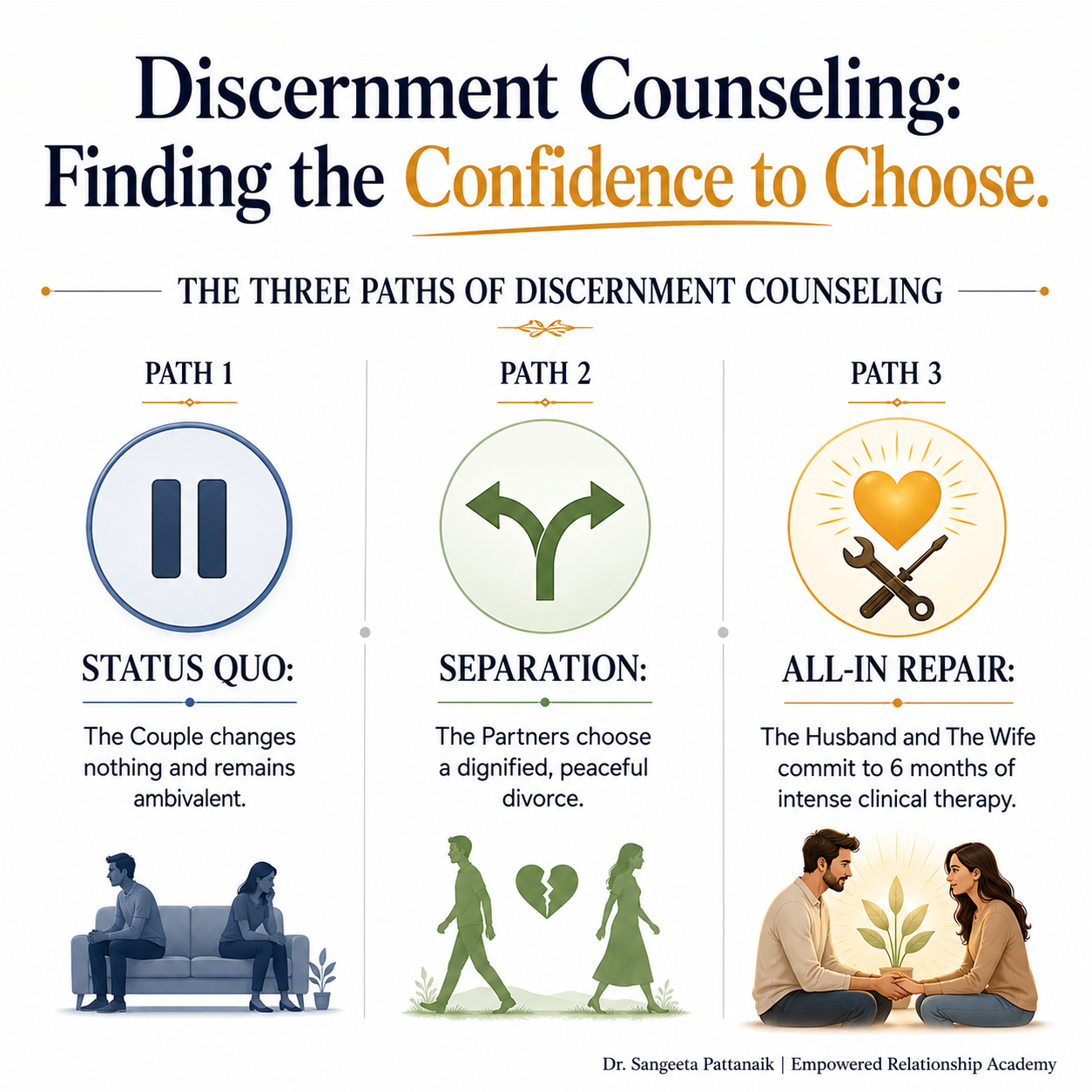
When couples are on the brink, traditional marriage therapy (which requires two partners fully committed to active skill-building) often fails. If The Initiating Partner has "one foot out the door" and The Reluctant Partner is desperate to hold on, the couple does not need marriage counseling; the couple needs Discernment Counseling.
Discernment Counseling is a specialized clinical model with one goal:
- It does not aim to save the marriage.
- It does not aim to guarantee a divorce.
- Its sole objective is to help The Husband and The Wife move from paralyzing ambivalence to absolute clarity and confidence about a path forward—whether that path is a peaceful separation, or committing to a six-month intensive repair track.
Identify the "Pursuer-Distancer" Trauma Trap
Often, the couple is not actually fighting each other; The Husband and The Wife are fighting their partner’s unhealed childhood triggers.
The Pursuing Partner
Responds to relationship stress by clinging tighter, demanding reassurance, and asking urgent questions due to a primal fear of abandonment.
The Distancing Partner
Responds to relationship stress by shutting down, going quiet, and withdrawing due to a primal fear of suffocation and criticism.
Clarity frequently emerges when The Initiating Partner realizes they aren't married to a "monster," but to another traumatized human being whose biological defense mechanisms deeply trigger their own.

Transitioning With Dignity
Let us conclude with an empowering clinical truth: Ending a marriage is not inherently an act of hostility; it can be an act of profound self-preservation and mutual respect.
Sometimes, the ultimate act of dignity The Husband and The Wife can show the partnership they once cherished is releasing it before it causes irreparable psychological damage to their souls or their children. If you decide to let go, you are not failing at a shared love. You are fighting for the clarity, safety, and psychological survival of your own individual peaceful futures.
Effective conflict resolution tools are not just for couples staying together. They are equally vital for a strategic, compassionate transition into effective co-parenting or dignified individual freedom.
If you are constantly asking “should I get a divorce?”, understand that the path through this pain is not endurance; the path is absolute clarity.
Take the First Step Toward Clarity
The Emotional Invisibility Score™
Discover How Seen, Valued & Emotionally Connected You Feel In Your Relationship.
Ambivalence is the most exhausting state for a marriage. Before The Husband or The Wife can decide if they should leave, the couple must first understand why they feel so desperately invisible to one another. Before you make a final, life-altering choice, I invite both partners to take this quick, scientifically structured self-assessment. It is designed to expose the hidden emotional architecture of your marriage and help you find the cognitive clarity required for your courageous next step.
Discover Your Score NowTakes 2 Minutes • 100% Confidential • Instant Results
Frequently Asked Questions About Divorce and Marriage Clarity
How do I know if my marriage is truly over or if it can be saved?
Therapists look at the "Threshold of Indifference." If you are still fighting and angry, there is often emotional energy left to save the marriage. However, if you have reached complete apathy—where you no longer care to argue, you feel relief at the idea of your spouse leaving, and you are emotionally detached—it is a strong clinical signal that the marriage has flatlined.
What is Discernment Counseling?
Unlike traditional marriage counseling that actively tries to fix the relationship, Discernment Counseling is a specialized, short-term process for couples on the brink of divorce. Its sole goal is to help an ambivalent couple achieve absolute clarity on whether to move toward a peaceful separation or commit to an intensive, six-month repair track.
Why do I feel so paralyzed when trying to decide on a divorce?
This paralysis is caused by an "Amygdala Hijack." Your brain views the loss of the marriage as a severe survival threat, flooding your body with cortisol and adrenaline. This shuts down your Prefrontal Cortex (your logical decision-making center), making it biologically impossible to think clearly. You must regulate your nervous system before you can make a rational choice.
What are the Four Horsemen in a marriage?
Identified by Dr. John Gottman, the Four Horsemen are toxic communication patterns that predict divorce with high accuracy: 1) Criticism (attacking your partner's character), 2) Contempt (acting with moral superiority or disgust—the deadliest predictor), 3) Defensiveness (playing the victim), and 4) Stonewalling (withdrawing and giving the silent treatment).