
The Mental Load of Marriage: Why “Helping” Your Partner Is Not the Same as Sharing Responsibility
The hidden psychological burden behind many arguments about housework, childcare, planning, and “Why do I have to ask you?”
Dr. Sangeeta Pattanaik

A marriage can look equal from the outside and still feel deeply unequal to one partner. You may both work. You may both contribute financially. You may both do household chores. You may both love your children.
That feeling is at the heart of the mental load of marriage. Mental load is not simply about doing things. It is about carrying the responsibility of remembering, anticipating, planning, coordinating and monitoring what needs to happen.
A recent study examining mental-load distribution in heterosexual couples specifically distinguished mental load from household task performance and examined its relationship with relationship and sexual satisfaction.
The important question is therefore not simply:
“Who does more work?”
It is:
“Who feels responsible for making sure everything works?”
What Is the Mental Load of Marriage?
Mental load refers to the cognitive responsibility involved in managing everyday family life. It includes noticing what needs to happen, remembering it, deciding when it needs to happen, planning how it will happen, and making sure it actually happens.
For example, taking a child to the doctor is a physical task. But remembering the appointment, checking the timing, arranging transport, carrying previous reports, remembering medication, and planning what needs to happen afterward are parts of the mental load surrounding that task.
The physical task may take 30 minutes. The mental responsibility may exist for days. That is why counting chores alone cannot always tell us whether responsibility is genuinely shared.
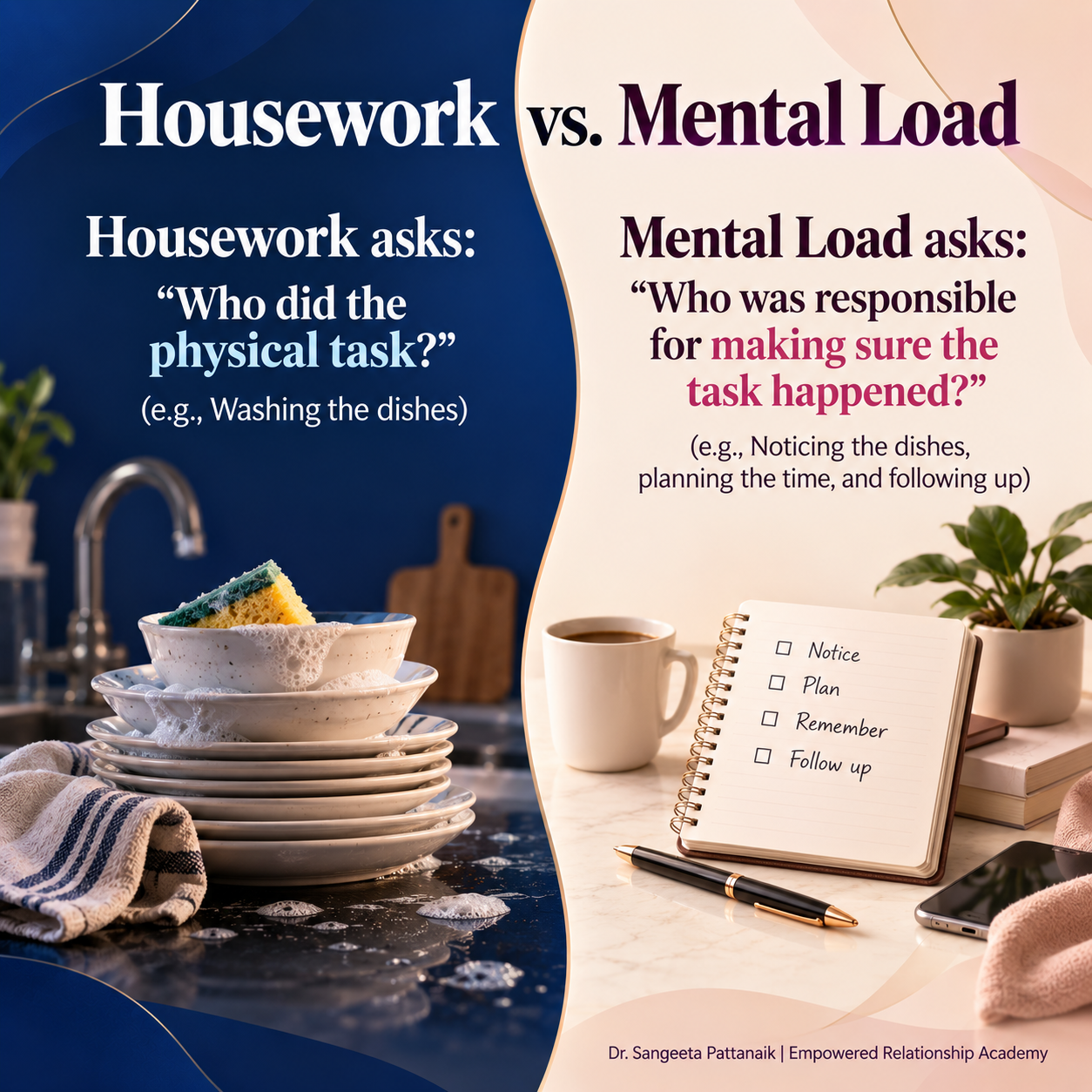
Mental Load Is Not the Same as Housework
This is one of the most important distinctions couples need to understand.
Housework Asks:
“Who did the task?”
Mental Load Asks:
“Who was responsible for making sure the task happened?”
Imagine a husband says: “I wash the dishes whenever my wife asks.” From his perspective, he is helping. But if his wife has to notice the dishes, decide when they need cleaning, remember to ask him, and then follow up, she may still feel that she is carrying the responsibility. The task was shared. The mental ownership was not.
“Just Tell Me What to Do”
There is nothing inherently wrong with offering help. But when it becomes the permanent structure of a relationship, one person remains responsible for identifying the work while the other waits for instructions. This creates an invisible hierarchy: Manager → Task Receiver instead of Partner → Partner.
Two Capable Adults Can Slowly Become “Manager + Dependent”
A healthy partnership ideally involves two capable adults working together. Both people notice problems, take initiative, make decisions, and take ownership. But if one partner repeatedly becomes responsible for organizing and supervising, the relationship can gradually begin to feel like a manager and a dependent.
This dynamic influences several critical areas of a relationship:
Respect
When one partner constantly reminds and supervises, they may stop experiencing their spouse as an equal adult. The thought becomes: “Why do I have to tell another adult everything?”
Appreciation
A partner carrying invisible responsibility feels unseen ("Everyone notices what I do only when I stop"). A painful mismatch between contribution and recognition occurs.
Emotional Closeness
Closeness is difficult when your mind is occupied with "What needs to happen next?" It's hard to relax into feeling taken care of.
Sexual Attraction
It is psychologically difficult to move from “I have to manage you” to “I desire you.” Unresolved responsibility dynamics heavily impact intimacy.
Frustration
The tenth reminder isn't about the chore; it’s evidence that the burden is entirely yours. The deeper emotion is: “Why am I always the person who has to remember?”
Autonomy
The manager becomes exhausted, and the dependent becomes passive. Neither gets the experience of functioning as an equal adult within the relationship.
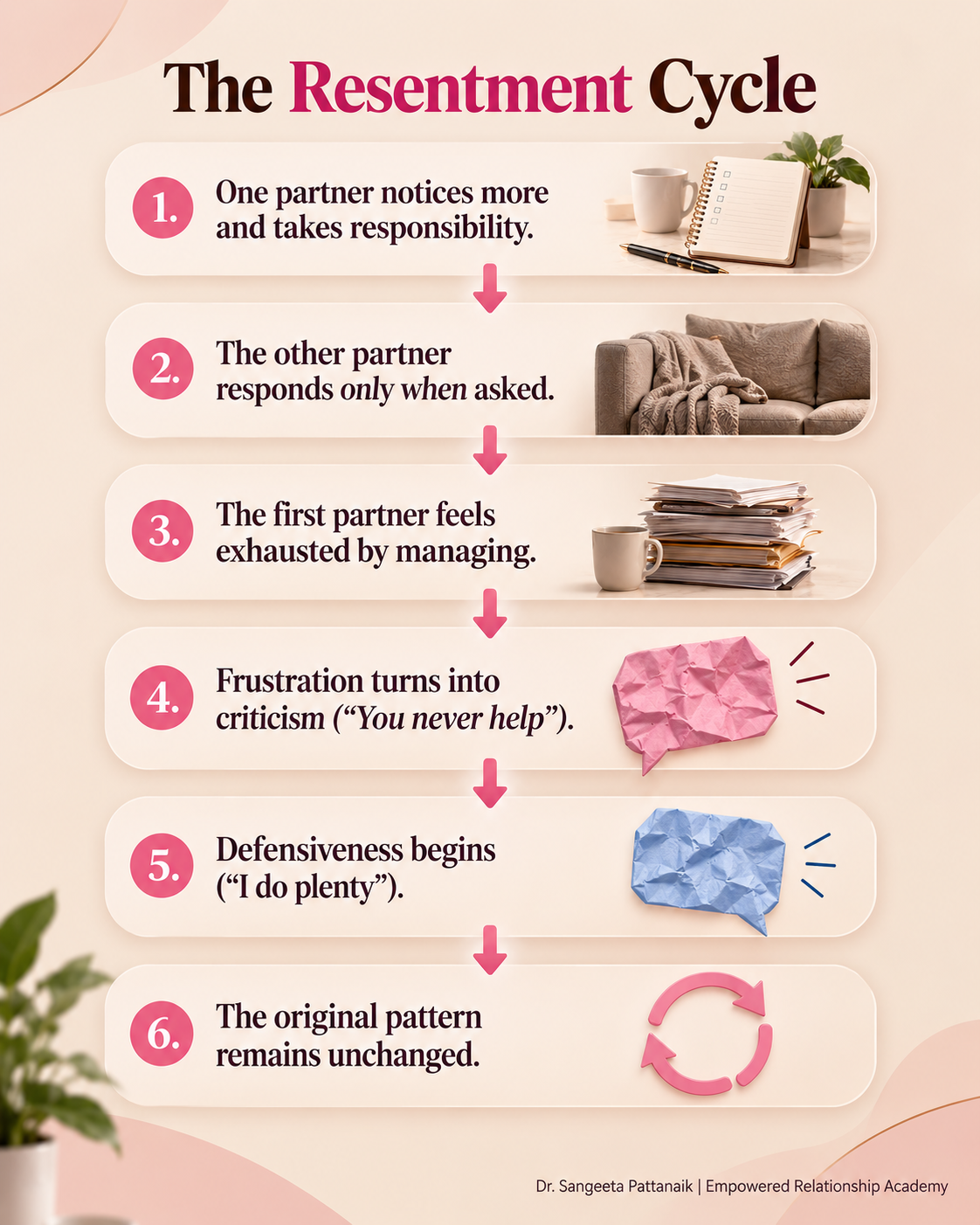
The Resentment Cycle
Resentment usually develops through accumulation rather than one dramatic event. The problem is not simply “I did this task.” It becomes: “I keep carrying responsibilities that I thought we were supposed to carry together.”
Why “You Never Help” and “I Always Help” Can Both Feel True
One partner is measuring Initiative and mental responsibility. The other is measuring Completed tasks. Both are reporting their experience honestly, but using different definitions of contribution. This is why couples must ask: “What exactly are we each counting as responsibility?”
The Invisible Work & Emotional Labour
The Invisible Work
Consider a school project. One parent sits for an hour to build it. The other remembered the deadline, bought materials, planned the evening, and monitored progress. The first contribution is visible; the second is hidden cognitive work. Neither is unimportant, but counting only physical execution hides the mental load.
Emotional Labour
Mental load extends to emotions: noticing a partner’s bad day, a child’s mood, or family disconnect. When one person constantly monitors the family's emotional atmosphere, the experience becomes: “I have to ask you to care.” This is deeply exhausting.
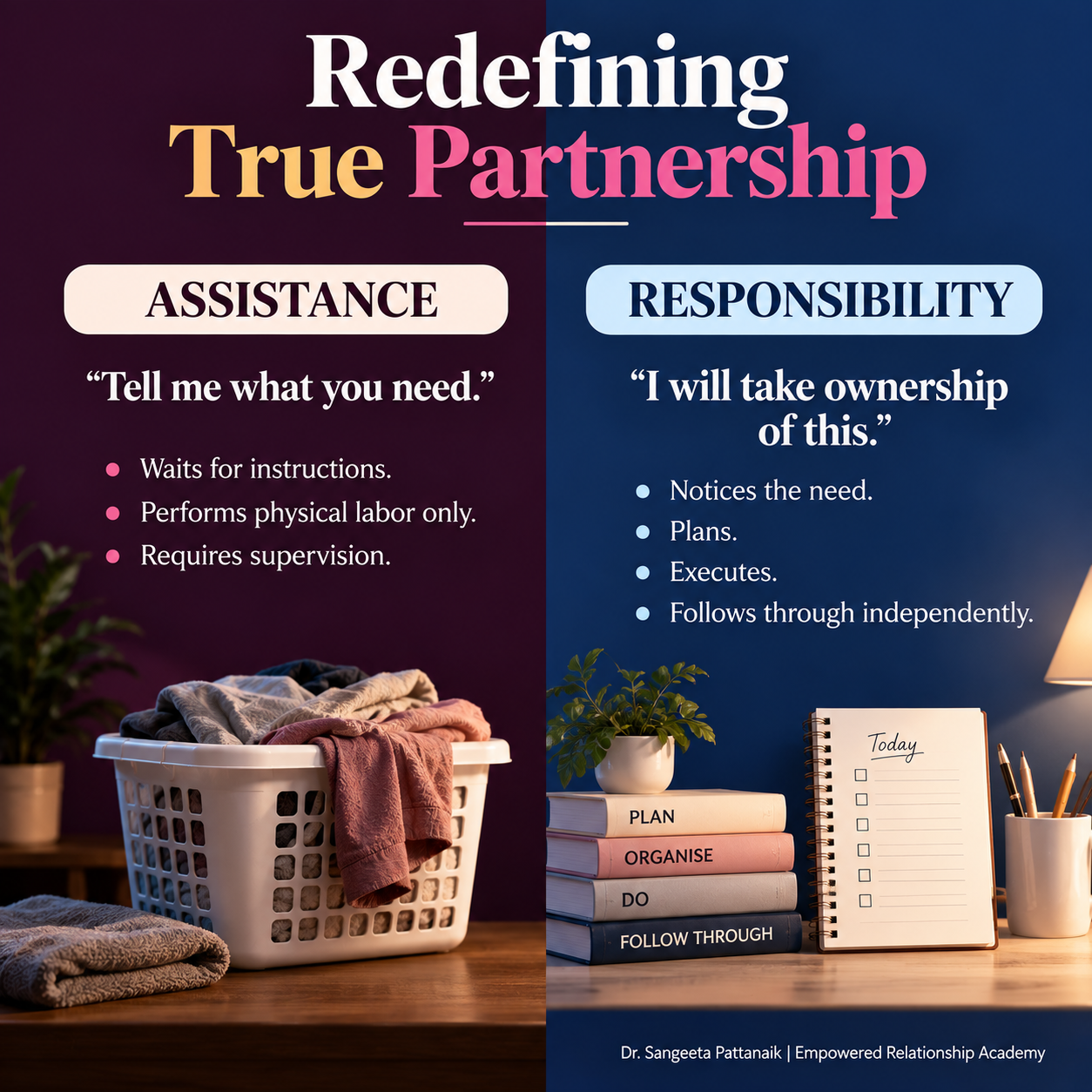
Responsibility vs. Assistance
There is a major psychological difference between these two approaches to a shared life:
Assistance
"Tell me what you need."
The person performs a task, but someone else remains responsible for identifying and managing it.
Ownership
"I will take ownership of this."
The person is responsible for noticing, planning, executing, and following through. The partner doesn't have to carry it in their head anymore.
What Couples Can Do to Reduce Mental Load
The answer is not a rigid 50/50 split. A better goal is: Shared responsibility, clear ownership, and sustainable fairness.
A Simple Mental-Load Audit
Ask each partner these questions separately. It reveals something a chore chart cannot: Who is carrying the responsibility inside their head?
- Who usually notices? First realizes something needs doing.
- Who usually remembers? Keeps it in their mental awareness.
- Who usually plans? Decides how and when it will happen.
- Who usually initiates? Starts the process without being asked.
- Who usually follows up? Checks whether it was actually completed.
- Who worries when it isn't done? Experiences the emotional consequence.

Final Takeaway
A healthy marriage does not require exactly 50% task execution. It requires both people to experience the relationship as a shared responsibility. The difference between “I help you” and “I own my share of our life” is monumental.
Genuine partnership is not having someone who helps when asked. It is having someone who recognizes: “This is our life. This is our responsibility. And we are in it together.”
Is Mental Load Creating a Crisis?
If mental load has led to chronic resentment, loss of affection, or feeling trapped in a parent-child dynamic, it deserves professional attention. Discover your baseline connection today.
Take Relationship Assessment