
What is Codependency? Signs You Might Be Losing Yourself (and How to Break Free)
Navigating the psychology of self-loss, Indian cultural conditioning around self-sacrifice, and how to reclaim your autonomy without destroying your bond.
By Dr. Sangeeta Pattanaik | Read Time: 15 Minutes
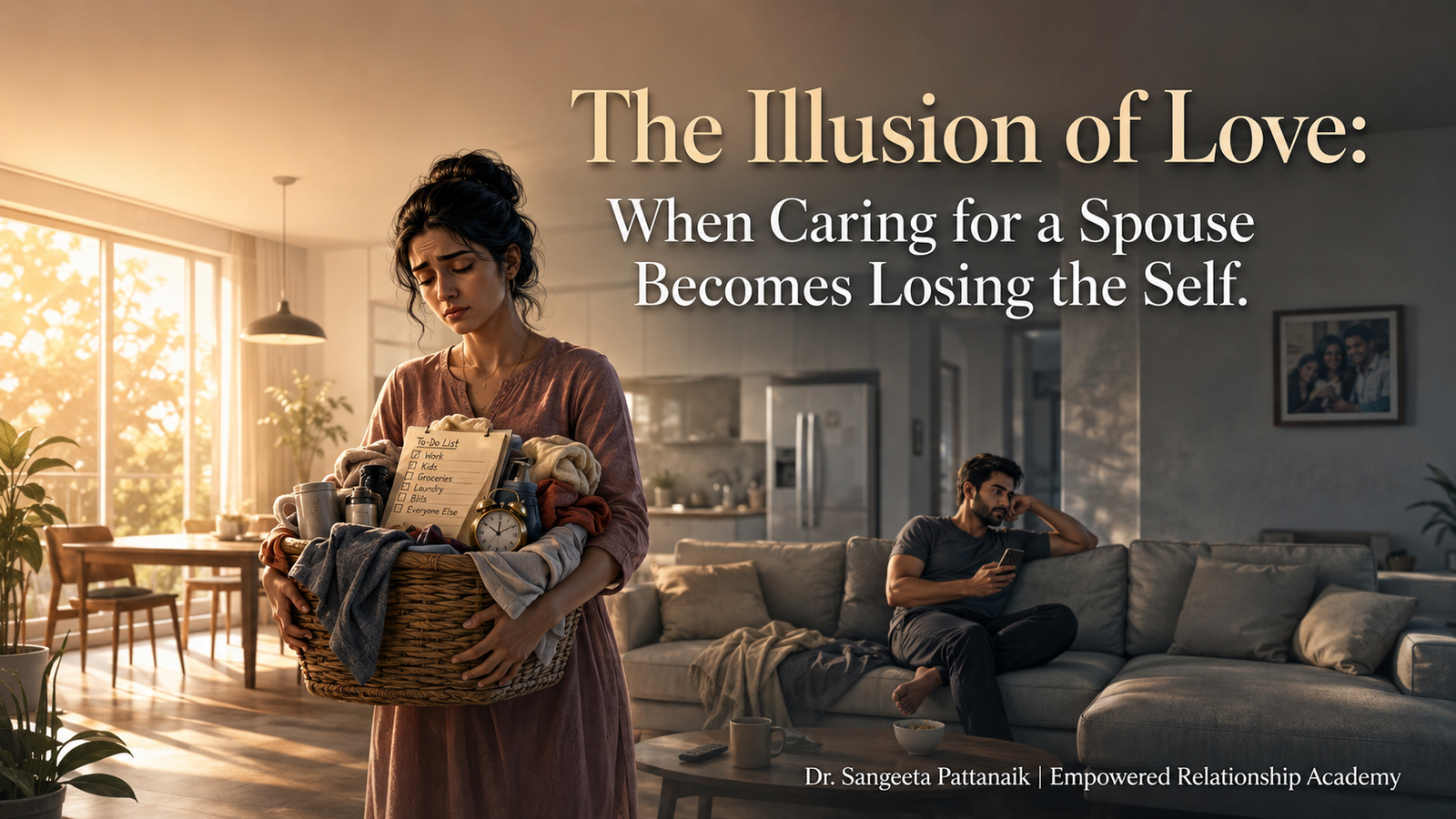
In our deeply rooted Indian culture, self-sacrifice is frequently elevated as the absolute highest expression of love. From our earliest childhoods, we are regaled with stories of devoted spouses and self-effacing partners who abandon their personal dreams, ignore their emotional boundaries, and endure silent exhaustion to keep their family systems intact. We are conditioned to believe that true marital devotion means saying, "My life is nothing without you, and I will fix all your problems at the cost of my own peace."
Dismantling the Romanticized Myth
As a clinical relationship therapist, I must gently dismantle this romanticized myth: There is a profound, life-altering difference between healthy devotion and psychological self-destruction. When your entire identity, emotional stability, and self-worth become completely consumed by your partner's moods, problems, and validation, you are not experiencing authentic love. You are trapped in a psychological dynamic known as codependency.
In an enmeshed relationship, you gradually disappear into the background of your own life. You become an emotional sponge, absorbing your spouse's anxieties while neglecting your own basic human needs. If you constantly feel drained, hyper-vigilant about keeping the peace, and unsure of who you are outside of your marriage, it is critical to recognize the signs of codependency.
Let us explore the deep clinical psychology behind why we lose ourselves in our relationships, examine how Indian cultural scripting masks this dynamic as "nobility," and build a step-by-step roadmap to reclaim your autonomy without destroying your bond.
1. What is Codependency? (The Psychology of Self-Loss)
In clinical psychology, codependency is defined as a dysfunctional relational pattern where one individual assumes the role of the chronic "rescuer" or "caretaker," excessively relying on their partner for approval, self-worth, and emotional identity.
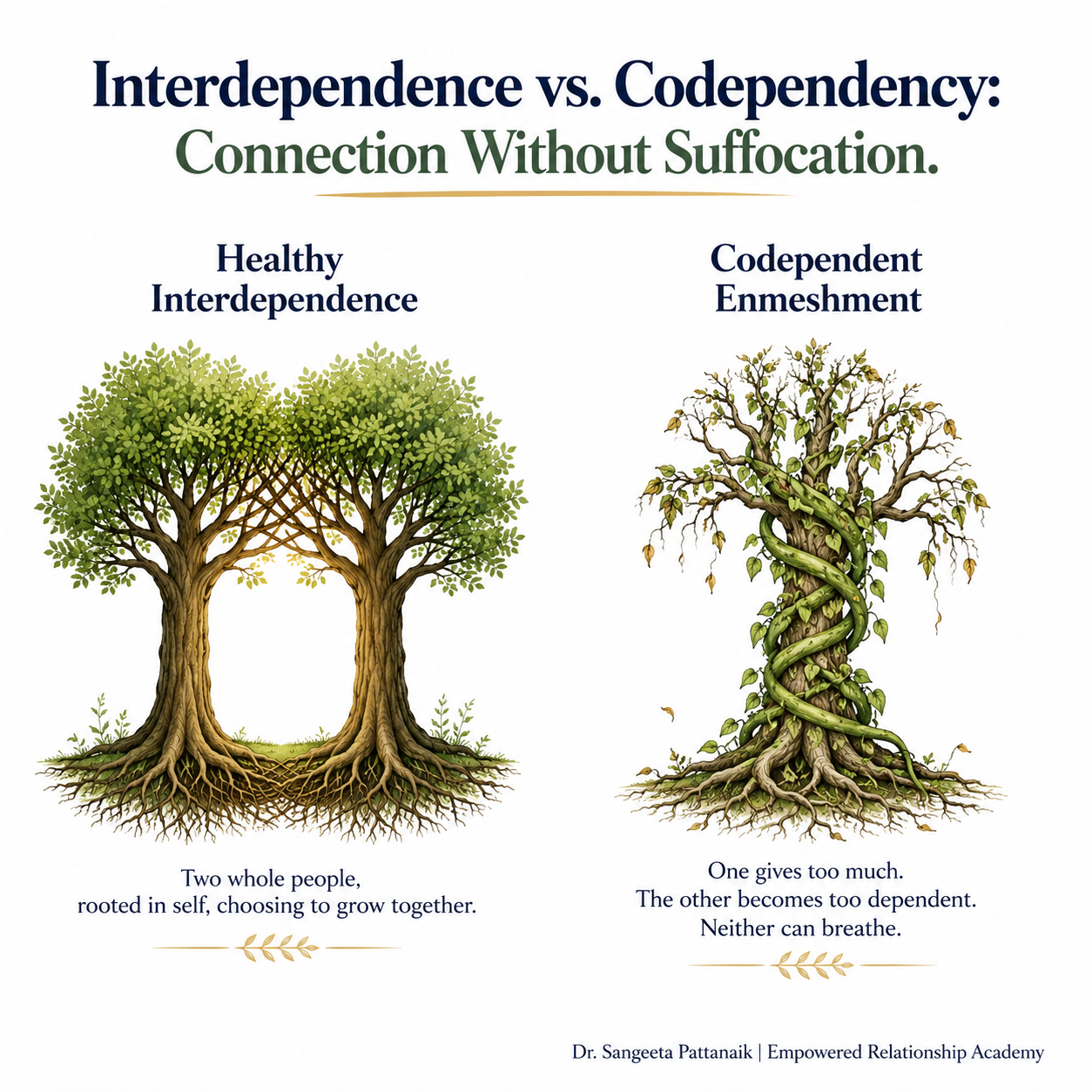
To truly grasp this concept, we must differentiate between two fundamentally opposite relationship models:
Healthy Interdependence
Two Autonomous Partners
Two whole, autonomous individuals choose to share their lives together. They rely on one another for mutual support, affection, and companionship, but their core identities remain distinct. If one has a difficult day, the other offers empathy, but their personal emotional foundation does not collapse. Both maintain separate hobbies, personal friendships, and individual boundaries.
Codependent Enmeshment
The Caregiver & Dependent Spouse
Personal boundaries completely dissolve, resembling a single psychological entity. The over-functioning partner (The Caregiver) subconsciously believes: "I am only valuable if I am rescuing, fixing, or managing my spouse." If the spouse is angry, anxious, or irresponsible, the caregiver feels an agonizing physiological panic and immediately rushes to fix the situation, enabling negative behavior.
2. The Cultural Trap: Why Codependency Thrives in Indian Marriages
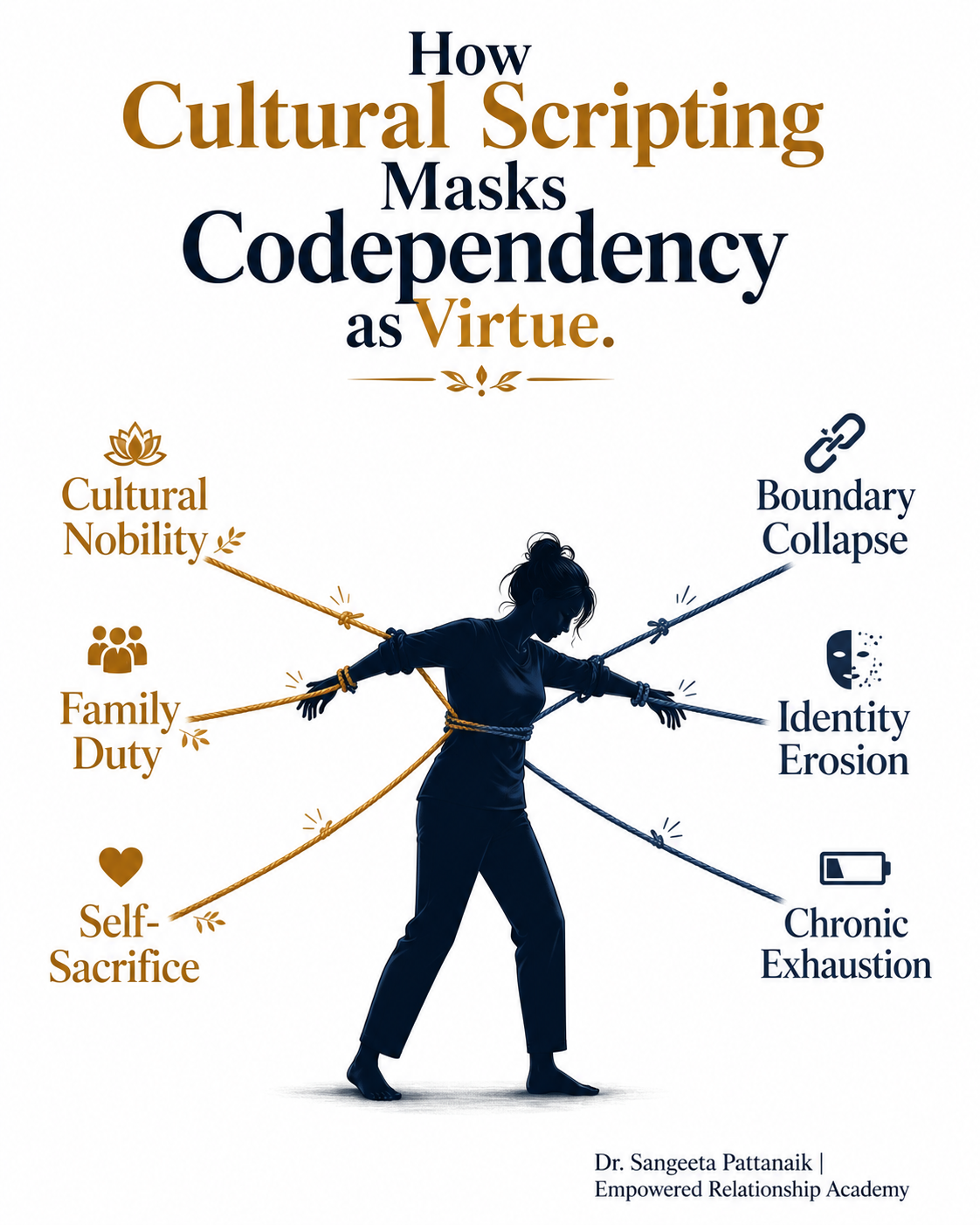
While codependency exists across the globe, it flourishes with unprecedented intensity within the Indian cultural landscape. In many traditional and even modern Indian households, clinical codependency is rarely recognized as a psychological wound; instead, it is actively praised, rewarded, and mistaken for moral nobility.
The Glorification of the Self-Sacrificing Spouse
In our society, women—and increasingly, conscientious men carrying the financial and emotional burdens of extended families—are systematically conditioned to measure their self-worth through self-erasure.
The Script for Wives
A "good wife" is culturally expected to abandon her maiden identity, assimilate entirely into her husband’s family ecosystem, suppress her personal opinions to avoid conflict, and view her husband's success as her sole achievement.
The Script for Husbands
A "dutiful husband" is expected to act as an uncomplaining financial and logistical shield, absorbing relentless extended family pressure and suppressing his own emotional vulnerability to appear strong for everyone else.
When a culture tells you that putting yourself last is the ultimate virtue, setting a basic emotional boundary feels like a selfish act of betrayal. We become terrified of the collective judgment of "log kya kahenge" (what will people say?), leading us to endure emotional neglect, chronic exhaustion, and toxic behaviors just to maintain the external facade of a "perfect, sacrificial partner."
The Confusion Between Love and Enmeshment
In many Indian homes, privacy and individual autonomy are mistakenly viewed as secrecy or rejection. When a spouse asks for quiet alone time to read a book, pursue a solo hobby, or take a solo walk, the family often reacts with suspicion or hurt feelings ("Why do you want to be away from us? Are you unhappy?"). This continuous pressure to share every waking thought, space, and emotion creates severe relational enmeshment, making it almost impossible to tell where one partner’s personality ends and the other partner's begins.
3. Undeniable Signs of Codependency: Are You Losing Yourself?
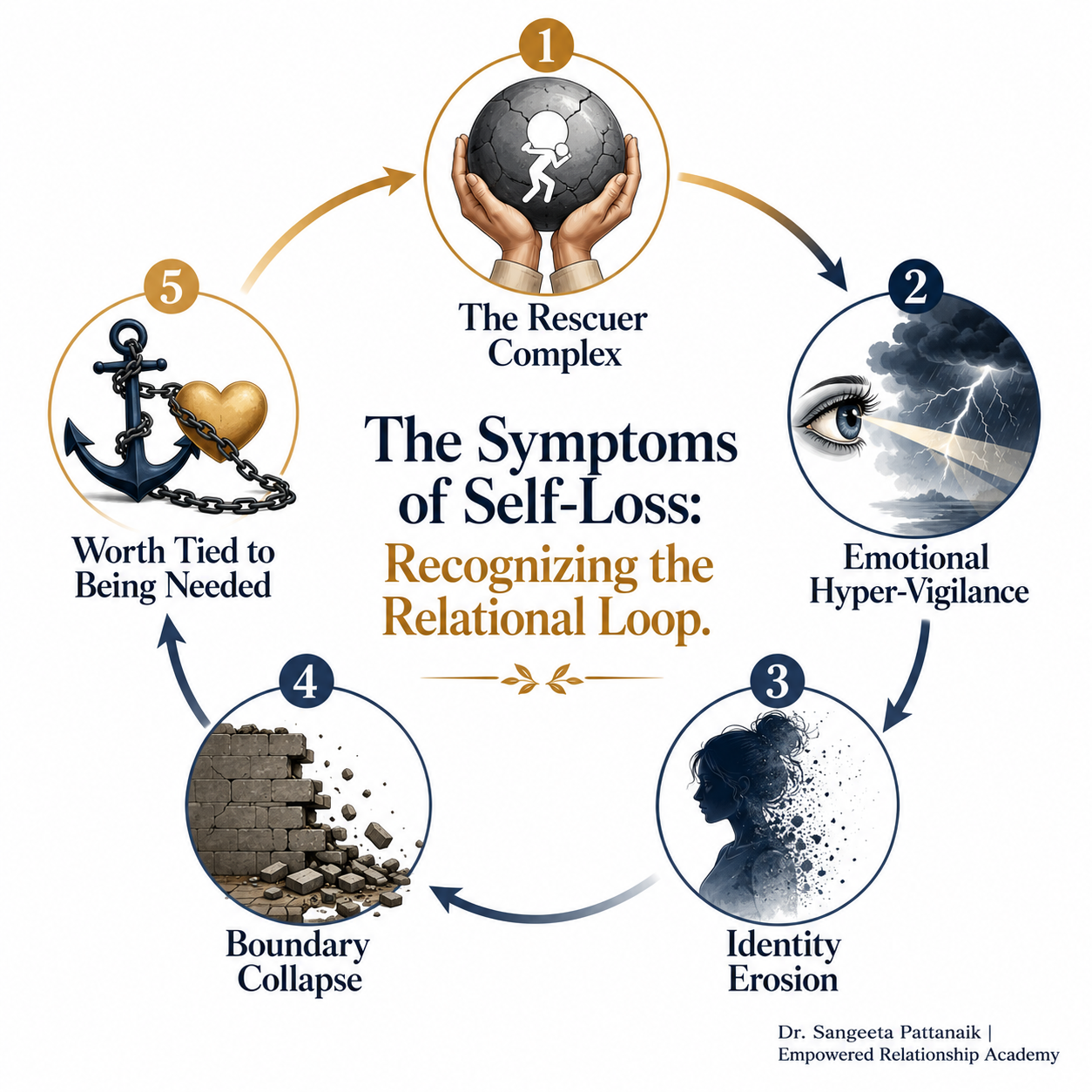
Because codependency develops gradually, you may not realize how deeply entrenched you have become until you experience severe emotional burnout. To evaluate the psychological health of your partnership, examine these five core signs of codependency:
1. The Rescuer Complex
Over-Functioning for an Under-Functioning Partner
You feel a compulsive responsibility to solve your spouse's problems, manage their responsibilities, or shield them from natural consequences. You step in to clean up the mess, mistaking over-functioning for love—not realizing you are robbing them of personal accountability and keeping them permanently dependent on you.
2. Emotional Hyper-Vigilance
The Weather Vane Syndrome
Your internal emotional state is entirely dictated by your spouse’s mood. If they are cheerful, you allow yourself to be happy. If they come home stressed or irritable, your anxiety spikes. You walk on eggshells, constantly monitoring their tone of voice and spinning helplessly in the winds of their moods.
3. Profound Identity Erosion
The Loss of the "I"
If asked about your personal passions outside of family, you respond with a blank stare. Over the years, you have quietly abandoned the music you loved, your nourishing friendships, and your career ambitions. You have merged your entire identity into being a caregiver, feeling a terrifying void when you are not actively caring for someone else.
4. Chronic People-Pleasing
Severe Boundary Collapse
You suffer from a paralyzing fear of conflict or rejection. To keep the peace, you habitually say "yes" when your entire body screams "no." You agree to dreaded social outings, take on exhausting domestic tasks, and tolerate disrespect. When you try to set a minor boundary, overwhelming guilt forces you to back down.
5. Tying Your Self-Worth to Being "Needed"
Beneath the surface of your relentless caretaking lies a deep, unspoken attachment wound: The fear of abandonment. You subconsciously believe that if you are not actively indispensable, useful, and needed by your partner, they will have no reason to love you or stay with you. You derive your entire sense of self-esteem from being the reliable, suffering martyr who holds the family together, making it psychologically terrifying to let your spouse become independent.
4. The Neurobiology of the Fixer: Why Your Brain Craves Being Needed
Why is breaking a codependent pattern so extraordinarily difficult? Why do we continue to rescue, please, and over-function even when our minds and bodies are suffering from chronic exhaustion?
The answer lies inside your autonomic nervous system and brain chemistry. Codependency is not just a behavioral habit; it is a neurological addiction to emotional regulation.
The Dopamine Reward of Being the Rescuer
When you step in to fix your spouse’s crisis, calm their anger, or organize their chaotic life, your brain's reward center releases a surge of Dopamine—the neurochemical responsible for pleasure, satisfaction, and validation. In that brief moment of rescuing, you feel powerful, valuable, and deeply needed. Over time, your brain becomes chemically dependent on this "caretaker high," driving you to unconsciously seek out crises just so you can experience the reward of fixing them.
The Cortisol Spike of Letting Go
Conversely, when you attempt to step back, set a boundary, or allow your partner to face struggles independently, your amygdala interprets this separation as an acute survival threat. Your bloodstream instantly floods with Cortisol (the stress hormone) and adrenaline. You experience genuine physiological withdrawal—a racing heart, tight chest, and catastrophic fears of abandonment. Most codependent individuals abort their healthy boundaries and rush back into rescuing simply to stop this unbearable anxiety.
5. How to Break Free and Reclaim Your Identity: A Therapist’s Roadmap
Reclaiming your identity from the grip of codependency does not mean you must stop loving your partner, nor does it mean your marriage must end. Truly breaking free means transforming your bond from an enmeshed, suffocating trap into a mature, supportive partnership of two whole adults.
Here is your clinical, step-by-step roadmap to overcome the signs of codependency and restore your personal autonomy:
Step 1: Shift From "Rescuing" to "Empowering Support"
You must immediately resign from your self-appointed job as your spouse’s life manager, problem solver, and emotional savior.
The Clinical Pivot: When your partner presents a complaint or crisis, consciously check your impulse to jump in and fix it. Instead of saying, "Don't worry, I will take care of everything for you," practice saying:
"I can see how difficult this situation is for you, and I love you. What do you think your next step should be to solve it?"
This simple pivot transfers the responsibility of problem-solving back onto the adult who owns the problem, demonstrating true respect for their capability while preserving your own mental energy.
Step 2: Reclaim the "I" Outside of the "We"
To rebuild an identity that has been swallowed by marriage, you must intentionally dedicate time, space, and resources to nurturing your individual self.
The Action Plan: Schedule two hours every single week that are strictly reserved for your solo pursuits—entirely disconnected from your spouse, children, and household management. Revisit an old creative passion, join a fitness or dance class alone, read in a quiet park, or nurture friendships that belong solely to you. Your spouse is meant to be a wonderful complement to your life, not the entire perimeter of your universe.
Step 3: Implement the "24-Hour Boundary Pause"
Because your default instinct is to please others and avoid conflict, you must break the automatic "yes" reflex that collapses your boundaries.
The Script: Whenever your spouse, extended family, or friends ask you to take on a burdensome task or sacrifice your personal time, you are strictly forbidden from answering immediately. Memorize this sentence:
"That sounds important. Let me check my schedule and my energy, and I will give you a clear answer tomorrow morning."
Creating a mandatory 24-hour buffer gives your logical prefrontal cortex time to come back online, allowing you to evaluate whether saying "yes" comes from authentic generosity or from a toxic fear of disapproval.
Step 4: Tolerate the Disapproval Anxiety
When you begin setting firm emotional boundaries and stop over-functioning, your system will experience friction. Your partner—who has grown comfortable relying on your endless caretaking—may initially react with confusion, resistance, or guilt-tripping ("You have changed; you don't care about me anymore").
You must develop the emotional stamina to sit with this temporary discomfort without rushing to fix it or apologizing for your boundaries. Remind your nervous system daily: "Another adult's temporary disappointment is not an emergency. My emotional boundaries are the protective framework that keeps my love authentic, sustainable, and free from resentment."

From Self-Loss to Self-Love: The True Foundation of Marriage
Let us conclude our exploration with an absolute, undeniable clinical truth: You cannot build a deeply nourishing, lifelong partnership by setting yourself on fire to keep your spouse warm.
When you strip away the cultural myths that glorify self-erasure, you realize that codependency is not an act of supreme love; it is an act of fear. It is the fear of standing alone, the fear of rejection, and the fear that you are not inherently worthy of love just as you are.
True romantic intimacy is never born from enmeshment, suffocation, or martyrdom. It is created when two distinct, self-reliant, and whole human beings look at each other across a room and say: "I do not need you to rescue me, and I do not need to fix you to feel valuable. I am a complete individual on my own, and from this place of absolute wholeness, I freely choose to share my life with you."
When you recognize the signs of codependency, step out of the exhausting rescuer trap, and dare to reclaim your personal identity, you do not weaken your marriage—you save it. You transform your home from an enmeshed web of anxiety into a magnificent, breathing sanctuary where two separate souls can grow, thrive, and love each other in true, lasting freedom.
Take the First Step Before Your Session
The Emotional Invisibility Score™
Discover How Seen, Valued & Emotionally Connected You Feel In Your Relationship.
Reclaiming your identity from a codependent dynamic requires a clear, objective understanding of how deeply your emotional boundaries have merged with your partner's under stress. Before you can successfully implement new boundaries and stop over-functioning, you must clearly understand the present emotional foundation of your relationship. Before making assumptions about your relational patterns, I invite both of you to take this quick, scientifically structured self-assessment. It will immediately map your communication styles and reveal exactly where your connection needs the most support as you work toward healthy interdependence.
Discover Your Score NowTakes 2 Minutes • 100% Confidential • Instant Results
Frequently Asked Questions About Codependency in Marriage
What is the difference between codependency and healthy interdependence?
In healthy interdependence, two autonomous adults support each other while maintaining distinct personal identities, individual boundaries, and separate hobbies. In codependency (enmeshment), personal boundaries dissolve. One partner assumes the role of a chronic "rescuer," deriving their entire self-worth and emotional stability from managing, fixing, or pleasing their spouse.
Why is codependency so common in Indian marriages?
In Indian culture, self-sacrifice and self-erasure are frequently glorified as the highest moral virtues, especially for wives and dutiful husbands. Setting basic emotional boundaries is often mistaken for selfishness or disrespect. Additionally, the cultural fear of collective judgment ("log kya kahenge") drives partners to endure emotional neglect and over-function just to maintain the external facade of a perfect family.
What are the undeniable warning signs that I am in a codependent relationship?
The five core signs are: 1) The Rescuer Complex (constantly solving your partner's problems and shielding them from consequences); 2) Emotional Hyper-Vigilance (your mood is entirely dictated by your spouse's mood); 3) Identity Erosion (losing touch with your personal hobbies, dreams, and passions); 4) Chronic People-Pleasing (saying "yes" out of fear of conflict); and 5) Tying Self-Worth to Being Needed (fearing abandonment if you aren't indispensable).
How can I stop being codependent without ending my marriage?
You can break free by practicing four clinical steps: shifting from rescuing to empowering support (asking your partner what *they* plan to do about their problems), dedicating two hours a week to solo hobbies outside the marriage, using the "24-Hour Boundary Pause" before agreeing to favors or burdensome requests, and learning to tolerate the temporary anxiety of another person's disapproval without rushing to fix it.