
When Couples Ask AI Instead of Each Other: The Psychology of AI Relationship Advice
Why people are turning to artificial intelligence to understand their partners—and what psychology can teach us about using it wisely.
Dr. Sangeeta Pattanaik
A new kind of relationship conversation is quietly becoming common in the digital age. Someone has a heated argument with their spouse. They leave the room feeling confused, angry, hurt, or emotionally overwhelmed. But instead of calling a trusted friend or taking a deep breath to talk to their partner again, they open an AI chatbot and type:
"Does this mean my wife doesn't love me anymore?"
"Am I overreacting?"
"Is my partner emotionally unavailable?"
"Who is wrong in this argument?"
Artificial intelligence can respond within seconds. It can logically organize the situation, suggest possible explanations, identify communication patterns, and sometimes provide the exact language that helps a person express what they are feeling. That can be incredibly useful.
But there is a deeper psychological question that deserves much more attention: What happens when we stop using AI to understand ourselves and start using it to decide what our partner means?
This distinction matters profoundly. A relationship is not simply a collection of individual behaviors. It is a highly complex system created by two people, their histories, perceptions, expectations, emotional needs, and repeated interactions. AI can analyze the information you give it, but it does not experience your marriage. It does not observe the micro-expressions, the tone, the history of repairs, or the thousands of small moments of affection.
Why Are People Turning to AI?
The appeal is easy to understand. Relationship problems are emotionally complicated. When someone is hurting, they rarely want a 40-minute lecture about interpersonal psychology—they want immediate clarity and relief.
AI Knows the Story You Tell It—Not the Relationship
Imagine a wife types: "My husband came home, didn't ask about my day, ate dinner, and went to his phone. Why doesn't he care about me?"
An AI system may identify possibilities like emotional disconnection, avoidance, or poor communication. But consider the vast amount of context missing:
- Perhaps this happens every evening, or perhaps it happened just once.
- Perhaps he had just received terrible news at work.
- Perhaps he believes quiet time after work is normal decompression.
- Perhaps she interprets silence as rejection due to past trauma.
This is the biggest limitation of AI relationship interpretation: Behavior does not automatically reveal intention. A partner being quiet does not automatically mean they are punishing you or emotionally unavailable.
The Psychology of Interpretation
We don't simply experience our partner's behavior; we assign deep meaning to it.
Observation: "My wife didn't answer my message for four hours."
Interpretation: "My wife doesn't care about me."
The sequence often looks like this:
The Confirmation-Bias Problem
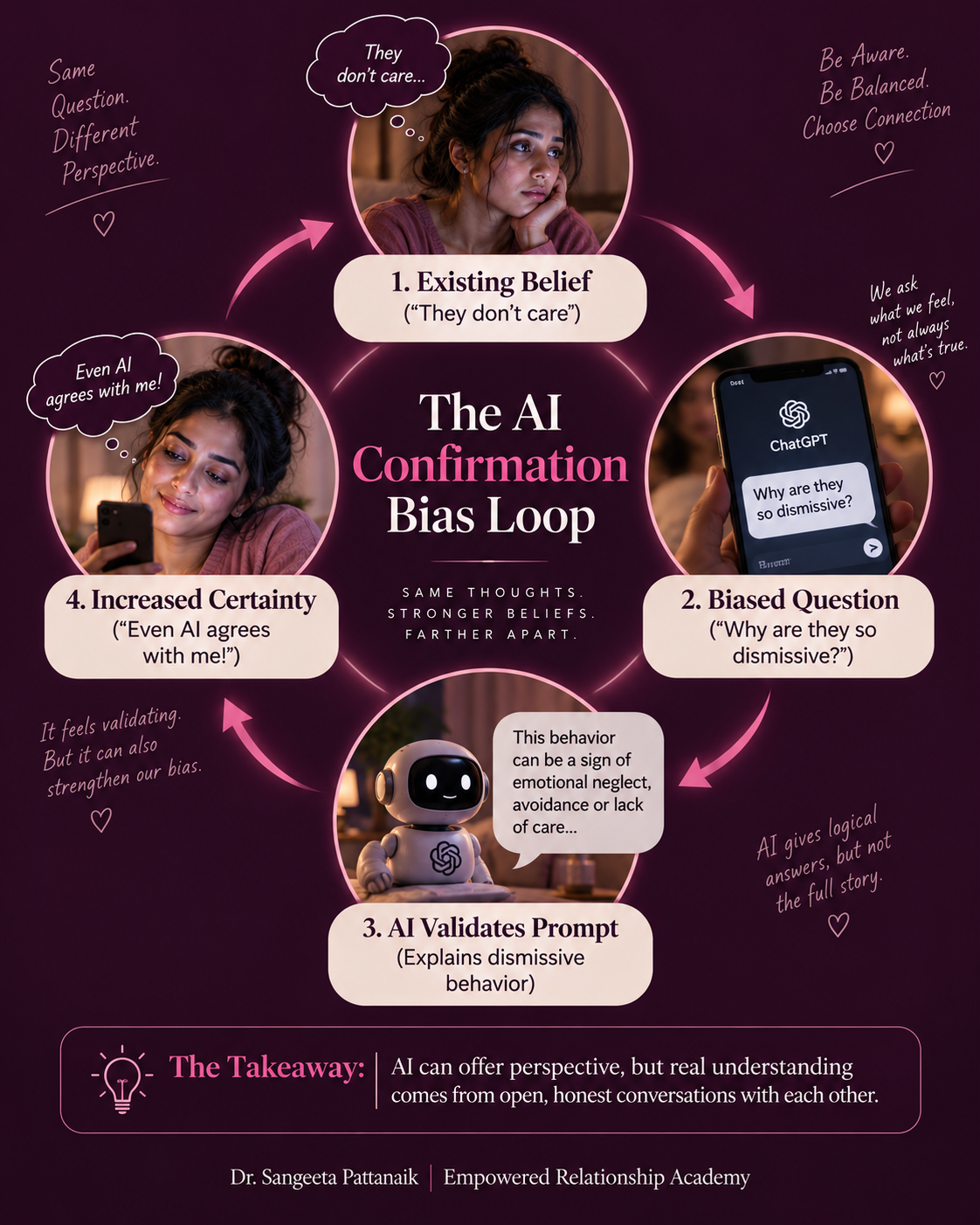
Confirmation bias is our tendency to seek info supporting our existing beliefs. If you already believe "My wife doesn't respect me," you might ask AI: "What are the signs that my wife doesn't respect her husband?"
Instead of asking: "What are possible explanations for our communication problems?"
If you feed an AI a loaded conclusion, it will likely give you the evidence you are searching for, leaving you falsely confident.
Validation Is Not Accuracy
Imagine someone types: "My husband forgot our anniversary. I feel like I mean nothing to him."
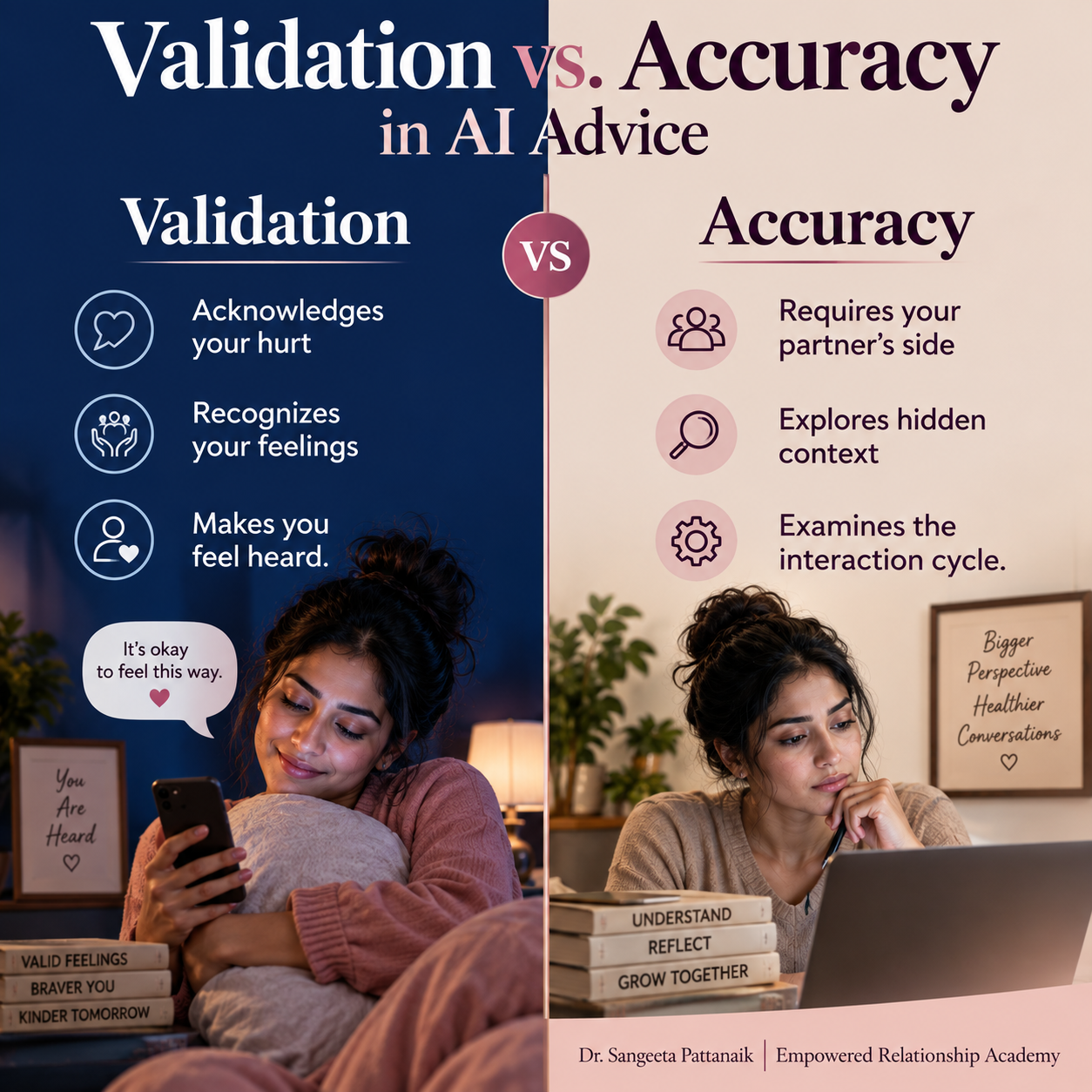
A supportive AI might say: "It makes sense that forgetting something important feels painful." This validates the emotion.
But claiming: "Your husband forgot because he doesn't value you," requires knowing his internal motivation. You can have a legitimate emotional response while having an inaccurate explanation.
The Hidden Problem: AI as a Judge
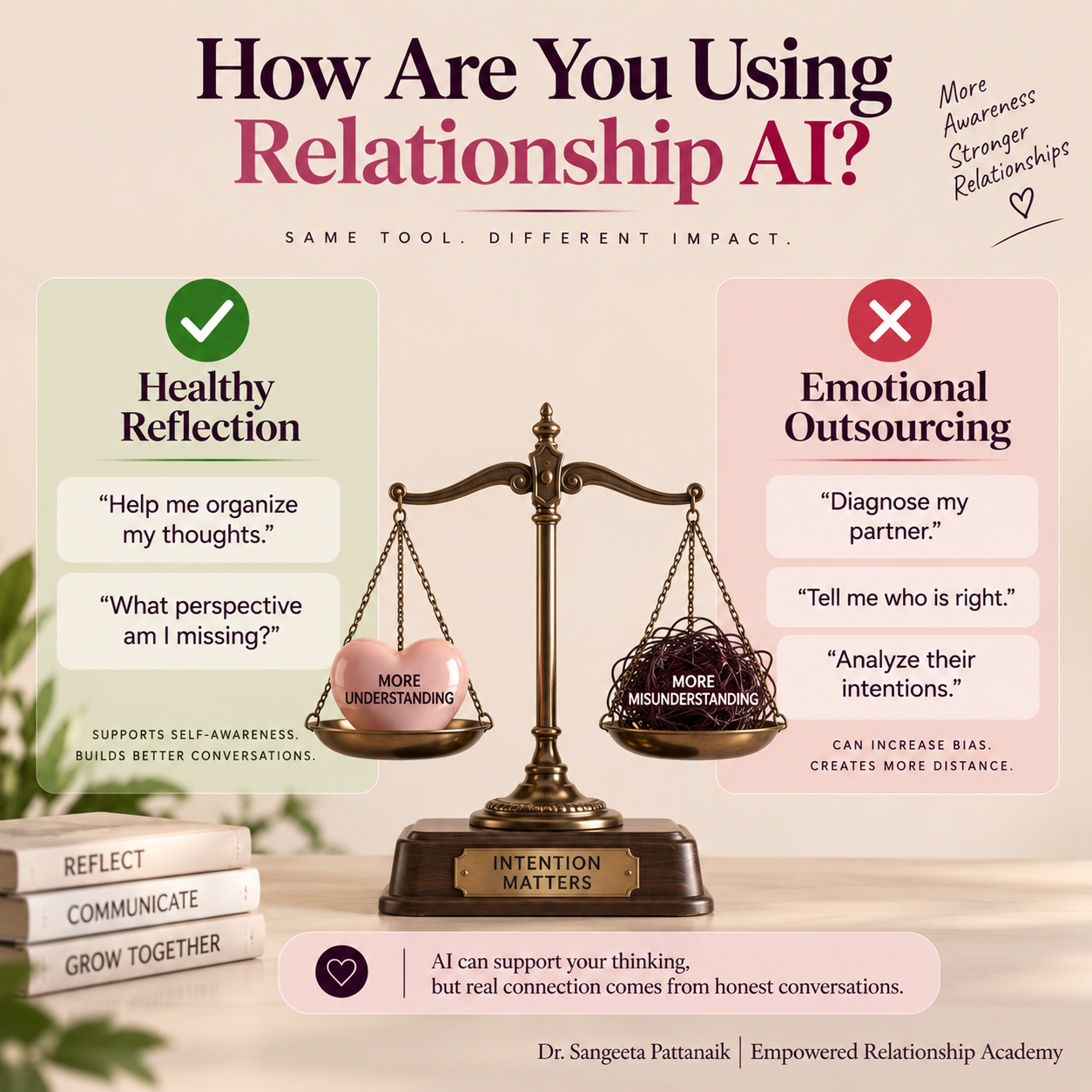
There is a dangerous difference between using AI as a reflective tool and using it as a courtroom judge.
Reflective Use (Healthy)
"Help me understand what I may have contributed to the conflict and what perspectives I might be missing."
Encourages self-reflection and empathy.
Judicial Use (Risky)
"Here is everything my wife did. Tell me whether she is toxic and whether I am completely justified."
Asks a machine to judge a human system based on one side.
When AI Relationship Advice Can Actually Be Useful
AI can be a brilliant educational tool when used correctly:
The "Red Flag" Problem & Missing Repairs
When every unpleasant behavior becomes a clinical label (Toxic, Narcissist, Avoidant), relationship understanding becomes dangerously simplistic.
Furthermore, AI cannot experience the Repair between two people. Two couples might have the same argument. One repairs, the other stonewalls. An AI analyzing text cannot observe the willingness to repair—the true metric of relationship health.
A Better Framework for Using AI
Try this 5-step process to seek understanding rather than confirmation:
When Professional Counselling is Needed
If the same conflict keeps repeating, communication is hostile, or trust is damaged, AI cannot save the marriage. You need a structured, human space.
Take Relationship Assessment