
Silent Treatment: Why It Destroys Marriages and How to Break the Cycle
The clinical psychology behind stonewalling, why it registers as physical pain, and the steps to heal your communication.
By Dr. Sangeeta Pattanaik | Read Time: 14 Minutes
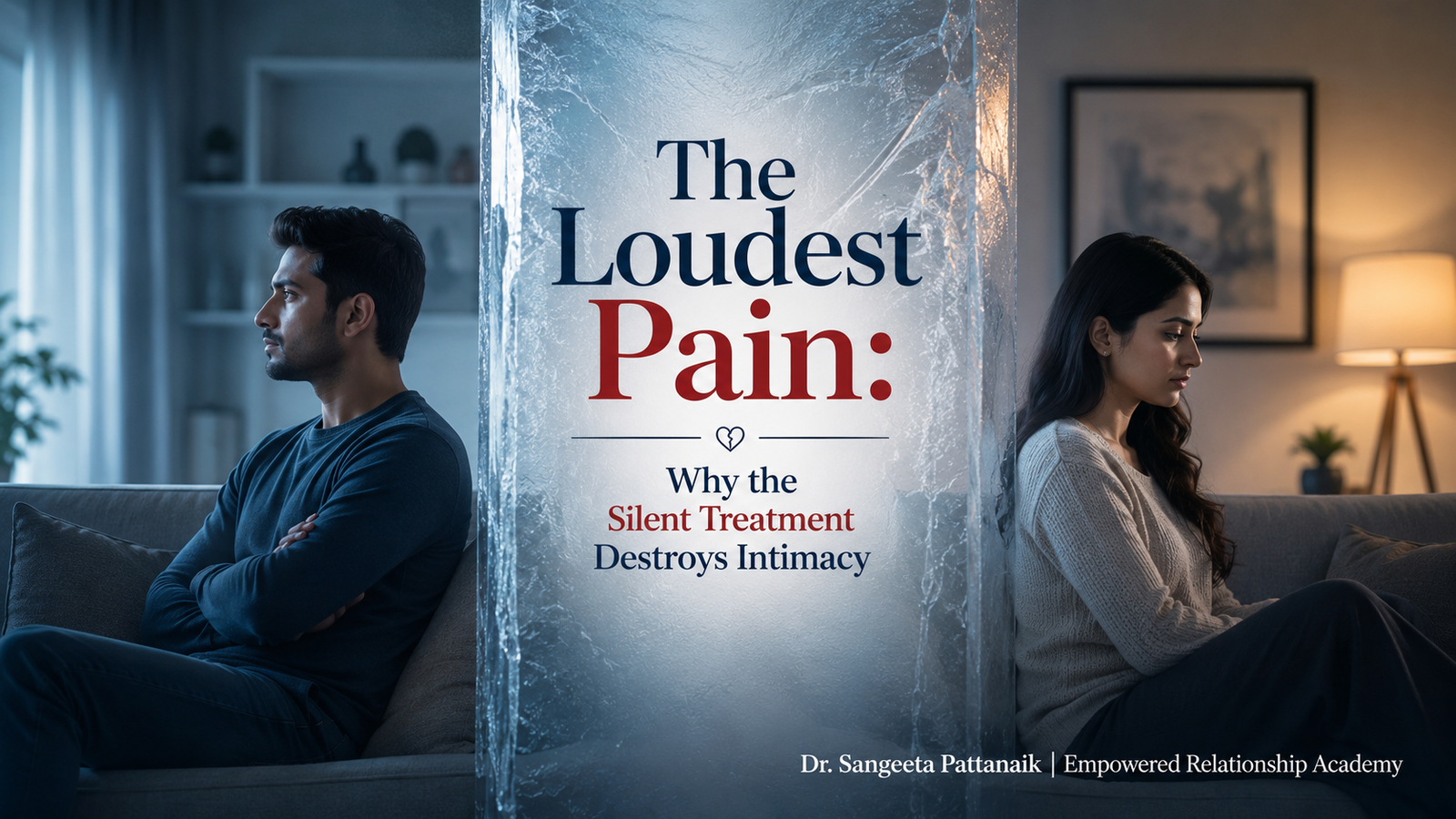
In my clinical practice as a relationship therapist, couples often come to me in a state of profound emotional exhaustion. When I ask them to describe their typical conflicts, one partner will frequently look down and say, "We don't really yell or scream. When my partner gets mad, they just go completely silent for days. They act like I don't exist."
To many people, silence feels like the polite, civilized alternative to an explosive argument. Especially in Indian culture, where we are heavily conditioned to "adjust," avoid family confrontation, and maintain household harmony at all costs, shutting down is frequently mistaken for maturity and restraint. We tell ourselves, "If I don't say anything, I can't say anything wrong."
The Illusion of Silence
As a clinical psychologist, I must shatter this dangerous illusion: The silent treatment is not peace; it is a passive-aggressive form of emotional warfare.
When prolonged emotional withdrawal becomes a habitual response to conflict, it morphs into what clinical relationship researchers call stonewalling in marriage. Over time, this weaponized silence inflicts far deeper psychological wounds than shouting ever could. Let us take a deep, clinical look into the psychology of stonewalling, understand why it destroys marital intimacy, and learn how to permanently break this devastating cycle.
1. What is Stonewalling in Marriage? (The 4th Horseman)
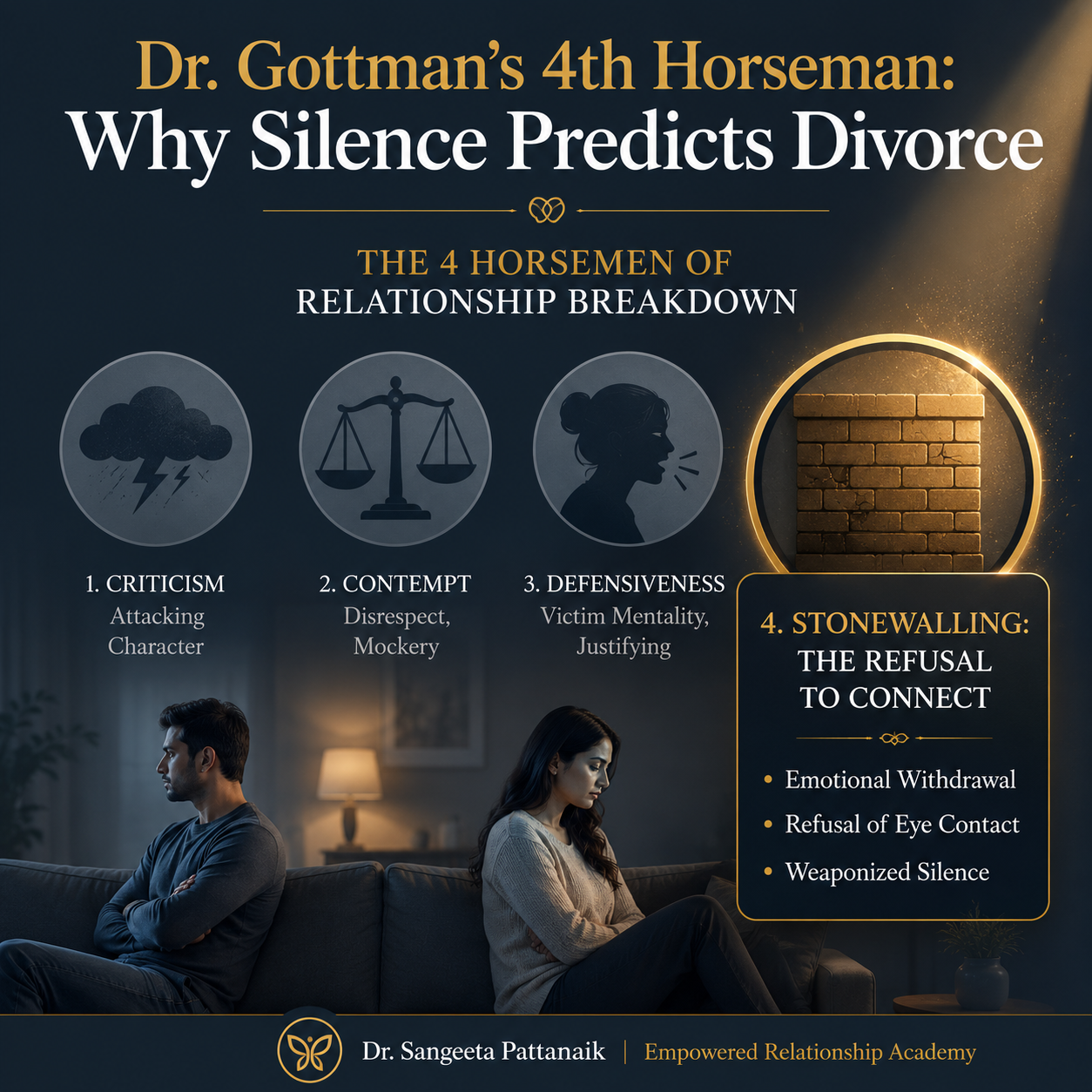
In relationship psychology, the term Stonewalling was popularized by renowned relationship researcher Dr. John Gottman. After studying thousands of couples over four decades, Dr. Gottman identified four specific negative communication patterns—which he famously named the "Four Horsemen of the Apocalypse"—that can predict marital breakdown and divorce with over 90% accuracy. Stonewalling is the fourth and most destructive horseman.
Defining Stonewalling
Stonewalling occurs when one partner completely withdraws from a stressful interaction, shuts down communication, and emotionally checks out of the relationship. Instead of confronting an issue, validating feelings, or listening to their partner's concerns, the stonewaller builds an impenetrable, invisible wall around themselves.
Common Behavioral Signs of Stonewalling Include:
- Refusing to answer simple questions or responding with flat, dismissive, one-word answers ("Fine," "Whatever," "Okay," "Leave it").
- Avoiding eye contact completely, looking away, or staring blankly at a television, laptop, or smartphone while you speak.
- Physically walking out of the room or leaving the house in the middle of a conversation without offering an explanation or a timeline for return.
- Engaging in the "Silent Treatment"—refusing to speak, acknowledge your partner’s physical presence, or make eye contact for hours, days, or even weeks after a disagreement.
While criticism and defensiveness are loud and chaotic, stonewalling is an eerie, suffocating silence that drains the emotional oxygen out of your home.
2. The Neuroscience of Silence: Why People Stonewall
To heal a destructive relationship behavior, we must first understand its biological and neurological root. While some individuals do use the silent treatment as a conscious, manipulative tool to punish their partner and exert emotional control, clinical research shows that roughly 85% of stonewallers do not shut down out of malice; they shut down out of severe physiological overwhelm.
The Phenomenon of "Physiological Flooding"
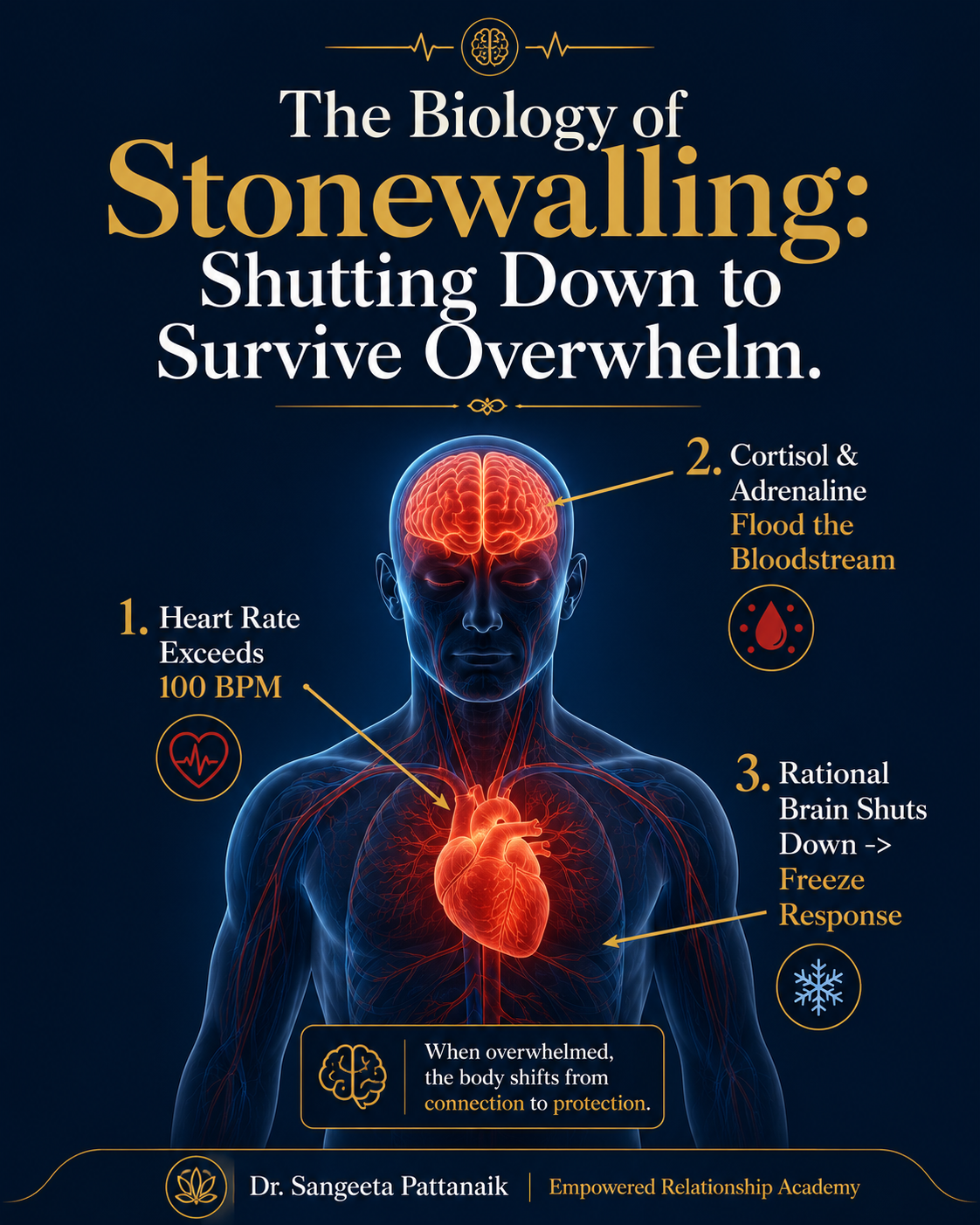
When a conflict begins to escalate, your nervous system continuously evaluates the environment for danger. If an argument feels overly intense, critical, aggressive, or relentless, the brain experiences what therapists call Physiological Flooding. Flooding is an acute biological survival state where your body perceives an emotional threat as a literal, physical danger to your life:
Heart Rate Spikes
Your heart rate skyrockets past 100 beats per minute (even while you are sitting completely still on the couch).
Hormone Surge
Your bloodstream is instantly flooded with Adrenaline and Cortisol (powerful stress hormones).
Amygdala Hijack
Your Prefrontal Cortex (logic and empathy) temporarily shuts down, handing total control over to your Amygdala (primitive alarm system).
When a human being is biologically flooded, they are neurologically incapable of processing new information, empathizing with their partner's tears, or articulating rational arguments. Their nervous system initiates a biological "Freeze" or "Flight" response. They stonewall—going blank, silent, and emotionally numb—as a desperate subconscious attempt to shield their nervous system from complete overload.
The Generational "Indian Script" of Silence
In Indian family dynamics, stonewalling is frequently reinforced by early childhood modeling. Many of us grew up in traditional households where elders used prolonged silence, sulking, or withdrawing affection as standard tools to display displeasure or maintain authority.
When you observe your parents going days without speaking after a domestic disagreement, your developing brain adopts a foundational marital script: "When I am angry, hurt, or overwhelmed, expressing my feelings will only cause more chaos. The safest thing to do is shut my mouth, suppress the emotion, and build a wall."
3. The Psychological Toll on the Receiving Partner
Why does the silent treatment feel so excruciating to the partner on the receiving end? Why does being ignored hurt significantly more than being yelled at?
Silence Registers as Physical Pain in the Brain
Neuroscientific research utilizing MRI brain imaging has revealed a profound truth: Social rejection, ostracism, and emotional withdrawal activate the exact same pain centers in the human brain as physical injury. Specifically, when your spouse gives you the silent treatment, your brain's Anterior Cingulate Cortex—the precise neural region responsible for registering physical pain, such as a burn or a fractured bone—lights up instantly. To your nervous system, being emotionally ignored by your primary attachment figure does not feel like "space"; it feels like a literal physical assault.
The Toxic "Pursuer-Distancer" Trap
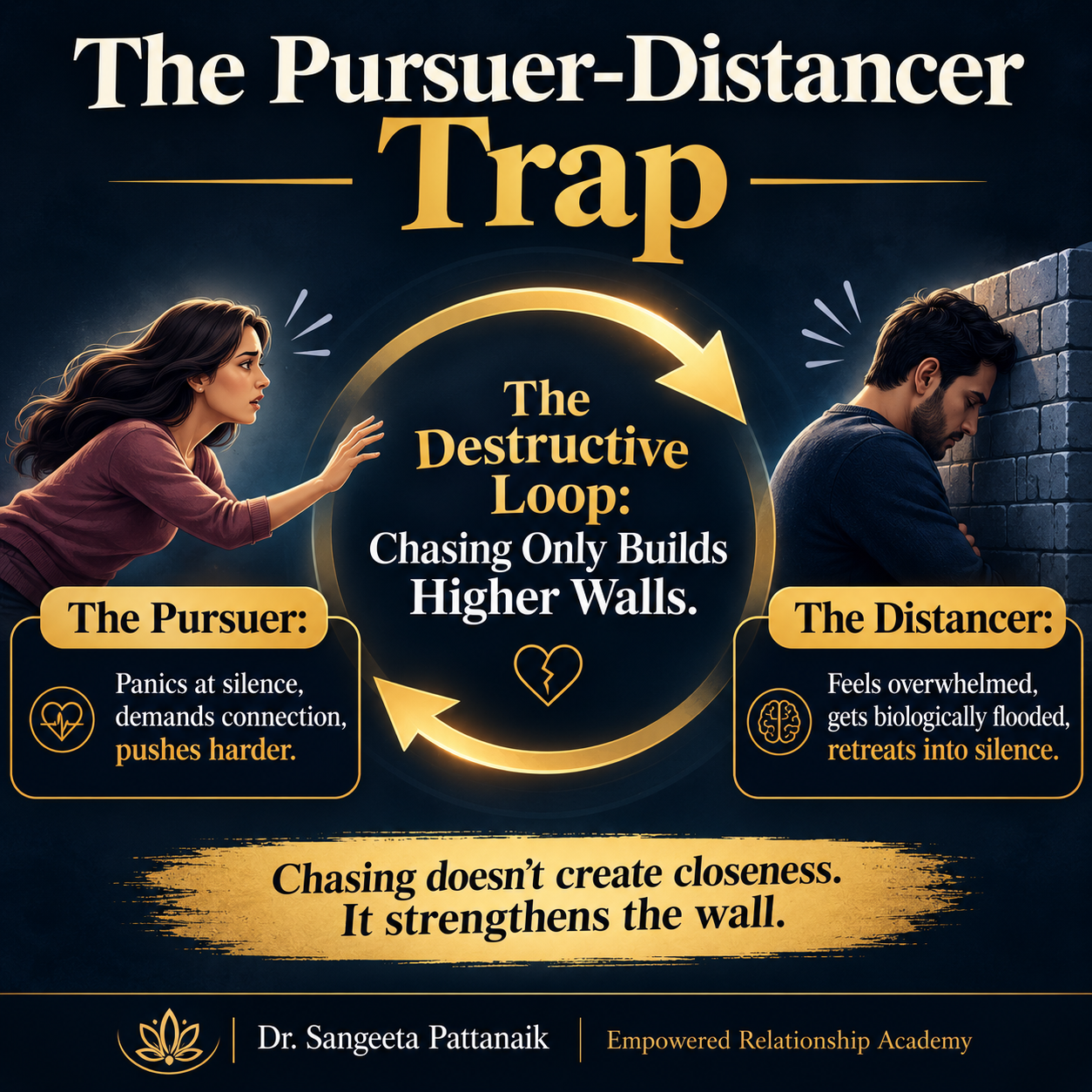
When one partner stonewalls (The Distancer), it triggers intense biological panic in the other partner (The Pursuer). If you are on the receiving end of silence, your subconscious mind interprets the emotional withdrawal as abandonment. To stop the physical and psychological pain of being ignored, you instinctively pursue: you ask repeated questions, follow them into the bedroom, send long emotional text messages, demand that they talk to you, or raise your voice just to get a reaction.
This dynamic creates a devastating psychological feedback loop:
- The Pursuer demands emotional connection because they feel ignored, invisible, and terrified of abandonment.
- The Distancer feels overwhelmed by the intensity of the pursuit, experiences physiological flooding, and shuts down.
- To survive the flooding, the Distancer retreats further behind a thicker wall of silence.
- The increased silence causes the Pursuer's panic to spike, driving them to push even harder for a response.
If this destructive loop is left unbroken, stonewalling in marriage inevitably destroys emotional intimacy, leading to chronic anxiety, profound resentment, and eventual divorce or permanent emotional detachment.
4. Stonewalling vs. Taking a Timeout (The Critical Difference)
One of the most important psychological distinctions I teach couples in my clinic is the difference between toxic stonewalling and taking a healthy, protective timeout. Taking temporary space during a heated argument is often necessary and represents clinical best practice. The difference lies entirely in intent, structure, and communication. Let us examine how to separate weaponized silence from emotional maturity:
1. The Underlying Intent
Toxic Stonewalling (The Weapon): The silence is used consciously or subconsciously to punish your partner, exert control, avoid accountability, or shut the other person out completely.
Healthy Timeout (The Tool): The break is taken purely to calm the flooded nervous system so that a productive, empathetic conversation can happen later.
2. How the Break is Communicated
Toxic Stonewalling: Abrupt silence, physically walking out of the room without uttering a single word, staring blankly at a screen, or slamming doors.
Healthy Timeout: Explicitly stating the need for a temporary break with emotional warmth and reassurance (e.g., "I love you, but I am feeling overwhelmed and need 30 minutes to calm down before we continue").
3. The Timeline of Silence
Toxic Stonewalling: Indefinite and unpredictable. The silent treatment drags on for hours, days, or even weeks until the receiving partner finally breaks down, apologizes, and "gives in."
Healthy Timeout: Clear and time-bound. A healthy break usually lasts between 20 minutes and 24 hours, and the person taking the break commits to an exact time to return to the conversation.
4. Behavior & Re-engagement
Toxic Stonewalling: Spending the silence fuming, rehearsing resentments, playing the victim, and never initiating repair when silence ends.
Healthy Timeout: Actively engaging in physiological self-soothing and proactively returning at the agreed time ready to listen, validate, and resolve the core issue.
5. How to Break the Cycle: A Therapist’s Step-by-Step Guide
Breaking the habit of stonewalling in marriage requires structured discipline from both partners. You cannot force your partner to open up, but you can change the dance steps of your conflict. Here is your clinical roadmap to dismantle the wall of silence.
Part A: For the Partner Who Stonewalls (The Distancer)
If you recognize that your default stress response is shutting down, you must learn to manually regulate your autonomic nervous system.
- Learn to Recognize Your "Flooding Warning Signs": You do not go from calm to biologically flooded in a single millisecond. Your body always gives preliminary physical warning signals. Notice your somatic cues: Is your jaw clenching? Are your shoulders creeping up toward your ears? Is your breathing becoming shallow? The moment you notice these physiological symptoms, you must intervene before your prefrontal cortex initiates a shutdown.
- Master the "Scripted Timeout": You must replace silent withdrawal with clear verbal communication. Memorize a structured, respectful script to use the moment you feel yourself beginning to flood:
"I am feeling biologically overwhelmed right now, and I can feel myself shutting down. Because I love you and care about our relationship, I need to take a 45-minute break to calm my nervous system. I am going to sit in the bedroom, and I will come back at 8:00 PM to finish this conversation."
- Practice Active Somatic Self-Soothing: During your timeout, you are strictly forbidden from sitting in silence and rehearsing all the reasons your partner is wrong. That mental loop keeps your cortisol pumping. You must engage in active self-soothing to lower your heart rate below 100 BPM:
- Practice 4-7-8 Breathing: Inhale deeply through your nose for 4 seconds, hold the breath for 7 seconds, and exhale slowly through your mouth for 8 seconds. This activates your parasympathetic nervous system (the "rest and digest" system).
- Splash ice-cold water on your face or hold an ice cube. This stimulates the Vagus Nerve and triggers an immediate physiological calming reflex.
- Go for a brisk 15-minute walk without your smartphone to burn off excess adrenaline.

Part B: For the Partner Who is Ignored (The Pursuer)
If your spouse is prone to stonewalling, your instinctive reaction to chase them, demand immediate answers, or raise your voice will only make their wall thicker. You must change your approach to help them feel safe enough to emerge.
- Respect the Timeout Without Chasing: When your partner calls a healthy timeout and gives you a clear return timeline, you must honor it immediately. Do not follow them from room to room. Do not stand outside the bedroom door demanding, "Why can't we just act like adults and talk about this right now?!" Chasing a flooded partner is like pouring gasoline on a fire; it forces their amygdala deeper into survival mode.
- Self-Regulate Your Own Abandonment Anxiety: While your partner is taking their break, your anxiety will likely spike. You must consciously remind yourself that their need for space is a biological mechanism to prevent a destructive fight, not a declaration that they do not love you. Use this time to soothe your own nervous system: make a cup of herbal tea, journal your feelings, or listen to calming music to keep your anxiety grounded.
- Welcome Them Back With a "Soft Start-Up": When your partner returns at the agreed-upon time, do not punish them for taking space with sarcasm or hostility ("Oh, look who finally decided to grace me with their presence after three hours"). Hostility will instantly trigger another amygdala hijack, and they will retreat right back into silence. Instead, welcome them back with what Dr. Gottman calls a Soft Start-Up:
"Thank you so much for taking that time to calm down and coming back like you promised. I really appreciate it. Can we hold hands or sit close while we talk through what happened earlier?"
Replacing Silence With Safe Vulnerability
Let us be abundantly clear: A marriage cannot survive on a diet of silence.
When you shut your partner out through prolonged emotional withdrawal, you are not protecting the relationship; you are slowly starving it to death. True marital peace is never found in the cold absence of words; it is discovered in the courageous willingness to stay emotionally connected, even when the conversation feels difficult and messy.
By understanding the neuroscience of physiological flooding, replacing punitive silent treatments with structured timeouts, and approaching each other with profound empathy, you can permanently tear down the brick walls of stonewalling—turning your marriage back into the safe, loving sanctuary it was always meant to be.
Take the First Step Before Your Session
Emotional Invisibility Score™
Discover How Seen, Valued & Emotionally Connected You Feel In Your Relationship.
Understanding the damaging psychological dynamics of stonewalling is a powerful breakthrough. But knowing exactly how deeply this emotional withdrawal has impacted your marital bond is where real, permanent healing begins. Before making assumptions about your relationship's communication health, I invite both of you to take this quick, scientifically structured self-assessment. It will immediately reveal your underlying emotional patterns and highlight where your connection needs the most support.
Discover Your Score NowTakes 2 Minutes • 100% Confidential • Instant Results
Frequently Asked Questions About Stonewalling
What is the difference between stonewalling and taking a break?
Stonewalling is a passive-aggressive withdrawal used to punish, control, or avoid accountability without giving a timeline for return. Taking a healthy break (timeout) involves explicitly communicating the need to calm down physically, giving a clear timeframe to return, and proactively engaging in conversation when the time is up.
Why does the silent treatment hurt so much?
Neuroscientific MRI studies show that emotional withdrawal and social ostracism activate the exact same pain center in the brain—the Anterior Cingulate Cortex—as literal physical injury. To your nervous system, being ignored by a primary attachment figure registers as a physical assault.
Why do people use the silent treatment in marriage?
While some use it manipulatively, roughly 85% of people who stonewall do so out of severe "physiological flooding." When an argument feels overwhelming, their heart rate spikes, stress hormones surge, and their logical brain shuts down. They retreat into silence as an involuntary survival mechanism to shield their nervous system from overload.
How should I respond when my partner gives me the silent treatment?
Do not pursue, chase, or demand immediate answers, as this will only push a flooded partner deeper into survival mode. Give them space, focus on self-soothing your own abandonment anxiety, and welcome them back with a "Soft Start-Up" (warmth and appreciation) when they emerge, rather than punishing them for taking a break.